
early 6th century – 707·Feast July 11
St. Hildulf
Abbot of Moyenmoutier and reputed bishop of Trier
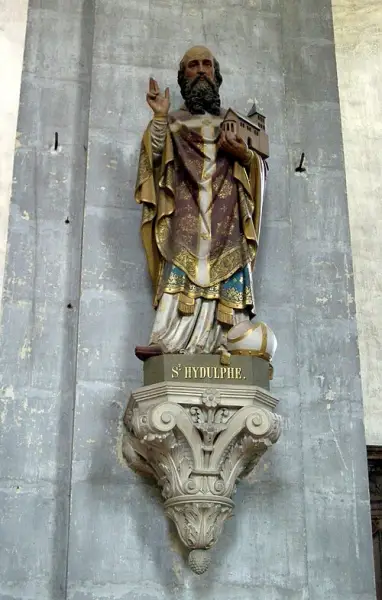
Overview
Hildulf, who died in 707, was a Benedictine abbot, the founder of Moyenmoutier Abbey in the Vosges, and by longstanding tradition a bishop of Trier. He is honored in both the Catholic and Orthodox churches, with a feast on 11 July. His story is unusually hard to establish: three biographies, all composed in the eleventh century, disagree on many points, and historians regard the later hagiography with suspicion even while accepting his foundation of Moyenmoutier. According to the received account he was born to a noble family, perhaps in Bavaria, early in the sixth century, studied at Regensburg — where Saints Albert and Erhard of Regensburg are said to have been his brothers — and became a monk at the Abbey of Saint Maximin in Trier. Tradition makes him bishop of Trier from 665, an office he laid down in Basinus's favor once five years had passed, withdrawing then to a hermitage among the Vosges. Soon afterwards he established Moyenmoutier, which he called the Middle Monastery for its position among four neighboring houses, and governed it until his death, with nearly three hundred monks said to have lived under his direction. His relics remain at Moyenmoutier, and a Lorraine congregation of reformed monasteries took his name.
The Complete Life
A Noble Youth of Uncertain Lands
Almost everything about Hildulf's origins comes filtered through three competing biographies, the Vitae Hidulphi, all written in the eleventh century and all at odds with one another on important points. Historians have doubted their testimony on many matters, though his founding of Moyenmoutier is hardly in question. What the tradition agrees on is this: he was born early in the sixth century to a noble family, most likely in Bavaria, though some authors point to Belgium, and the hagiographer John O'Hanlon, for his part, listed him among the Irish saints. The Vitae give him two brothers who were themselves honored as saints, Albert and Erhard of Regensburg, tying his family to the church of that Bavarian city. There he was sent to complete his education. From Regensburg his path led west to Trier, one of the ancient capitals of Christian Gaul, where he entered the Abbey of Saint Maximin as a monk. Whatever the truth of the surrounding legends, this early formation — a nobleman turned contemplative in the monasteries of the Rhine and Danube — fits the world of seventh-century German missionary monasticism in which the rest of his life would unfold.
§ Narrative
In the School of Saint Deodatus
The decisive friendship of Hildulf's early career was with Saint Deodatus, a man who had served as bishop of Nevers in France and then laid his dignity aside for the solitary life. In the Vosges, Deodatus had raised a monastery of Augustinian canons, a house that after his death took the name Saint-Dié, from the Latin Sancti Deodati. The tradition relates that when Deodatus died, Hildulf stepped into his place and governed the young community as its abbot. Many scholars find this connection difficult to believe, and it is one of the points on which the eleventh-century biographies strain credulity. Still, the story expresses something true about Hildulf's vocation: he belonged to the generation of monk-bishops and monk-founders who withdrew from episcopal cities into the forests of Lorraine and the Vosges and planted monastic families there. Whether or not he truly inherited Deodatus's house, he would repeat the pattern in his own foundation, and the landscape of the Vosges — where Saint-Dié and Moyenmoutier lie within sight of one another's history — preserved both men's memory side by side for centuries afterward.
§ Narrative
The Bishop Who May Have Been
Many traditions relate that in 665 Hildulf was elected bishop of Trier after Saint Numerian, and that during his tenure he built the Johanniskirche in that city, endowing it with relics of martyrs of the Theban Legion. In 667, the story continues, he translated the relics of Trier's own saints — Maximin, Agritius, Nicetius and Basinus — to the abbey church of Saint Maximin. When five years had run their course he gave the office up to Basinus, his successor, and withdrew to a hermitage among the Vosges. Scholars of the present day are more cautious. A contemporary view holds that he was never a diocesan bishop at all, nor abbot of Saint-Dié, but probably a chorepiscopus — an auxiliary bishop without a fixed see, attached to the monastery of Saint Maximinus in Trier. Bishops of this kind were common in the mission lands of seventh-century Germany, where they traveled, ordained and sanctified on behalf of distant ordinaries, and they played a real part in the Christianization of the country. On this reading, Hildulf's historical importance lies less in governing Trier than in that unsettled, itinerant episcopal service which the traditions later dressed in the robes of a metropolitan.
§ Narrative
The Middle Monastery in the Vosges
Released, whether in fact or in legend, from the government of Trier, Hildulf retired to the Vosges and there accomplished the work for which he is remembered. Soon after 671 he founded the monastery of Moyenmoutier, a name he is said to have chosen himself in the Latin form Monasterium Medium — the Middle Monastery — because it stood at the center of a group of four other houses. He became its first abbot and held the office until his death. The rule he followed blended the teaching of Saint Benedict with that of Saint Columban, a combination typical of the region. A crowd of disciples soon gathered, so many that he had to send some of them off to several sub-monasteries; in all, almost three hundred monks were said to be under his leadership across the various foundations. At the head of his disciples stood Saint Spinulus and the holy twins Benignus and Johannes. Like the abbots of that school, Hildulf insisted on the dignity of handwork; tradition relates that he took up some daily task with his own hands until infirmity in his final years stayed them. Tradition also places him beside his brother Erhard at the baptism of Saint Odilia of Alsace, when a celebrated miracle was wrought. He died in 707 as abbot of both Moyenmoutier and Bonmoutier, the house once called Galilaea and later Saint-Dié.
§ Narrative
A Reliquary, a Congregation, a Name
Legend has it that Hildulf was laid to rest in a sandstone sarcophagus at Moyenmoutier, and it remains on view today in the commune's chapel of Saint-Grégoire. His relics wandered several times across the centuries; since 1854 they have rested for veneration in one of the side chapels of the old abbey church, and his casket of carved and gilded wood, fashioned in the eighteenth century, is preserved in the Moyenmoutier treasury and received the legal protection of a historical monument in 1965. His name also lived on institutionally. In 1600 Dom Didier de La Cour, prior of the Benedictine house of Saint-Vanne outside the walls of Verdun, began a thorough reform of his monastery, and Moyenmoutier with it became a center of reformed monasticism across Lorraine, Champagne and Burgundy. In 1604 the union was made official under the title Congregation of Saint-Vanne and Saint-Hydulphe, a name honoring Hildulf himself together with Saint Vitonus of Verdun — a congregation that survived until the French Revolution dissolved it. Popular devotion remembered him as an intercessor in nervous diseases, and the Martyrologium Romanum of 2004 lists him for 11 July, the feast he still keeps among Benedictines and in the East.
§ Veneration
Timeline
- 665
Elected bishop of Trier after Saint Numerian, according to monastic tradition
§ Narrative
- 667
Brought relics of Saints Maximin, Agritius, Nicetius and Basinus to the abbey church of Saint Maximin
§ Narrative
- 671
Founded Moyenmoutier, the 'Middle Monastery', in the Vosges in the years immediately following this date
§ Narrative
- 707
Died while serving as abbot of both Moyenmoutier and Bonmoutier
§ Narrative
- 1604
Reformed houses of Saint-Vanne and Moyenmoutier united as a congregation bearing his name
§ Veneration
- 1854
Relics installed for veneration in a side chapel of the former abbey church at Moyenmoutier
§ Veneration
- 1965
Eighteenth-century gilded wooden casket holding his relics classified as a historical monument
§ Veneration
The Record
- Major works
- Moyenmoutier Abbey·Johanniskirche in Trier (attributed)
- Patron of
- Invoked in nervous diseases
- Canonization
- Pre-congregation saint, honored by Catholic and Orthodox churches; listed in the Martyrologium Romanum (2004)
Prayer
Bibliography
Show 6 sources
- Muessig, Dr Carolyn; Jones, Graham (9 April 2004). "Saints at a Glance". University of Leicester.
- Odden, Per Einar. "Den hellige Hidulf av Moyenmoutier (~612-707)", Den katolske kirke, November 28, 2015
- O'Hanlon, John. Lives of the Irish saints, Volume 7, 1873. p. 191
- Walsh, Michael J., A New Dictionary of Saints, Liturgical Press, 2007, p. 263, ISBN 9780814631867
- Burns, Paul, Butler's Lives of the Saints (2000), p. 81.
- Alzog, John. Manual of Universal Church History, Robert Clarke Company, 1903, p. 390
Profile text adapted from the Wikipedia article, licensed CC BY-SA 4.0.
Pray with this saint every day
Save St. Hildulf to your favorites, read the full profile, and get feast-day reminders in the Saints app.
Get the Saints AppFree on the App Store for iPhone and iPad