
died c. 750·Feast March 10
St. Himelin
Priest stricken by plague on his return from Rome
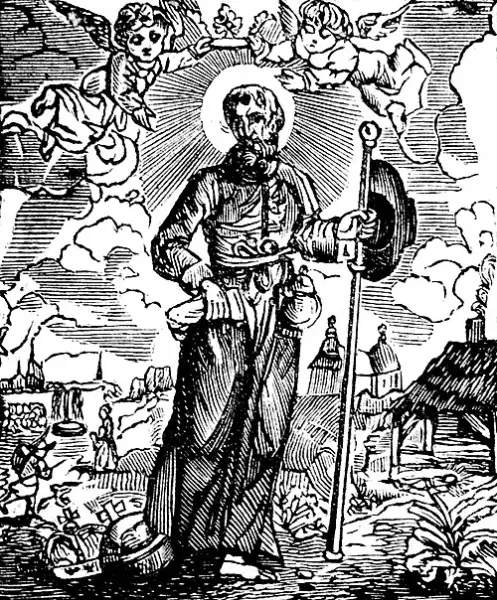
Overview
Himelin, who died at Vissenaken around the year 750, was a priest from Ireland or Scotland whose memory has survived in a single village of Brabant. Returning from a pilgrimage to Rome, he fell ill while passing through Vissenaken, today part of the municipality of Tienen in Belgium. There the legend sets his one recorded miracle: begging water from a girl of the village, he was at first refused, for bubonic plague was raging in the district and the townspeople feared infection. At his persistence she finally handed him a pitcher, and the water in it was found to have turned into wine. Three days later Himelin died of the plague he had carried with him on the road. Tradition makes him a brother of Saint Rumbold, the patron saint of Mechelen, which would place him in a family of missionary stock from the Celtic lands. He is venerated on 10 March, depicted either as a pilgrim with a staff or lying ill in bed, and his cult, never spreading beyond the place of his death, remains confined to Vissenaken itself.
The Complete Life
A Pilgrim Priest from the Celtic Lands
Himelin belonged to the great movement of priests and monks who left Ireland and Scotland in the early Middle Ages and made their way across Europe, often with Rome as the goal of their travels. The sources disagree on whether he should be called Irish or Scottish, a hesitation that itself reflects how intertwined the two missions were; his name carries him into the company of the wandering saints of both peoples. What is certain in his story is the journey: he made a pilgrimage to the shrines of the apostles at Rome, a formidable undertaking for any man of the eighth century, and set out homeward along the roads of the continent. Tradition adds that he was the brother of Saint Rumbold, the patron saint of Mechelen, one of the great missionary figures of the Low Countries — a family detail, if true, that would make the wandering of the brothers a shared vocation rather than a solitary choice. It was on this homeward road, as he passed through the village of Vissenaken in present-day Brabant, now within the municipality of Tienen in Belgium, that his strength failed him and his pilgrimage reached its true destination.
§ Introduction
The Pitcher of Water at Vissenaken
The legend that keeps Himelin's name alive belongs to the smallest and most human of settings. Sick and thirsty at the roadside in Vissenaken, he asked a girl of the village for a drink of water. She refused him: bubonic plague was in the district, and the people dared not come near a stranger who might carry the contagion. But the priest pressed his request, and after much insistence she yielded and brought him a pitcher of water. When he took it, the water had become wine — a quiet sign, in the village's telling, that this sufferer was no ordinary traveler but one of heaven's own. The miracle did not spare him. Three days later Himelin died of the plague he had brought with him to Vissenaken, a victim of the disease he had contracted on the pilgrim roads. The story joins two of the oldest themes of Christian legend: the refusal of water to the stranger, condemned from the Gospel onward, and the sudden transformation of simple water, as at Cana, into the wine of a wedding feast. In Vissenaken it became the charter of a devotion that has never left the village.
§ Introduction
A Saint Who Stayed in One Village
Himelin's cult never spread. Unlike the great saints of the Low Countries, whose feasts filled calendars across Europe, his memory remained fixed to the place of his death, and the sources state plainly that his veneration is confined to Vissenaken. There he is honored on 10 March, the day the tradition assigns to his festival. In art he takes two forms that capture the two halves of his story: a pilgrim with his staff, the traveler on the road from Rome, or a man lying ill in bed, the stranger taken in at last. His association with Saint Rumbold of Mechelen linked the village saint to one of the principal shrines of Brabant, and the old collections — the Book of Saints of the Monks of Ramsgate and the directories of the saints of Ireland and Scotland — preserve his entry among the missionary clergy of the early eighth century. For the faithful of Vissenaken he remains what he has always been: the priest who asked for water and was given it, and who left behind, in place of a great foundation, the memory of a kindness rewarded by wine.
§ Introduction
The Record
- Symbols
- Depicted as a pilgrim with a staff·Depicted lying ill in bed
- Canonization
- Pre-congregation saint; his cult has always remained confined to Vissenaken
Prayer
Bibliography
Show 3 sources
- "Saint of the Day, March 10: Himelin of Vissenaeken", saintpatrickdc.org. Retrieved 2012-03-22.
- Kempeneers, Paul. Toponymie van Vissenaken.
- Monks of Ramsgate. "Hymelin". Book of Saints, 1921.
Profile text adapted from the Wikipedia article, licensed CC BY-SA 4.0.
Pray with this saint every day
Save St. Himelin to your favorites, read the full profile, and get feast-day reminders in the Saints app.
Get the Saints AppFree on the App Store for iPhone and iPad