
died c. 11th century·Feast February 4
St. Himerius of Bosto
Pilgrim martyr slain on the road to Rome
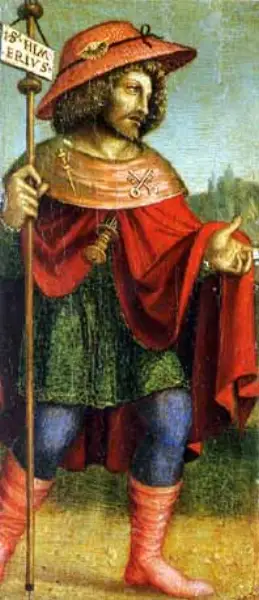
Overview
Himerius of Bosto, called in Italian Imerio and in older sources Imier, is honored as a pilgrim and martyr. His cult belongs to the province of Varese in Lombardy, where he is venerated jointly with Gemolus, the companion said to have been killed beside him — though some scholars hold that the two names preserve the memory of a single man. A tradition reaching back to the eleventh century makes him one of a company of Nordic pilgrims traveling with a bishop ad limina apostolorum, to the tombs of Peter and Paul at Rome. On the way the party was ambushed at Valganna by raiders out of Uboldo or Seprio; Gemolus lost his life there, and Himerius, though he got clear of the attack, later died of his wounds at Varese. He was buried in the church of San Michele at Bosto, which in time took his own name. A fuller legend adds pursuit, a stolen horse, the beheading of Gemolus and his cephalophore return to his uncle the bishop. The two saints are recorded in medieval Milanese sources, and Gemolus's relics were formally authenticated in 1941 by a commission under Cardinal Ildefonso Schuster.
The Complete Life
Companions of a Bishop on the Road to Rome
Himerius is venerated as a pilgrim and martyr, and his memory is bound inseparably to that of Gemolus, the companion of his journey and his death; the two are honored together throughout the province of Varese, though a strand of scholarly opinion suspects they may be one man remembered twice. The oldest strand of the tradition, reaching back to the eleventh century, makes both of them men of the North — Nordic companions in the retinue of a bishop traveling ad limina apostolorum, the solemn journey to the sepulchres of the apostles at Rome. Their goal was the Basilica of Saint Peter and the Basilica of Saint Paul Outside the Walls, the two great shrines that drew pilgrims from every people of the Latin and Germanic worlds. However the details are judged, the picture is of a small company from the far North making its way down through the Lombard plain, with the passes of the Alps behind them and the pilgrim roads of Italy ahead — one of countless bands whose devotions stitched the medieval world together, and whose names survived only where blood was spilled.
§ Introduction
The Assault at Valganna
The martyrdom took place at Valganna, where the bishop's company was waylaid by raiders out of Uboldo or Seprio. In the simpler account, Himerius and Gemolus both perished in the attack, and Gemolus found burial at Ganna; there in 1095 an abbey honoring him was raised by Atto, Ardericus and Inghizo with the permission of Arnulf III, Archbishop of Milan. Himerius, who had escaped the attackers, eventually succumbed to his wounds at Varese and was buried in the church of San Michele at Bosto, which was later renamed for him. A second and more elaborate version of the story fills out the night of the crime. The bishop, camped at Valganna, was robbed of his horse and valuables by brigands from Uboldo; Gemolus, in this telling the bishop's own nephew, pursued them with Himerius, calling on the brigands to surrender their plunder in God's name and that of the apostles Peter and Paul. The brigands answered by cutting off his head and turning on Himerius, who escaped only to die of his wounds. In the manner of the cephalophores, Gemolus is said to have gathered up his own head, mounted a horse, and carried to the small mountain where his uncle the bishop awaited; there he died, and there the grieving prelate laid him and raised a church to Saint Michael, patron of the Lombards and guardian of cemeteries.
§ Another version of their story
Blood-Stained Rocks and a Cardinal's Commission
The memory of the two saints is fixed by name in the written record of Milan. They appear in the Liber Notitiae Sanctorum Mediolani, a thirteenth-century manuscript attributed to Goffredo da Bussero and preserved in the archiepiscopal archives of Milan, and in the Gospel of the Passion kept in the archives of the Abbey of Ganna. Devotion attached itself to the landscape itself: rocks near the Abbey of Ganna stained red by a particular algae were identified in popular tradition with the drops of Gemolus's blood, and so striking was the identification that in the fourteenth century the monks built a second oratory, set some distance from the road, to shelter the veneration of that natural wonder. In modern times the cult received ecclesiastical confirmation: in 1941 a commission headed by Cardinal Ildefonso Schuster, the cardinal archbishop of Milan and a scholar of Lombard antiquity, determined the relics of Gemolo to be authentic. Himerius's own memorial remains his church at Bosto, which exchanged the name of Saint Michael for his, and the shared feast by which the province of Varese keeps the memory of the pilgrims who died within sight of their journey's purpose.
§ Veneration
Timeline
- 1095
Abbey dedicated to Gemolus built at Ganna by Atto, Ardericus and Inghizo with the permission of Archbishop Arnulf III of Milan
§ Introduction
- 1941
Commission headed by Cardinal Ildefonso Schuster determined the relics of Gemolo to be authentic
§ Veneration
The Record
- Symbols
- Depicted as a pilgrim being stabbed·Pilgrim's cloak and staff
- Canonization
- Pre-congregation martyr; venerated in the province of Varese since the eleventh century
Prayer
Bibliography
Show 4 sources
- "Sant' Imerio di Bosto"
- "Leggenda di S. Imerio". Archived from the original on 2005-03-01. Retrieved 2007-03-24.
- "Badia di Ganna". www.provincia.va.it. Retrieved 4 August 2021.
- "Passio di San Gemolo"
Profile text adapted from the Wikipedia article, licensed CC BY-SA 4.0.
Pray with this saint every day
Save St. Himerius of Bosto to your favorites, read the full profile, and get feast-day reminders in the Saints app.
Get the Saints AppFree on the App Store for iPhone and iPad