
c. 165 – c. 235·Feast August 13
St. Hippolytus of Rome
Church Father, exegete, and martyr of the third century
Overview
Hippolytus of Rome, who lived from about 165 to about 235, ranks with the greatest Christian minds of the second and third centuries, though scholars still cannot settle his provenance, his identity, or even the bounds of his written corpus. Eusebius and Jerome had read his works yet admitted they could not say where he led a community; Photios of Constantinople calls him a disciple of Irenaeus, though the claim is doubted. In the traditional account he served as a learned presbyter of the Roman church under Pope Zephyrinus, defended the Logos theology of the Greek apologists, attacking the modalism he alleged in Zephyrinus, and broke with Pope Callixtus I when Callixtus extended absolution to Christians guilty of grave sins such as adultery. He is said to have allowed himself to be elected a rival bishop of Rome — an antipope before the word existed — and to have attacked Urban I and Pontian as well. Under the persecution of Emperor Maximinus Thrax he and Pontian were exiled together to Sardinia in 235, probably to die in the mines, but before his death he was reconciled to the church: under Pope Fabian his body was brought back to Rome and interred on the Via Tiburtina, and by about 255 he was honored as a martyr in the rank of a priest. His literary legacy is vast — biblical commentaries, chronography, ecclesiastical law, and works such as the Apostolic Tradition and the Refutation of All Heresies — though scholars still debate how much of it is genuinely his.
The Complete Life
The Man Whom Even Antiquity Could Not Place
Scarcely anything about Hippolytus can be established with certainty, and the difficulty begins with the question of who and where he was. Rome, Palestine, Egypt, Anatolia and various parts of the Middle East have all been proposed as his homeland. The finest ancient students of Christian literature — Eusebius and Jerome — read his works and openly conceded that they could not name the community in which the biblical commentator and theologian held office. Photios I of Constantinople, writing in his Bibliotheca, describes him as a disciple of Irenaeus, who was himself said to have been a disciple of Polycarp; the context suggests Photios meant that Hippolytus publicly claimed this pedigree, but modern scholars regard the assertion as doubtful. One Victorian theory, still widely repeated, gives the clearest outline: that as a presbyter of the Roman church under Pope Zephyrinus, reigning from 199 to 217, Hippolytus was distinguished for learning and eloquence — it was in those same years that a young Origen sat and listened to his preaching. Even the legends that grew around his name — priest of the Novatianist schism, soldier converted by Saint Lawrence, bishop of Portus drowned in a well — testify to the same fact: the writer's biography perished from Western memory, likely in part because his language of composition was Greek.
§ Life
A Teacher of the Logos Doctrine
Within the Roman church of the early third century, Hippolytus found his vocation as a teacher and guardian of doctrine. In the traditional reconstruction, he accused Pope Zephyrinus of modalism — the teaching that Father and Son are merely two names for one and the same subject — and set against it the Logos doctrine of the Greek apologists, above all Justin Martyr, which distinguished the Father from the Word through whom all things were made. He was, by the same account, an ethical conservative, and this moral rigorism shaped the second great quarrel of his career: when Pope Callixtus I, reigning from 217 to 222, opened absolution even to believers guilty of deadly sin, adultery among them, and Hippolytus recoiled, holding that the church's discipline could not be softened without betraying its holiness. Some scholars go further and suggest that he himself advocated a pronounced rigorism, demanding a stricter penitential practice than the Roman church was prepared to impose on its flood of new pagan converts. Whether teacher, polemicist, or both at once, he embodied the strict Greek theological tradition within a Roman community that was moving, under its bishops, toward a more merciful and centralized discipline.
§ Life
Rival Bishop of Rome
The quarrel over penitential discipline hardened, in the older view, into schism. Hippolytus is said to have allowed himself to be elected a rival bishop of Rome, and to have carried his attack into the pontificates that followed, opposing Pope Urban I from 222 to 230 and Pope Pontian from 230 to 235. If the theory holds, he bears the strange distinction of being numbered among the antipopes of the church's earliest centuries — a doctor of the church set against his own bishops. Modern scholarship offers gentler explanations of the conflict. In G. Salmon's view Hippolytus stood at the head of Rome's Greek-speaking believers, a community set within the city whose theological temper ran stricter than that of the Latin majority. Allen Brent reads the same situation sociologically: the Roman house-churches of the period were developing into something akin to the Greek philosophical schools, each gathered around a compelling teacher, and Hippolytus's circle was one such school, loyal to its master's doctrine rather than to a single monarch-bishop. On any of these readings, the schism was as much a conflict of cultures and structures as of doctrine — and it ended, remarkably, not in excommunication but in reconciliation, sealed in shared exile and shared burial.
§ Life
Prophecy, History, and the Delay of the End
Hippolytus holds an important place in the development of Christian eschatology. Once the persecutions of Septimius Severus's day broke out, apocalyptic subjects drew many an early Christian author, and his treatise On Christ and the Antichrist — a complete survival, probably written around 200 — is among the earliest of these works. In it, as in his Commentary on the Prophet Daniel, he set out his interpretation of Christ's second advent. He was thought to be generally influenced by Irenaeus, but where Irenaeus ranged over the whole sweep of salvation history, Hippolytus pressed prophecy toward the meaning it held for the church of his own day. Following long-established usage, he read Daniel's seventy prophetic weeks as weeks of literal years, and expounded the visions of chapters 2 and 7 — the four kingdoms — as referring to the Babylonians, Persians, Greeks and Romans, giving the whole an explicitly Christological interpretation. Strikingly, he refused to believe the Second Coming imminent. In his commentary on Daniel he criticized those who predicted the end in the near future, insisting instead on a fixed chronology: six millennia, he held, would run from the world's making, and Christ had been born 5,500 years after Adam, so five hundred years remained from his birth to the completion of the six thousand, 'and in this way the end will be.' It is a scheme of patient chronological expectation rather than fevered apocalypse.
§ Eschatology
Exile, Reconciliation, and Burial on the Via Tiburtina
The persecution of Emperor Maximinus Thrax brought the schism of the Roman church to its end. In 235 Hippolytus and Pope Pontian were exiled together to Sardinia, most likely to the mines and their lethal labor. Most probably the aged schismatic made his peace before dying in that exile to the party at Rome from which he had parted — an inference drawn from what happened next. Under Pope Fabian, reigning from 236 to 250, the bodies of both men were brought back to the city. The Chronography of 354, or more precisely the Liberian Catalogue, records that on 13 August, probably in the year 236, the two were interred in Rome, Hippolytus in a cemetery on the Via Tiburtina, the burial ground now known as the Catacomb of Sant'Ippolito, his funeral being conducted by Justin the Confessor. The same document shows that by about 255 Hippolytus was honored as a martyr — and, tellingly, gives him the rank of priest, not bishop. The detail is the strongest evidence for the reconciliation: the community remembered its returning exile not with his rival dignity but with the ministry in which he had first served it. He died around 235, aged about seventy, his quarrels buried with him and his martyrdom remembered in their place.
§ Life
A Corpus in Dispute, a Rite Still Prayed
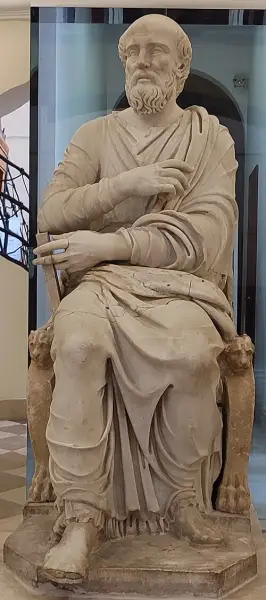
What reached later generations of Hippolytus came above all through his chronography and his church-law writings, though the corpus bearing his name remains one of the great tangles of patristic scholarship. His chronicle of the world, reaching from creation to the year 234, became a basis for chronographical writing in both East and West. The work now called the Apostolic Tradition, generally ascribed to him, contains the earliest known ritual of ordination — the source, as updated by Pope Paul VI, of the words of episcopal ordination still used by the Catholic Church — and records the first liturgical reference to the Virgin Mary, within the ordination rite of a bishop; its twenty-first chapter preserves what may be a proto-Apostles' Creed. In his Commentary on the Prophet Daniel stands the oldest witness to a December 25 feast of the Lord's birth, while his Commentary on the Song of Songs is the earliest attested Christian interpretation of that book. Legends also gathered around his name: Prudentius made him a martyr dragged to death by wild horses, parallel to the mythological Hippolytus, and so he became patron of horses — sick horses were brought to his church at St Ippolyts in Hertfordshire in the Middle Ages. In Ethiopia, where canons attributed to him entered the Fetha Negest, he is remembered as Abulides. Catholics keep his feast with Saint Pontian on 13 August; the Orthodox honor him on 30 January; and in 1551 the marble statue recovered on the Via Tiburtina gave his memory a face, though scholarship now questions even that.
§ Writings
Timeline
- 165
Born at Rome, according to the traditional dating
§ Introduction
- 199
Served as a presbyter of the Roman church under Pope Zephyrinus; the young Origen heard him preach
§ Life
- 200
Probably composed the treatise On Christ and the Antichrist
§ Eschatology
- 217
Scandalized by Pope Callixtus I's extension of absolution for grave sins; by this account set up as a rival bishop of Rome
§ Life
- 234
Compiled his chronicle of the world, carrying universal history up to this year
§ Writings
- 235
Exiled to Sardinia with Pope Pontian under Emperor Maximinus Thrax, likely to die in the mines
§ Life
- 13 Aug 236
Remains brought back to Rome under Pope Fabian and interred in a cemetery on the Via Tiburtina
§ Life
- 1551
Marble statue bearing a paschal cycle and a list of his writings recovered from the cemetery of the Via Tiburtina
§ Writings
- 1842
Books IV–X of the Refutation of All Heresies found, without their author's name, in a monastery on Mount Athos
§ Writings
- 1851
Emmanuel Miller published the Athos manuscripts as Philosophumena, attributing them to Origen
§ Writings
In Their Own Words
A soldier of the civil authority must be taught not to kill men and to refuse to do so if he is commanded, and to refuse to take an oath; if he is unwilling to comply, he must be rejected.
If a catechumen or a believer seeks to become a soldier, they must be rejected, for they have despised God.
If a man is a pander, he must desist or be rejected.
A gladiator or a trainer of gladiators, or a huntsman, or anyone connected with these shows ... must desist or be rejected.
If a man is an actor or pantomimist, he must be rejected.
The Record
- Major works
- Refutation of All Heresies (Philosophumena)·Apostolic Tradition·Commentary on the Prophet Daniel·Commentary on the Song of Songs·On Christ and the Antichrist·Chronicle of universal history to 234·On the Twelve Apostles of Christ·On the Seventy Apostles of Christ
- Patron of
- Horses
- Canonization
- Pre-congregation martyr, honored as a Church Father by Catholic, Orthodox, Oriental Orthodox and Anglican churches
Prayer
Bibliography
Show 7 sources
- Brent, Allen (1995). Hippolytus and the Roman church in the third century: communities in tension before the emergence of a monarch-bishop. Leiden: Brill. ISBN 978-90-04-10245-3.
- Cross, F. L. (2005). The Oxford Dictionary of the Christian Church. Oxford University Press.
- Cerrato, J. A. (2002). Hippolytus between East and West - the commentaries and the provenance of the corpus. Oxford: Oxford University Press. ISBN 0-19-924696-0.
- Hippolytus, The Treatise on the Apostolic Tradition of Saint Hippolytus of Rome, Bishop and Martyr, trans. Gregory Dix, (London, Alban Press, 1992).
- Quasten, Johannes (1953). Patrology - the Anti-Nicene literature after Irenaeus. Westminster, MD: Newman.
- Schmidt, T.C. and Nicholas, N.; The Chronicon of Hippolytus, second edition (English translation, rough draft), (2010).
- Smith, Yancy W. (2008). Hippolytus' Commentary On the Song of Songs in Social and Critical Context. Brite Divinity School at Texas Christian University.
Profile text adapted from the Wikipedia article, licensed CC BY-SA 4.0.
Pray with this saint every day
Save St. Hippolytus of Rome to your favorites, read the full profile, and get feast-day reminders in the Saints app.
Get the Saints AppFree on the App Store for iPhone and iPad