
died 1197·Feast November 13
St. Homobonus
Merchant saint and patron of business people
Overview
St. Homobonus was a cloth merchant of Cremona in Lombardy whose honest trading and generous almsgiving made him, within fourteen months of his death, the object of an urgent canonization request from his fellow citizens. Born Omobono Tucenghi — a name his fellow citizens soon heard as homo bonus, the good man — he was a married layman whose father, a prosperous tailor and merchant, left him an inheritance that freed him to live as he believed God asked. He regarded his work itself as a divine calling, convinced that God had granted him his labor precisely so that his earnings could sustain those who lived in want. He conducted his business with scrupulous honesty, kept a plain table and plain clothes despite comfortable means, gave much of his money to the needy, made the works of mercy in both their spiritual and corporal forms the program of his life, and even saw to the burial of the dead whom no one claimed. Night after night he presented himself at the church of St. Giles shortly before midnight, joining the night office and staying until the morning Mass had been sung. He died on November 13, 1197, and was canonized on January 12, 1199 by Pope Innocent III, who hailed him in the bull of canonization as a father of the poor and a tree bearing its fruit beside running waters.
The Complete Life
A Good Man of Cremona
Homobonus was born in the twelfth century at Cremona, a busy commercial city of the Lombard plain. His baptismal name, Omobono Tucenghi, was soon read by his neighbors as a prophecy, for in Latin homo bonus means the good man. He was a married layman, rooted in the ordinary life of the city — family, shop, and workshop — and it was precisely there, among the looms and ledgers of the cloth trade, that his sanctity took shape. His father was a prosperous tailor and merchant, and the inheritance Homobonus received from him gave him an ease that few of his fellow tradesmen enjoyed. Rather than letting that ease soften him, he treated it as equipment for service. He was convinced that God had granted him his labor precisely so that his earnings could sustain those who lived in want, and he pursued that conviction with a consistency that made his shop a byword for fairness. His business at Cremona was conducted with scrupulous honesty at a time when sharp practice was the ordinary expectation of the market, and it was this reputation for clean dealing, as much as any striking miracle, that first set him apart in the eyes of his fellow citizens.
§ Life
The Sanctity of the Workday
The spirituality of Homobonus was built from the ordinary materials of a merchant's life. Though he and his wife enjoyed comfortable means, they chose plain living and plain dress, channeling the surplus of their money to the needy. He gave himself to the works of mercy in both their spiritual and corporal forms, and took upon himself a duty others avoided: the burial of the dead whom no one claimed. A legend told of his travels captures the flavor of his charity — journeying one day, he handed over every scrap of his provisions to a beggar, and when he drew water from a stream to refill his flask, the water was found to have become wine. His days ended in prayer. Each night he made his way to the church of St. Giles a short while before midnight to join the night office, remaining until the morning Mass had been sung. In this rhythm of ledger and liturgy, of honest trade and midnight vigil, Homobonus demonstrated that the whole of a Christian's life, not merely its religious moments, could be offered to God. He died on November 13, 1197, most likely after keeping the very vigil that was his habit.
§ Life
The Good Man Raised to the Altars
The citizens of Cremona did not wait a generation to honor their merchant. Fourteen months after his death, on January 12, 1199, Pope Innocent III canonized Homobonus at the urgent pleading of the people of the city — a strikingly swift elevation, and one of the earliest canonizations of a layman who had won his sanctity not in a cloister or a battlefield but in a shop. In the bull of canonization the pope heaped titles upon him that read like a portrait of the Christian citizen: a father to the poor, a consoler of the afflicted, untiring in constant prayer, a man of peace and a maker of peace, good in name and in deed. He reached, above all, for the image of the psalm, declaring that this saint still stands like a tree set beside running water, yielding its fruit when its season comes. The choice of such language for a cloth merchant of Lombardy marked a milestone in the Church's understanding of holiness, affirming that commerce conducted with justice and charity can be a genuine path to the altars.
§ Life
Patron of All Who Trade
The veneration of Homobonus has continued for more than eight centuries, rooted first in his native city. His remains rest in the crypt of Cremona's cathedral, and his head is kept in the church of Saint Giles, the church of his nightly vigils. In 1592 the cathedral of Cremona received its dedication in his honor, together with St Mary's Assumption, and in 1643 the City Council formally chose him as patron of the city. His cult spread beyond Lombardy: when the church of San Salvatore in Portico passed in 1575 to the Università dei Sarti, the tailors' guild, it was placed under the patronage of the same merchant saint, and the Roman church of Sant'Omobono still bears his name. In Italy a comune, Sant'Omobono Terme, is called after him, and on the far side of the world Saint Homobonus Hospital serves the city of Freetown in Sierra Leone. Bishop Nicolini of Cremona marked the eighth centenary of his death by dedicating the span from November 1997 to January 1999 as the year of St Homobonus. Today he is honored as protector of Cremona and of merchants, textile workers, tailors, shoemakers, clothworkers, entrepreneurs, and business people everywhere.
§ Veneration
Timeline
- 13 Nov 1197
Died at Cremona after keeping his custom of assisting at the night office in the church of St. Giles
§ Life
- 12 Jan 1199
Canonized by Pope Innocent III, who acted on the earnest plea of the people of Cremona
§ Life
- 1575
The church of San Salvatore in Portico in Rome was given to the tailors' association and dedicated to him
§ Veneration
- 1592
Cremona Cathedral was dedicated to him together with St Mary's Assumption
§ Veneration
- 1643
The City Council chose him as patron of the city of Cremona
§ Veneration
- 1997
Bishop Nicolini of Cremona dedicated a year to his memory, celebrated with spiritual, pastoral and cultural initiatives
§ Veneration
In Their Own Words
father of the poor
this saint, is still like a tree planted by streams of water that yields its fruit in our time
The Record
- Patron of
- entrepreneurs·tailors·shoemakers·clothworkers·Cremona·business people
- Symbols
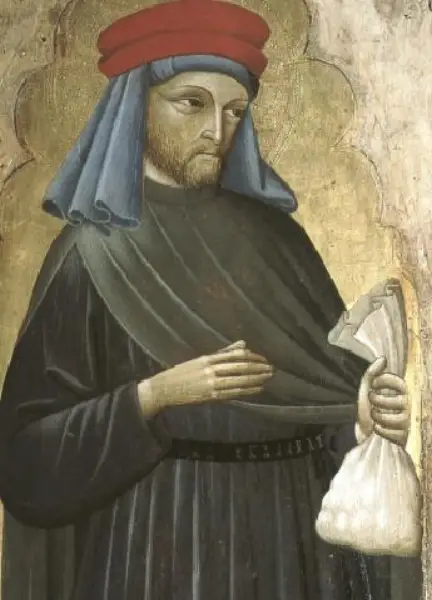
- bag of money·merchant's robes·a beggar at his side
- Canonization
- Canonized January 12, 1199 by Pope Innocent III
Prayer
Bibliography
Show 7 sources
- "St. Homobonus", Saint John Institute
- Butler, Alban. "St. Homobonus, Merchant, Confessor", The Lives of the Saints. Volume XI: November, 1866
- "Saint Homobonus Tucenghi of Cremona", Missionary Childhood Association, Boston, November 2013
- John Paul II. "Letter to H.E. Msgr. Giulio Nicolini, Bishop of Cremona", 24 June 1997, Libreria Editrice Vaticana
- "Lot Essay", Christie's, 4 Jul 2000
- Reninger, Sue. "Following the Steps of a Good Man", Catholic Women in Business, November 23, 2021
- Agasso, Domenico. "Sant' Omobono di Cremona", Santi e Beati, February 1, 2001
Profile text adapted from the Wikipedia article, licensed CC BY-SA 4.0.
Pray with this saint every day
Save St. Homobonus to your favorites, read the full profile, and get feast-day reminders in the Saints app.
Get the Saints AppFree on the App Store for iPhone and iPad