
c. 350 – 429·Feast January 16
St. Honoratus
Founder of Lérins Abbey and Archbishop of Arles
Overview
Honoratus (c. 350 – 6 January 429), honored as Saint Honorat, was the founder of Lérins Abbey and later one of the early Archbishops of Arles, venerated by Catholics and Eastern Orthodox alike. Born of a consular Roman house in northern Gaul and given a first-rate education, he converted to Christianity together with his brother Venantius and set out from Marseille around 368, under the guidance of Caprasius, for the holy places of Palestine and the desert monasteries of Syria and Egypt. Venantius died suddenly at Methone in Achaea, and the journey home through Italy left Honoratus in Provence, where, encouraged by Leontius of Fréjus, he settled on the wild island of Lérins to live as a solitary. Disciples soon gathered — Lupus of Troyes, Eucherius of Lyon, and Hilary of Arles among them — and around the solitary grew the Monastery of Lérins, the celebrated nursery of fifth- and sixth-century bishops and writers whose Rule was drawn chiefly from Pachomius; tradition holds that St. Patrick prepared there for his mission to Ireland. In 426, after Archbishop Patroclus was assassinated, Honoratus was called from his island to the troubled see of Arles, where he restored order and orthodoxy. He died in the arms of his disciple and successor Hilary.
The Complete Life
A Consular House in Northern Gaul
Honoratus was born around 350 in the north of Gaul, into a Roman family of consular rank — a household of status, wealth, and expectation. To such families the imperial service was the natural road, and Honoratus was given the outstanding education that road required. But the fourth century was also the century in which the faith captured precisely this class, and in Honoratus the capture was total: he became a Christian, and his conversion drew his brother Venantius with him. The two young men resolved on a journey that no Gallic aristocrat planned lightly — a pilgrimage out of the Roman world entirely, to the places where Christ had walked and to the desert schools of Syria and Egypt where the new martyrdom of asceticism was being invented. Around 368 they sailed from Marseille under the guidance of a holy man named Caprasius. The brothers got no further than Methone in Achaea: there Venantius died suddenly, and the pilgrimage of two became, of necessity, a return — through Italy, with a halt at Rome, and then on to Provence, where the rest of Honoratus' life would be made.
§ Life
An Island for Solitude
What Honoratus wanted, after the shattered pilgrimage, was the desert he had never reached. He found a substitute of his own: the wild island of Lérins off the Provençal coast, today called the Île Saint-Honorat in his memory. Encouraged by Leontius of Fréjus, he settled there with the declared intention of living in solitude. The intention is worth pausing over, because it failed in the most fruitful way possible. Solitude on a small island near the mouths of the Rhone could not be kept secret, and in the monastic culture of the age a holy solitary was a magnet. Disciples began arriving — men who would themselves become celebrated: Lupus of Troyes, Eucherius of Lyon, Hilary of Arles. The hermit found himself, almost against his will, an abbot. Out of the gathering grew the Monastery of Lérins, organized under a Rule of Life Honoratus drew up chiefly on the model of Pachomius, the Egyptian master whose cenobitic system he had once hoped to see at its source. The desert had been transplanted to Gaul, and it flourished.
§ Life
The Nursery of Bishops
Lérins became, within a generation, one of the great institutions of the Gallic church. The claim later writers kept repeating about it is that during the fifth and sixth centuries it served as a nursery of illustrious bishops and remarkable ecclesiastical writers — a claim the personnel list makes good: its early circle alone could count Lupus of Troyes, Eucherius of Lyon, and Hilary of Arles, and tradition adds that Patrick, apostle of Ireland, trained there for the mission that would make him famous. The monastery's fame did not consist in isolation but in supply: an island that formed pastors, scholars, and missionaries for a church building itself in a collapsing empire. Honoratus governed his monks even after he left them; when he was taken to Arles he continued to direct the community from afar, the abbot who had become an archbishop without ceasing to be either. His own writings, and the Rule he gave the solitaries of Lérins, have not survived — the school outlived the teacher's voice — but John Cassian, who had visited the monastery, dedicated several of his Conferences to Honoratus, a tribute from one founder of Gallic monasticism to another.
§ Lerins
Called from the Island to Arles
The end of Honoratus' life as a simple abbot came by compulsion. In 426 Patroclus, Archbishop of Arles, was assassinated, and the see he left was in disorder, its faith disturbed by Arian and Manichaean teaching. Honoratus' sanctity was by then known across the whole southeast of Gaul, and the choice of successor fell on him: the solitary was summoned from his island to govern one of the principal cities of Christian Gaul. He accepted, and the record of his episcopate is brief but emphatic — he appears to have succeeded in restoring both order and orthodoxy to the troubled diocese, while still directing from a distance the monks he had gathered on Lérins. He did not long enjoy the dignity. On 6 January 429 he died at Arles in the arms of Hilary, his disciple and probably his kinsman, who was chosen to follow him in the see. Hilary's memorial discourse on his teacher, the Sermo de Vita Sancti Honorati, written probably around 430, remains the fullest ancient witness to the man.
§ Archbishop of Arles
Island, Pilgrimage, and Rain
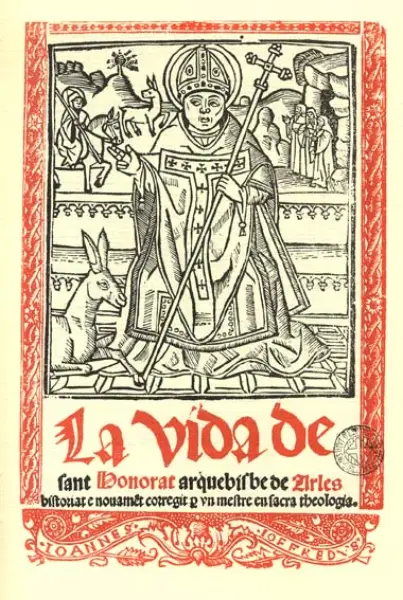
Honoratus' memory took root in the landscape of Provence. One of the two Lérins islands off the coast near Antibes still bears his name, the Île Saint-Honorat, so that the geography of the Riviera carries his biography in it. In the Middle Ages he became the object of a genuine regional pilgrimage centered on Lérins Abbey and the country around Arles — a devotion given its literary form by Raymond Féraud, a monk who around 1300 composed at Roquesteron a hagiographical life of the saint in Occitan verse, the La Vida de Sant Honorat, whose woodcut title page became one of the standard images of him. Popular religion assigned him a strikingly practical portfolio: he was invoked against drought, against misfortune, and both against rain and for rain, the whole weather-chart of a farming country — and his iconography answered to it, showing him as a bishop looming above Lérins with a phoenix at his feet, or striking water from a rock while his mitre rests nearby. His feast is kept on 16 January by Catholics, and on the same date by Eastern Orthodox, who honor him as Archbishop of Arles and founder of Lérins.
§ Legacy
Timeline
- 350
Born in northern Gaul, around this year, to a consular Roman family
§ Life
- 368
Converted with his brother Venantius and sailed from Marseille under Caprasius' guidance for Palestine, Syria, and Egypt
§ Life
- 426
Summoned from Lérins to succeed the assassinated Patroclus as Archbishop of Arles
§ Archbishop of Arles
- 6 Jan 429
Died at Arles in the arms of his disciple Hilary, who succeeded him in the see
§ Archbishop of Arles
- 430
Hilary's funeral discourse on him, the Sermo de Vita Sancti Honorati, was written around this year
§ Archbishop of Arles
- 1300
Raymond Féraud's Occitan verse life of the saint, composed at Roquesteron around this year, made him the goal of a regional pilgrimage
§ La Vida de Sant Honorat
The Record
- Major works
- A Rule of Life for Lérins, chiefly drawn from that of St. Pachomius (not preserved)·Various writings, none of which survive
- Patron of
- Against drought·Against misfortune·Against rain·For rain
- Symbols
- Shown as a bishop above the island of Lérins with a phoenix beneath him·Drawing water from a rock, his mitre set beside him
- Canonization
- Pre-congregation; honored from antiquity in the Catholic and Eastern Orthodox Churches
Prayer
Bibliography
Show 7 sources
- Butler, Alban. The Lives or the Fathers, Martyrs and Other Principal Saints, Vol. I, D. & J. Sadlier, & Company, 1864
- Clugnet, Léon. "St. Honoratus." The Catholic Encyclopedia. Vol. 7. New York: Robert Appleton Company, 1910. Retrieved 17 Jul. 2013
- Staley, Tony. "So long ago, but not really", The Compass News, Diocese of Green Bay, January 12, 2001
- Attwater, Donald and Catherine Rachel John. The Penguin Dictionary of Saints. 3rd edition. New York: Penguin Books, 1993. ISBN 0-14-051312-4
- "St. Honoratus the Archbishop of Arles and Founder of Lerins Monastery", Orthodox Church in America
- January 29 / January 16 Orthodox calendar
- "St. Honoratus of Arles", The Newman Connection
Profile text adapted from the Wikipedia article, licensed CC BY-SA 4.0.
Pray with this saint every day
Save St. Honoratus to your favorites, read the full profile, and get feast-day reminders in the Saints app.
Get the Saints AppFree on the App Store for iPhone and iPad