
died c. 600·Feast May 16
St. Honoratus of Amiens
Bishop of Amiens and patron of bakers
Overview
Honoratus of Amiens (Honoré, sometimes Honorius), who died on 16 January around the year 600, was the seventh bishop of Amiens and one of the most beloved popular saints of France. Born at Port-le-Grand in Ponthieu to a noble family, he was educated under Saint Beatus (Rato), his predecessor in the Amiens see, and showed such piety from youth that the Church marked him out. He resisted his own election to the episcopate, judging himself unworthy, but accepted it — and tradition says a ray of heavenly light rested on his head and holy oil appeared on his forehead. As bishop he found the relics of the martyrs Victoricus, Fuscian, and Gentian, hidden for three hundred years. The legend that fixed his popular image tells of his nursemaid, who refused to believe her boy a bishop until the bread-peel she had thrust into the ground took root and flowered into a mulberry tree — a tree still shown to pilgrims in the sixteenth century. Exhumed in 1060 amid reports of many miracles, he became the patron of bakers, pastry chefs, and their kin, the giver of his name to Paris's Rue Saint-Honoré and the Rue du Faubourg Saint-Honoré, and the godfather of the gâteau Saint-Honoré. Some sources, confusing him with Saint Honorius of Canterbury, date his death to 653.
The Complete Life
A Noble Boy of Ponthieu
Honoratus came from Port-le-Grand in the Ponthieu country near Amiens, born to a noble family whose lands lay within the orbit of the episcopal city. His inclinations turned Godward early: the sources note his piety as a trait his family observed rather than manufactured, and their response was to place his education in the hands of the best teacher available — Saint Beatus (Rato), the bishop of Amiens and Honoratus' own predecessor in the see. It is an odd and telling arrangement: the future bishop was formed, in effect, by the sitting bishop, in what was still a young and provincial church. Nothing is recorded of his ordination, his service, or the years between his education and his elevation; the eleventh-century Vie de Saint-Honoré, compiled by a canon of Amiens from old manuscripts and local traditions, passes over them. What the tradition keeps is the shape of the man — a noble's son of Picardy, formed in the household of a saint, who would rather have stayed in the background of the church he served than govern it.
§ Hagiography
Light on an Unwilling Bishop
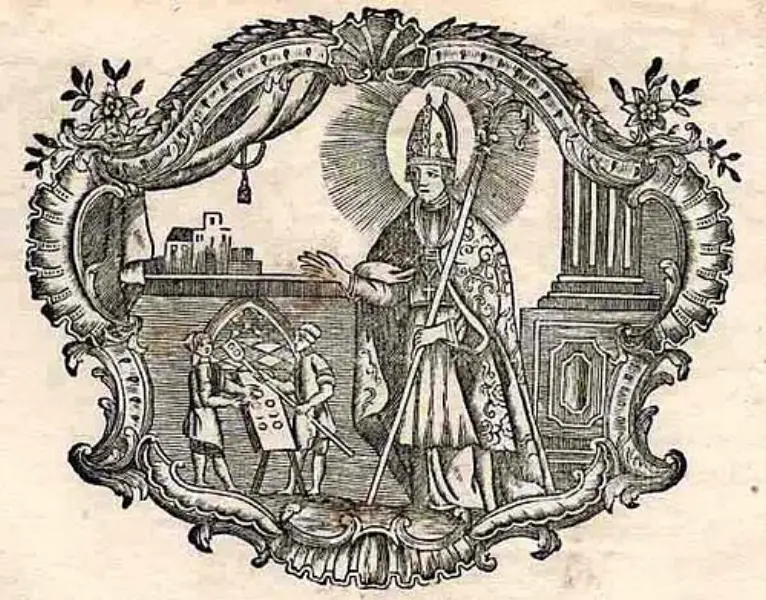
When the see of Amiens fell vacant, the choice fell on Honoratus — and he refused it. His objection was not politic but personal: he believed himself unworthy of the honor, and said so. The tradition records that he resisted election, and only after pressure consented to be the seventh bishop of Amiens. Heaven, in the hagiographers' telling, settled the question of his worthiness with signs: at his election a shaft of heavenly light fell upon his head, and holy oil appeared without any known source on his forehead — marks of an anointing no committee had administered. Back in his home village, the news met a different kind of skepticism. His old nursemaid, baking bread for the family, refused to credit that the boy she had raised could be a bishop, and said she would believe it only if the wooden peel she was using took root in the ground and grew into a tree. Set into the earth, the peel flowered into a mulberry that bore both blossom and fruit — and the miraculous tree was still being shown to the curious as late as the sixteenth century.
§ Legend
A Bishop's Hidden Work
Of Honoratus' government of the diocese the sources preserve one act, and it is a characteristic one. During his episcopate he discovered the relics of the martyrs Victoricus, Fuscian, and Gentian, which had lain hidden for three hundred years — an act of archaeological piety common to the early Frankish church, where bishops who found the bones of their predecessors' martyrs restored to a region both its holy dead and its sense of continuity. The finding belongs to the decades around 600, when Amiens was consolidating its Christian identity in the old Roman city. Beyond this, his episcopal career is silence: no synods, no letters, no foundation charter carries his name. His fame rests instead on sanctity remembered rather than administration recorded — the saint whom Picardy kept in its stories, whose body lay in its soil, and whose wonders multiplied when the body was raised. A bishop judged by the archives would be a footnote; the bakers of France judged him otherwise, and their verdict is the one that lasted.
§ Hagiography
Exhumed in 1060
The turning point in his cult came six centuries after his death, in 1060, when his body was exhumed and reports of numerous miracles began to circulate; from that moment his devotion was widespread across France. His relics were invoked against drought and against floods, and for a good wheat harvest — the anxieties of a bread country gathered around a saint whom bakers would later claim as their own. Bishop Guy, son of Enguerrand I, Count of Ponthieu, instituted a procession in which an urn bearing his relics was borne in circuit around the city walls. In 1240, while the great cathedral of Amiens was rising, his relics were taken on tour through the surrounding countryside to raise funds for the work — a relic quest so familiar to Picardy that it was carved into the tympanum of the cathedral's south transept. A statue of the saint stands at the southern portal. Never formally canonized by a pope, Honoratus belongs to the long line of bishops whom the devotion of their own people made saints, and whose cult the liturgical calendar simply confirmed: his feast was fixed on 16 May.
§ Veneration
Bakers, Streets, and a Cake
No French saint is bound to a trade more affectionately than Honoratus is bound to baking. The association began in the legend of the flowering bread-peel and matured into institutional patronage: in 1400 the Paris bakers' guild made his church its home and kept his feast there on 16 May, and in 1659 Louis XIV ordered every baker in the realm to observe the saint's feast and to give donations in his honor and for the benefit of the community. The Carthusians made him patron of their house at Abbeville, founded in 1306, and the full roll of his clients grew to include confectioners, pastry chefs, those who bake the altar's bread, chandlers, sellers of flowers and of flour, dealers in grain, and refiners of oil. Paris bears his name twice over: the church of Saint-Honoré gave its name to the Rue Saint-Honoré and, by way of the bakers' chapel of 1202, to the Rue du Faubourg Saint-Honoré, today among the most famous streets in the world. Confectionery completed the homage with the gâteau Saint-Honoré, the cream-and-caramel pastry named for a bishop whose legend began, fittingly, with a woman's bread.
§ Patronage
Timeline
- 600
Died as seventh bishop of Amiens, around this year; later confusion with Honorius of Canterbury produced the date 653
§ Honoratus of Amiens
- 1060
His body was exhumed, and reports of many miracles spread his devotion widely across France
§ Veneration
- 1202
The baker Renold Theriens gave Paris land for a chapel in his honor, which gave its name to the Rue du Faubourg Saint-Honoré
§ Veneration
- 1240
His relics were carried through the countryside around Amiens to raise funds for building the cathedral
§ Veneration
- 1306
A Carthusian establishment at Abbeville was founded under his patronage
§ Patronage
- 1400
The Paris bakers' guild set up its home in his church and kept his feast there each 16 May
§ Patronage
- 1659
Louis XIV ordered every baker to observe the feast of Saint Honoratus and to make donations in his honor
§ Patronage
The Record
- Patron of
- Bakers·Pastry chefs·Confectioners·Bakers of altar bread·Candle-makers·Florists·Flour merchants·Corn chandlers·Oil refiners
- Symbols
- A baker's peel or shovel·A bishop holding a large Host·Three Hosts on a baker's shovel·Loaves of bread·A hand reaching from heaven to give him bread for Mass
- Canonization
- Pre-congregation; cult confirmed by the devotion that followed the 1060 exhumation of his body
Prayer
Bibliography
Show 4 sources
- "Honoratus of Amiens May 16", Latin Saints of the Orthodox Patriarchate of Rome
- Marabini, Liana. "Saint Honoratus, patron of bakers and pastry chefs", The Daily Compass, April 6, 2021
- Prichep, Deena. "Thank The Patron Saint Of Bakers For This Cake Today", The Salt, NPR, May 16, 2012
- "Honorato de Amiens, Santo", Catholic.net
Profile text adapted from the Wikipedia article, licensed CC BY-SA 4.0.
Pray with this saint every day
Save St. Honoratus of Amiens to your favorites, read the full profile, and get feast-day reminders in the Saints app.
Get the Saints AppFree on the App Store for iPhone and iPad