
died c. 303·Feast February 27
St. Honorina
Virgin martyr of Gaul and patroness of boatmen
Overview
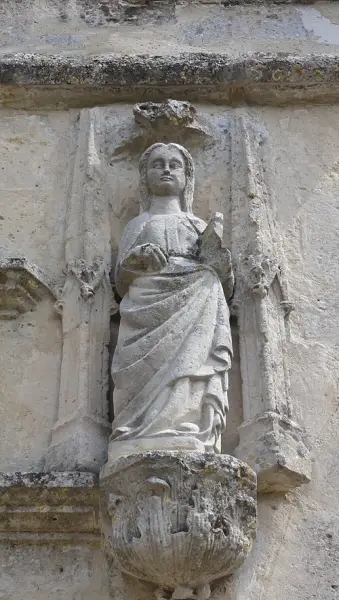
Saint Honorina (Sainte Honorine) was a virgin put to death for her faith in third-century Roman Gaul, honored today by Catholics and Orthodox alike. Tradition makes her a member of the Gallic tribe of the Calates from the Pays de Caux, put to death in the first years of the fourth century under Diocletian, near the modern town of Mélamare between Lillebonne and Harfleur, for refusing to abandon her Christian faith — one of the earliest martyrs of Gaul. Her executioners threw her body into the Seine; it drifted downstream to Graville, afterward called Graville-Sainte-Honorine, now part of Le Havre, where Christians recovered and buried it. Monks later raised a church over her relics and, in 876, fled with them inland ahead of the Norman raids to a stronghold where the Seine meets the Oise — the place that grew into Conflans-Sainte-Honorine, where her relics remain in the parish church of Saint-Maclou. Benedictines of Bec Abbey founded a priory there in 1080, and a new relic church followed in 1086. She is the patroness of boatmen and of the inland-waterway port of Conflans, and prisoners and captives invoke her; freed prisoners hung their chains at her shrine in gratitude. Her feast falls on 27 February.
The Complete Life
A Virgin of the Calates
Almost nothing certain is known of Honorina's life — the brevity of the record is itself the story of a woman at the very beginning of Gaul's Christian history. The tradition that grew up along the Seine makes her a member of the Calates, the Gallic tribe of the Pays de Caux, the plateau country between the lower Seine and the sea. She is remembered as a virgin consecrated to Christ in the years when the church of Gaul was still young and persecution could still reach it, and it is for her faith, kept to the end, that she died. Other accounts localize her differently — some place her martyrdom at Coulonces in Calvados, others in the Pays d'Auge, where several villages still carry her name — a scatter of traditions that measures how widely northern France claimed her. What every version agrees on is the essentials: a young woman, a Christian confession, a Roman magistrate's sentence, and a death in the persecutions of Diocletian at the opening of the fourth century.
§ Tradition
Martyred by the Seine
The traditional account sets her death in the first years of the 300s, during Diocletian's persecution, close to today's village of Mélamare, which lies between Lillebonne and Harfleur in the Seine valley. Executed for her refusal to give up her faith, her body was thrown into the river by her executioners — either as contempt or as a way of denying the Christians any relic of her. The river, in the story, refused to cooperate. Her remains floated downstream and came to shore at Graville, on the right bank near the mouth of the Seine, a place that afterward took her name as Graville-Sainte-Honorine and now lies within the city of Le Havre. Local Christians recovered the body and buried it first at the foot of a nearby cliff; in time monks gathered the remains into a reliquary and built a church to shelter them. The account is legend rather than acta, but it made the Seine the axis of her cult: the water that received her martyr's body became the road along which her memory — and eventually her relics — traveled through the history of Normandy.
§ Tradition
From Graville to Conflans
Her relics stayed on the Norman coast until the Vikings came. In the fifth century a community of monks had established a priory at Graville-Sainte-Honorine and built her a church; in 876, with the Norman fleets raiding the coast, the monks carried the reliquary inland for safety to a fortress standing where the Seine meets the Oise. The refuge became a shrine, the shrine a priory — Benedictines of Bec Abbey founded the priory of Conflans in 1080, probably to serve the pilgrims already gathering — and after the wooden castle there was destroyed in a siege of 21 June 1082, a new church was built at a safer distance and consecrated to her in 1086. Her relics were translated into it with the bishop of Paris looking on beside Anselm, Bec's abbot and future archbishop of Canterbury. From these events the town took the name Conflans-Sainte-Honorine. It became the great port of the tugs and barges that work the rivers and canals of northern France, and its patroness became the mother of boatmen; a confraternity was founded in her honor, indulgences were attached to her cult, and an Ascension Day pilgrimage grew up under the priory's monks. Freed prisoners brought their chains as ex-votos — the origin of the shackle she holds in art.
§ Relics
Timeline
- 303
Martyred near modern Mélamare during the Diocletianic persecution; her body was cast into the Seine and drifted to Graville
§ Tradition
- 876
With Norman raids threatening the coast, monks carried her reliquary inland to a fortress chapel at the meeting of the Seine and the Oise
§ Relics
- 1080
Benedictine monks of Bec Abbey founded the priory of Conflans, probably to care for pilgrims at her shrine
§ Relics
- 21 Jun 1082
The wooden castle of Conflans was destroyed in a siege during a dynastic struggle for the lordship
§ Relics
- 1086
A new church dedicated to her was finished and her relics translated there before the bishop of Paris and Abbot Anselm of Bec
§ Relics
The Record
- Patron of
- Boatmen and sailors of inland waterways·Prisoners and captives·The commune of Conflans-Sainte-Honorine
- Symbols
- Palm of martyrdom·A chain or shackle held in the hand
- Canonization
- Pre-congregation
Prayer
Bibliography
Show 6 sources
- The Benedictine Monks of St. Augustine's Abbey, Ramsgate (1921). "Honorina (St.) V. M.". The Book of Saints: A Dictionary of Servants of God Canonized by the Catholic Church. London: A. & C. Black, Ltd. p. 138. ISBN 978-0-265-23529-4
- Borrelli, Antonio (13 October 2002). "Sant' Onorina". Santi, beati e testimoni: Enciclopedia dei Santi (in Italian). Retrieved 18 March 2023
- Dagallier, Anne (4 October 2018). "Honorine, une sainte aux précieuses reliques". Diocèse de Versailles (in French). Église catholique des Yvelines. Retrieved 18 March 2023
- Dunbar, Agnes Baillie Cunninghame (1904). "St. Honoria (1) Feb. 27". A Dictionary of Saintly Women. Vol. 1. London: Bell. p. 393
- Gautier, Vital Jean (1876). Pouillé du diocèse de Versailles. Paris: Chez Victor Palmé. p. 146. Retrieved 19 March 2023
- "The Orthodox Saints of France: 'H'". The Orthodox West: A resource for the Orthodox Saints of Western lands. Orthodox West Initiative. Retrieved 18 March 2023
Profile text adapted from the Wikipedia article, licensed CC BY-SA 4.0.
Pray with this saint every day
Save St. Honorina to your favorites, read the full profile, and get feast-day reminders in the Saints app.
Get the Saints AppFree on the App Store for iPhone and iPad