
d. c. 420·Feast 8 August
St. Hormizd the Martyr
Persian Martyr
Overview
Hormizd was a Persian nobleman of the fifth century who lost everything for refusing to trade his Christian faith for the favor of King Bahram V. Born into the highest aristocracy — a son of a provincial governor and, by tradition, of Achaemenid descent — he was stripped of his rank when he would not conform, set to the humiliating work of tending the royal camels, and finally summoned before the emperor, who offered him restored honors if he would recant. Hormizd answered by tearing from himself the new robes the king had given him, and for this he was put to death. His passion was recorded by Theodoret of Cyrrhus in his Ecclesiastical History, and his name entered the Roman Martyrology in 1583, which fixed his feast on 8 August. In an odd turn of history his cult was planted in India: at the Synod of Diamper in 1599 Latin missionaries replaced the commemoration of Rabban Hormizd, the seventh-century East Syrian abbot, with that of this Persian martyr at the old cathedral church of Angamaly in Kerala, which thus took the martyr as its patron.
The Complete Life
Introduction
The Persian empire of the fifth century was the scene of one of the longest persecutions the church has known, for the Sasanian kings identified Christianity with their Roman enemy, and each war with Byzantium brought fresh slaughter. Bahram V, who reigned from about 420, pursued the Christians of his realm with particular severity, and Hormizd stands among the most celebrated of the victims of his cruelty. What makes Hormizd's case remarkable is his station: he belonged to the first nobility of Persia, the son of a marzban or provincial governor, and by the reckoning of the tradition a descendant of the ancient Achaemenid line. Men of such rank had everything to lose and every inducement to conform. His endurance therefore acquired a public meaning far beyond himself, and the account of his passion traveled west, finding its way into the pages of Theodoret of Cyrrhus, the great church historian of the Greek East.
§ Introduction
Early Life
Hormizd grew to manhood in a world where the profession of Christianity was itself dangerous. Theodoret, who preserves the story, says that words could hardly convey the manner in which the Christians of Persia were being put to death in those years, and that still the executions did not frighten the faithful away from their faith. The historian thus presents the Persian church of the period as a community schooled in the expectation of martyrdom, and Hormizd as its product. Modern scholarship confirms the antiquity of the narrative: Christelle Jullien notes that the passions of notables put to death under Bahram V — among them Hormozd, Shahin and the deacon Benjamin — are known from literary tradition reported by Theodoret, echoed by Michael the Syrian, and preserved also in an Armenian document. Hormizd thus belongs to a well-attested company of Persian aristocratic martyrs whose deaths were commemorated across the whole of the Christian East.
§ Early life
Martyrdom
The persecutors of Hormizd proceeded by humiliation before violence. Because of his steadfast adherence to Christianity his high offices were taken from him, and he was assigned the demeaning labor of looking after the camels of the royal stables — bitter work for a prince of the Achaemenid race. Long afterwards the king summoned him, offering to restore his position and bestow fresh favors if he would surrender his faith. Hormizd's answer has become the memorable gesture of his passion: he not only refused the offer but tore off the new garment the emperor had caused to be given him, casting back the price of his soul. For this contempt of the royal gift he was put to death. The pattern of the narrative — degradation, temptation, defiant gesture, execution — is the classic shape of the Persian martyr acts, and in Hormizd it is given with unusual biographical vividness.
§ His martyrdom for Christian faith
Veneration in the Catholic Church
Once his confession had cost his life, Hormizd's memory passed into the universal martyrologies of the West. The Roman Martyrology issued at Rome in 1583 took his name into the calendar of the universal church and set his feast on 8 August, and from that date the Persian martyr has been venerated as a Catholic saint. The entry was carried forward in the corrected editions: the English translation printed in 1907 records under 8 August 'In Persia, St. Hormisdas, a martyr.' In the East his cult has an even longer history, for he was honored among the saints of the Church of the East from early times, and today his name is reverenced across the full spectrum of the churches of the East Syrian tradition, including the Chaldean Catholic Church in communion with Rome and the Syro-Malabar Church of India, where a major shrine bears his name.
§ Hormizd the Persian as Catholic saint
The Synod of Diamper and Hormizd
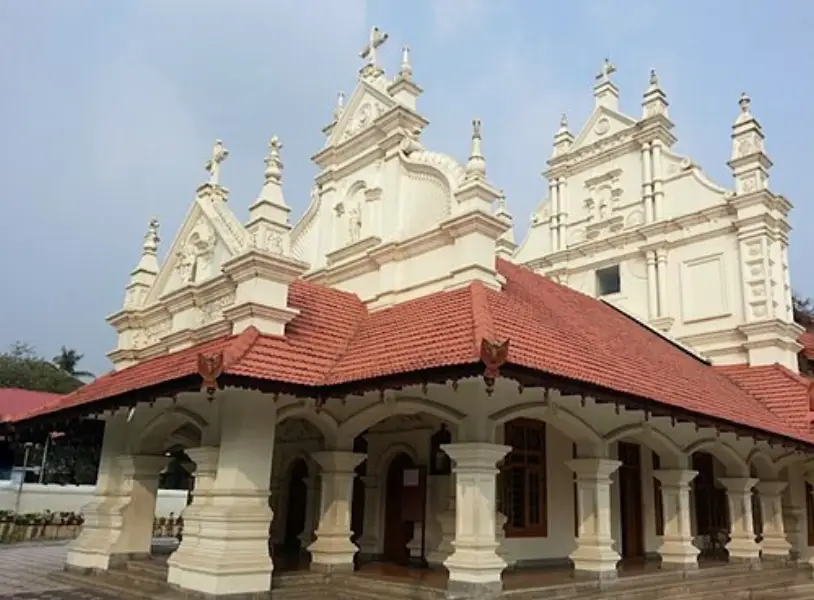
The martyr's most curious connection is with the Christians of St. Thomas in Kerala. The cathedral church of Angamaly, built under Archbishop Abraham of the ancient East Syrian hierarchy, had been dedicated to Rabban Hormizd, the celebrated seventh-century abbot of the Church of the East. When the Synod of Diamper met in 1599 under Archbishop Aleixo de Menezes to bring the Malabar Christians under Latin discipline, Rabban Hormizd was condemned as a Nestorian: his Syrian life was ordered burned, his two yearly feasts prohibited, and the church ordered rededicated to Hormizd the Persian martyr, the Catholic saint of the 1583 Martyrology, whose feast was fixed for 8 August. Thus by a synodal decree the memory of one Hormizd was deliberately substituted for another in the same building — Mar Hormizd Church of Angamaly, now of the Syro-Malabar Church. History has since relented: Rabban Hormizd is himself honored today as a saint of the Chaldean Catholic Church, so that in a sense both men reclaimed the dedication that divided them.
§ The Synod of Diamper and Hormizd
Timeline
- 420
Under the persecution waged by Bahram V, the Persian nobleman Hormizd, son of a provincial governor, held fast to his Christian faith amid the king's provocations
§ Introduction
- 420
Stripped of his high position, Hormizd was degraded to the care of the royal herds of camels
§ His martyrdom for Christian faith
- 420
Called before the emperor and offered fresh favors to abandon Christ, he refused and tore off the new dress presented to him, and was martyred
§ His martyrdom for Christian faith
- 1583
The Roman Martyrology published at Rome entered his name and fixed his feast on 8 August
§ Hormizd the Persian as Catholic saint
- 1599
The Synod of Diamper ordered the Saint Thomas Christians of Angamaly to keep the feast of Hormizd the Martyr in place of that of Rabban Hormizd, deemed tainted with Nestorianism
§ The Synod of Diamper and Hormizd
- 1907
An English edition of the Roman Martyrology carried the entry 'In Persia, St. Hormisdas, a martyr' under 8 August
§ Introduction
The Record
- Patron of
- Mar Hormizd Church, Angamaly (Syro-Malabar Church), Kerala, India
- Symbols
- Camel or shepherd's staff (in memory of his degraded office)·Nobleman's robes torn asunder
- Canonization
- Named in the Roman Martyrology (1583); venerated in the Church of the East, the Chaldean Catholic Church and the Syro-Malabar Church
Prayer
Bibliography
Show 9 sources
- Theodoret of Cyrrhus, Historia Ecclesiastica, book 5, chapter 39: "St. Hormisdas, a Persian martyr".
- Roman Martyrology: Saint Homizd, Persian and Martyr, 8 August, 1583 edition.
- The Roman Martyrology published by order of Gregory XIII, revised by authority of Urban VIII and Clement X, augmented and corrected by Benedict XIV in 1749 (Baltimore: John Murphy Company, revised edition 1916), p. 237.
- "Martyrs of Persia under Sapor II". Encyclopaedia Iranica. Retrieved from iranicaonline.org.
- Butler, Alban; Butler, Charles. The Lives of the Primitive Fathers, Martyrs, and Other Principal Saints: Compiled from Original Monuments and Other Authentic Records, Volume 8, 3rd ed., J. Moir, 1799, p. 134.
- Wigram, W. A. An Introduction to the History of the Assyrian Church. Giorgias Press, LLC, 2004, p. 118.
- Zacharia, Scaria. Randu Prajina Gadhyakrithikal = Two Ancient Prose Works (containing the decrees of the Synod of Diamper, Session III, decree X). Changanacherry: The Sandesanilayam Press, 1976, p. 183.
- La vie des saints: pour tous les jours de l'annee, tiree des meilleurs et des plus fideles Auteurs, tomo 3. Paris: Chez Charles Robustel, 1714, pp. 311-314.
- "The removal of Patrons and some Historical reflexions," Sathyadeepam Weekly, 88 (25 March 2015): 5, 16.
Profile text adapted from the Wikipedia article, licensed CC BY-SA 4.0.
Pray with this saint every day
Save St. Hormizd the Martyr to your favorites, read the full profile, and get feast-day reminders in the Saints app.
Get the Saints AppFree on the App Store for iPhone and iPad