
d. c. 290·Feast 29 September (Roman Catholic Church); 30 September (Eastern Orthodox Church); 9 or 10 October (Coptic and Ethiopian Orthodox churches); Monday after the Second Sunday of Easter (Armenian Apostolic Church)
St. Hripsime
Virgin and Martyr of Armenia
Overview
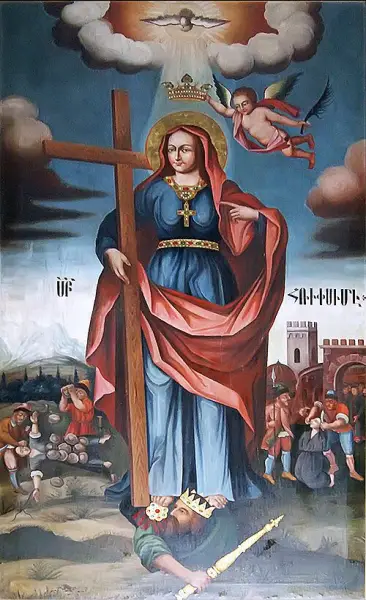
Hripsime was a Roman virgin whose martyrdom stands at the head of the story of Armenia's conversion to Christianity. According to the history attributed to Agathangelos, she belonged to a community of consecrated women in Rome living under the direction of their superior Gayane, and when Diocletian's persecution broke out the community fled east, settling near Vagharshapat in Armenia. Diocletian, who had marked Hripsime out as a prospective bride, wrote to King Tiridates demanding her return or surrender; Tiridates instead sought her for himself, and when the virgin resisted his violence and escaped, king and emperor alike turned to persecution. Hripsime and her companions — thirty-seven of the more than seventy nuns who had come to Armenia — were put to death with horrible tortures. The sequel belongs to Armenian national epic: Tiridates was transformed, in punishment, into the semblance of a wild boar, and only the release of the imprisoned Gregory the Illuminator, whose prayers healed the king, restored him and brought the whole nation to baptism. The martyrs' graves became shrines; on the site of Hripsime's burial stands the great church of Saint Hripsime at Echmiadzin, rebuilt in stone by Catholicos Komitas in 618, still among the most visited sanctuaries of Armenia.
The Complete Life
Biography
The tale of Hripsime comes down in the History of the Armenians attributed to Agathangelos, the same work that tells of Gregory the Illuminator and the baptism of the Armenian nation. In it she appears as a woman of noble stock among a company of Christian virgins leading the common life at Rome under their abbess Gayane. Hunted by Diocletian's persecution — and, in the story's most striking detail, pursued by Diocletian himself, who had chosen her as his bride — the community escaped eastward and settled near Vagharshapat, the Armenian capital. The emperor's letter to Tiridates released her into a second danger: the Armenian king commanded her brought to his palace, and though he possessed great bodily strength he could not overcome her, and she eluded him. The frustrated lust of two emperors thus became the occasion of her witness: she and her sisters were massacred, thirty-seven of the more than seventy who had fled to Armenia dying together. The narrative continues with Tiridates driven mad and transformed into the shape of a wild boar, his household and capital stricken with torments, and the vision sent to his sister revealing that Gregory — imprisoned years before for his faith — must be freed to end them. Gregory's release and prayer restored the king, the unburied bodies of the nuns were honored, shrines rose over their graves, and king and people accepted baptism. Historians have debated the story's formation: Nicholas Adontz judged the martyrdom of Hripsime and Gayane an independent tale later joined to the conversion narrative, and highlighted the parallel case of Diocletian's consort Prisca with her daughter Galeria Valeria, whom Maximinus Daza banished after the younger woman turned down his proposal of marriage, as a possible historical kernel. Modern scholars also question the Roman origin: B. Outtier and M. Thierry judge it improbable that fugitives from Italy would travel so far as Armenia, and onomastic grounds point instead to Constantinople, the 'New Rome', or western Asia Minor. Nina Garsoian reads the whole episode theologically: the virgin's triumph over a king identified with the old boar-god Vahagn stages the victory of the Christian deity over the Iranian divinity that ancient Armenia worshipped.
§ Biography
Veneration
Hripsime and her companions are among the first martyrs of the Armenian church and remain at the heart of its devotion. The Armenian Apostolic Church keeps their feast on the Monday following the Second Sunday of Easter; the Eastern Orthodox churches commemorate them with Gayane and her sisters on 30 September, the Catholic Church on 29 September; and the Coptic Orthodox Church keeps them on Thout 29, the 9th or 10th of October. In Ethiopia she is among the most beloved of all saints under the name Arsema: churches and monasteries bear her name, the oldest standing on an island of Lake Tana, where Ethiopian Christians make an annual pilgrimage each January; her passion is sung in popular hymns and told in the Gedle Arsema, found in nearly every spiritual bookshop of the country, and the Ethiopian Synaxarium recounts her martyrdom on Mäskäräm 29. The church raised over her grave at Echmiadzin, rebuilt in 618 by Catholicos Komitas, remains one of Armenia's most visited shrines. According to the medieval historian Stepanos Orbelian, her relics remained in the hands of the Armenian primates down to 1292, when the fall of Hromkla to the Mamluks sent them away to Egypt.
§ Veneration
In Art and Letters
Told first in the Armenian chronicles of Agathangelos and Movses Khorenatsi, the passion of Hripsime made its way across the entire Christian world and left its mark on many arts. The martyrdom of the virgin and her abbess appears in a miniature of the Menologion of Basil II, the great early eleventh-century Byzantine illumination cycle. For the consecration of her church in 618, Catholicos Komitas Aghtsetsi composed a sharakan, a hymn that stands at the head of Armenian sacred music. The story reached the stage as well: in 1668 Louis Marie Pidou, head of the Theatine school at Lviv, wrote The Martyrdom of St. Hripsime, the earliest Armenian tragedy known to survive; composed to neoclassical conventions and urging communion with Rome, it ends with the martyr's spirit promising her intercession for the Armenians so long as they keep faith with the church of her homeland, and later Armenian plays on the same theme drew inspiration from it.
§ In art
Timeline
- 290
Put to death near Vagharshapat together with her sister nuns after resisting both Diocletian and King Tiridates
§ Biography
- 618
Catholicos Komitas demolished the earlier martyrium and erected the present Church of Saint Hripsime at Echmiadzin
§ Biography
- 618
Komitas Aghtsetsi composed a sharakan hymn in honor of Hripsime and her companions for the consecration of her church
§ In art
- 1292
According to Stepanos Orbelian, her relics, long held by the Armenian catholicoi, were carried off to Egypt by the Mamluks after the fall of Hromkla
§ Biography
- 1668
Louis Marie Pidou wrote The Martyrdom of St. Hripsime at Lviv, the earliest surviving Armenian tragedy
§ In art
The Record
- Patron of
- Armenia and its conversion·Consecrated virgins
- Symbols
- Palm and crown of virgin martyrdom·Church of Saint Hripsime, Echmiadzin
- Canonization
- Pre-Congregation; venerated in the Catholic, Eastern Orthodox, Oriental Orthodox and Armenian Apostolic churches
Prayer
Bibliography
Show 10 sources
- "Synaxarium Tout 29: St. Arbsima (Repsima) the Virgin and Her Sisters the Virgins". CopticChurch.net. Archived from the original on 14 August 2025. Retrieved 16 December 2025.
- Agathangelos (1976). History of the Armenians. Translation and commentary by Robert W. Thomson. Albany: State University of New York Press. ISBN 0-87395-323-1.
- Sargsyan, Levon (2002). "Hṛipʻsimyantsʻ kuyser" (The Virgins of Hripsime). In Ayvazyan, Hovhannes (ed.). Christian Armenia Encyclopedia. Yerevan: Haykakan Hanragitaran. pp. 637-638.
- Sebeos (1999). "37. Building of the church of Hṙipʻsimē". The Armenian History Attributed to Sebeos. Translated by Robert W. Thomson. Liverpool University Press. pp. 76-77. ISBN 0-85323-564-3.
- Garsoïan, Nina G. (1982). "The Iranian Substratum of the 'Agatʻangełos' Cycle". East of Byzantium: Syria and Armenia in the Formative Period. Washington, D.C.: Dumbarton Oaks Center for Byzantine Studies. pp. 151-174.
- Thierry, M.; Outtier, B. (1990). "Histoire des Saintes Hripsimiennes". Syria. 67 (3): 700-702. doi:10.3406/syria.1990.7192.
- Matthew of Tokhat (1868). The Life and Times of S. Gregory the Illuminator. Translated by S. C. Malan. London: Rivingtons. pp. 217-218.
- Budge, E. A. Wallis (1928). The Book of the Saints of the Ethiopian Church. Vol. 1. Cambridge University Press. pp. 101-103.
- Cowe, Peter (1997). "Medieval Armenian Literary and Cultural Trends (Twelfth-Seventeenth Centuries)". In Hovannisian, Richard G. (ed.). The Armenian People from Ancient to Modern Times. Vol. 1. New York: St. Martin's Press. p. 323. ISBN 0-312-10169-4.
- Il menologio di Basilio II (cod. vaticano greco 1613). Vol. 1. Torino: Fratelli Bocca Editori. 1907. p. 22.
Profile text adapted from the Wikipedia article, licensed CC BY-SA 4.0.
Pray with this saint every day
Save St. Hripsime to your favorites, read the full profile, and get feast-day reminders in the Saints app.
Get the Saints AppFree on the App Store for iPhone and iPad