
c. 656 – 30 May 727·Feast 3 November
St. Hubert of Liège
First Bishop of Liège, 'Apostle of the Ardennes'
Overview
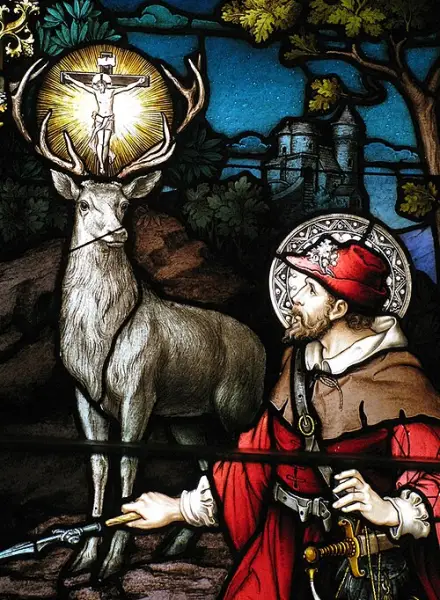
Hubert, Latinized Hubertus, was a Frankish nobleman of the late seventh century who traded the court and the hunt for the episcopate, and became the first bishop of Liège and the evangelist of the Ardennes. Born about 656, eldest son of a Frankish duke, he rose as a young courtier — count of the palace at Paris under Theuderic III, then grand master of the household to Pepin of Herstal at the Austrasian court — and married into the countly family of Leuven. The death of his wife Floribanne broke his worldly career: he withdrew to the forests of the Ardennes, and there, according to the legend fixed to his name, he saw on a Good Friday morning a crucifix shining between the antlers of the stag he was hunting and heard the command to turn to the Lord. He placed himself under the direction of Lambert, bishop of Maastricht, gave away his wealth and his birthright, was ordained, and became his chief helper. Sent to Rome on the bishop's business in 708, he learned on arrival — as, by the hagiographers' account, the Pope learned in the same hour by a vision — that Lambert had been murdered; he returned as bishop of Maastricht. In 720 he translated Lambert's relics to Liège, where a basilica over the martyrdom became the cathedral of a new see, and Hubert governed it as its first bishop, preaching through the still-pagan Ardennes and Toxandria until his death on 30 May 727. His bones rested at Liège, then at the abbey of Amdain (later Saint-Hubert) from 825; the shrine was dispersed in the Reformation era. He is patron of hunters, archers, dogs, foresters, trappers, mathematicians, opticians and metalworkers, and his name was invoked against rabies through Saint Hubert's Key into the twentieth century.
The Complete Life
Early Life
Hubert was born about 656 or 658, the first-born son of a duke of the Franks, and was formed in the world his birth opened to him. As a youth he was presented at the Neustrian court of Theuderic III at Paris, where his pleasing bearing and courtly address gained him the office of count of the palace. Like most noblemen of his time he was devoted to the chase. About 682 he married Floribanne, daughter of Dagobert, Count of Leuven; their son Floribert would in time hold his father's see, for in the Merovingian world bishoprics were treated nearly as the heritable property of the great families. Hubert then moved to the Austrasian court, where Pepin of Herstal, mayor of the palace, received him warmly and soon made him grand master of the household. He had everything the age could give a nobleman: office, marriage, inheritance and the friendship of the most powerful man in the Frankish kingdoms.
§ Early life
Spiritual Conversion
The turning of Hubert's life came through grief. Floribanne died giving birth to their son, and the widowed courtier left the court and withdrew into the Ardennes, giving himself up wholly to hunting. There the legend places on a Good Friday morning, with the faithful gathered in church, Hubert spurred after a splendid stag, and the beast wheeled to face him with a crucifix gleaming between its antlers — the scene that has fixed his image for all time. A voice warned him that unless he turned to the Lord and began to live a holy life he would soon descend into hell. Cast to the ground, he asked what he must do, and was told to seek out Lambert. Historical criticism has long since mapped the literary history of this tale: its earliest witness is one of the later legendary lives of Hubert, and the whole invention was carried over bodily from the legend of Saint Eustace, the Roman general converted by the vision of a crucifix between an antler; only in the fifteenth century was the stag story attached to Hubert himself. But the borrowing fixed his iconography forever, and through it he became for later ages the very figure of the noble sinner converted in the field.
§ Spiritual conversion
Religious Career
Hubert went at once to Maastricht, where Bishop Lambert received him kindly and took him as his spiritual director's pupil. The renunciations were total: he surrendered his considerable offices, handed his birthright in Aquitaine to his younger brother Odo, placed his infant son under Odo's guardianship, and distributed his personal wealth to the poor. Sent by Lambert into the Ardennes to live among the forest people, he prepared for holy orders, received ordination, and quickly rose to a leading place among the bishop's helpers in the government of the diocese. In 708, charged by the bishop with a journey to Rome on the church's business, he was absent when Lambert was assassinated at Liège by the followers of Pepin. The hagiographies relate that the pope learned of the murder in a vision, together with a command to consecrate Hubert bishop of Maastricht. As bishop Hubert gave the revenues of his see to the poor and became known for his preaching. In 720, in obedience to another vision, he carried Lambert's remains from Maastricht to Liège with solemn ceremony, several neighboring bishops assisting; a basilica was raised where the bishop had been slain and given cathedral rank the following year, the seat of the diocese passing from Maastricht to Liège, then only a village — the seed of the city's later eminence, in which Lambert is revered as patron while Hubert stands as founder and first bishop. To the work of the new see he added the evangelization of the Ardennes and of Toxandria, the district between Tongeren and the Waal–Rhine confluence, where his skill in the hunter's crafts won him the confidence of the forest peoples, and he was consulted as an authority in every matter of the woods.
§ Religious career
Death
Hubert died a peaceful death on 30 May 727, or by some reckonings 728, at a place called in Latin Fura, some thirty miles from Liège. Later medieval tradition located Fura at Tervuren near Brussels, but recent scholarship judges Voeren (Fourons), much nearer Liège, the likelier site of his death. He was first buried in the collegiate church of St. Peter at Liège; in 825 his bones were translated to the Benedictine abbey of Amdain in the Ardennes, the house afterwards called Saint-Hubert, which became a great center of pilgrimage in his name. There his coffin remained until it disappeared in the turmoil of the Reformation. His feast of 3 November probably marks the date of that translation of 825 rather than the day of his death.
§ Death
Veneration
Hubert was among the most widely honored saints of the Middle Ages. The Bollandists printed seven early lives of him in the Acta Sanctorum for November, the first written by a contemporary though sparing in detail. His noble birth and his lordship of the hunt commended him to the military aristocracy of Europe: the order of the Bavarian St. Hubert, the International Order of St. Hubertus of Bohemia, and the order of the Archbishop-Elector of Cologne all bore his name, and a knightly order dedicated to Saint Hubert came into being in 1444 under Gerhard V, count of Jülich and Berg. In the Rhineland he stood among the Four Holy Marshals of God, with Quirinus of Neuss, Cornelius and Anthony. At least two Church of England churches are dedicated to him, and the St. Hubert's Mass, a service with music for horns, is still offered each year around his feast of 3 November. From early times his name was invoked against rabies, cured — it was believed — by the traditional Saint Hubert's Key, a practice that persisted into the early twentieth century.
§ Veneration
Patronage and Legacy
The saint protects archers and their dogs, those who work the forests and trap game, the followers of the hunt, makers of eyeglasses, students of mathematics, smiths and metal founders, and the city of Liège itself. Sportsmen have long honored him as the originator of ethical hunting: in some tellings the visionary stag itself instructs the hunter to take only clean and humane kills, to spare the young does and the beasts past their prime, and to put down the injured animal rather than hunt trophies — a hunter's ethic still taught in the rigorous German and Austrian hunter-education courses, and carried forward by the French chasse à courre, whose practitioners venerate him as their forefather. In Belgium his feast of 3 November is kept with the blessing of horses, dogs and other animals, not only those of the hunt; the St. Hubert Club of Great Britain works for responsible deer management in his name; and the Catholic Concern for Animals confers a St. Hubert Award on those who, like the saint, give up the exploitation of animals for compassionate living. Schools, colleges and hamlets across the world bear his name, and his stag stands in the arms of municipalities from Finland to Belarus, and even — as the logo of a famous herbal liqueur — in the world's shops.
§ Patronage
Timeline
- 656
Born around this year, the eldest son of a Frankish duke, probably at Toulouse
§ Early life
- 682
Married Floribanne, daughter of Dagobert, Count of Leuven; their son Floribert would later succeed him as bishop of Liège
§ Early life
- 708
On pilgrimage to Rome for Bishop Lambert, he learned of Lambert's assassination and, by the hagiographers' account, was appointed bishop in his place
§ Religious career
- 720
Translated the relics of St. Lambert from Maastricht to Liège, where the new basilica became a cathedral and the see was moved from Maastricht to Liège
§ Religious career
- 727
Died peacefully on 30 May at Fura — identified today with Voeren near Liège rather than Tervuren — and was buried in the collegiate church of St. Peter at Liège
§ Death
- 825
His remains were moved to the Benedictine abbey of Amdain in the Ardennes, which thenceforth drew pilgrims to his shrine
§ Death
- 1444
Gerhard V of Jülich and Berg founded the Order of Saint Hubert, a chivalric order bearing his name
§ Veneration
The Record
- Patron of
- Hunters and huntsmen·Archers·Dogs·Forest workers and trappers·Mathematicians·Opticians·Metalworkers and smelters·Liège·Against rabies
- Symbols
- Stag with a crucifix between its antlers·Knight with a banner bearing the stag's head and cross·Young courtier with two hounds·Saint Hubert's Key
- Canonization
- Pre-Congregation; venerated in the Roman Catholic, Anglican and Eastern Orthodox churches
Prayer
Bibliography
Show 9 sources
- Crystal, David (1994). The Cambridge Biographical Encyclopedia. Cambridge: Cambridge University Press. p. 471. ISBN 0521434211.
- "St Hubert's Key, Belgium, 1880-1920". Science Museum, London. Archived from the original on 21 February 2011. Retrieved 21 February 2011.
- R. de la Haye, "Lambertus, laatste bisschop van Maastricht; Hubertus, eerste bisschop van Luik: Hun eigentijdse levensbeschrijvingen", Publications de la Société Historique et Archéologique dans le Limbourg (PSHAL) 143 (2007), 9-66.
- Brown, C. F. Wemyss. "St. Hubert." The Catholic Encyclopedia. Vol. 7. New York: Robert Appleton Company, 1910.
- Delehaye, Hippolyte (1911). "Hubert, St". In Chisholm, Hugh (ed.). Encyclopædia Britannica. Vol. 13 (11th ed.). Cambridge University Press. p. 846.
- Guérin, Paul. Les Petits Bollandistes: Vies des Saints, Bloud et Barral: Paris, 1882, Vol. 13.
- Watkins, Basil, ed. (2016) [1921]. "Hubert of Liege (St)". The Book of Saints: A Comprehensive Biographical Dictionary (8th ed.). Bloomsbury Publishing. p. 318. ISBN 978-0-56766-414-3.
- Farmer, David Hugh (2004). The Oxford Dictionary of Saints. Oxford University Press. p. 414. ISBN 9780198609490.
- Jones, Deborah M. (2009). The School of Compassion. Leominster, Herefordshire, England: Gracewing. ISBN 9780852447314.
Profile text adapted from the Wikipedia article, licensed CC BY-SA 4.0.
Pray with this saint every day
Save St. Hubert of Liège to your favorites, read the full profile, and get feast-day reminders in the Saints app.
Get the Saints AppFree on the App Store for iPhone and iPad