
1053 – 1132·Feast April 1
St. Hugh of Châteauneuf
Bishop of Grenoble and Carthusian protector
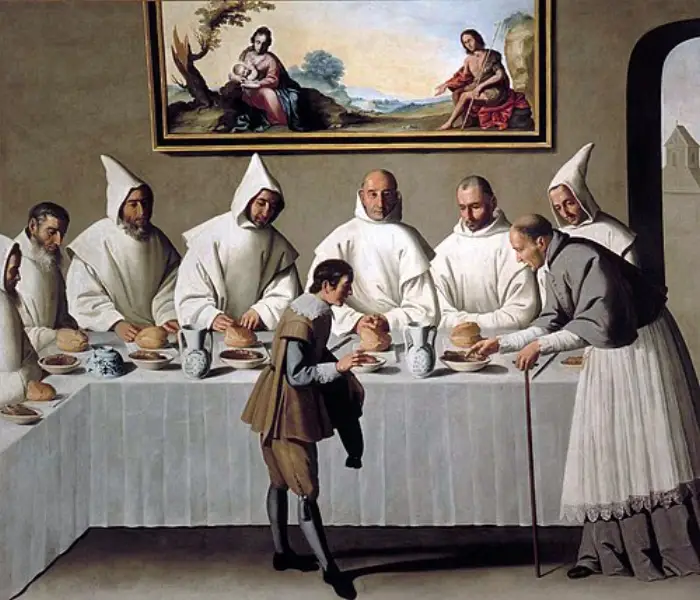
Overview
Hugh of Châteauneuf, frequently styled Hugh of Grenoble, presided over the diocese of Grenoble for close to fifty years, holding its bishopric from 1080 to his death in 1132. His birth came at Châteauneuf-sur-Isère in the County of Albon, to a father named Odilo of Valence; the boy's piety and talent for theology appeared early, and he became a canon of Valence before ever receiving orders. Elected to the bishopric at Avignon's council of 1080, Hugh was ordained in Rome at the hands of Pope Gregory VII and dispatched to mend a see sunk in grave disorder. Fidelity to the Gregorian reform marked his whole episcopate. Two years after taking up the work, once abuses had been checked and devotion revived, he sought to withdraw to Cluny as a Benedictine, but the pope commanded him to stay. In 1084 he welcomed Bruno of Cologne and six companions and established them in the Alpine wilds of the Chartreuse — a step that mattered decisively for the rise of the Carthusian Order — and afterward he founded the house of Chalais. His protracted quarrel with Count Guigues III of Albon concerning church lands in the Grésivaudan closed with an accord struck in 1099. Canonized a mere two years after dying, he stands among the chief patrons of Grenoble and is invoked by the headache-afflicted.
The Complete Life
A Childhood Marked by Piety
Hugh was born in 1053 at Châteauneuf-sur-Isère, a town in the County of Albon within the Holy Roman Empire, in what is now France. His father was Odilo of Valence, and from his earliest years the boy displayed a marked piety together with a quick facility for theological learning that set him apart. Even before he received holy orders he was appointed a canon of Valence, an unusual honor for a layman and a sign of the esteem his gifts already commanded. Contemporary memory preserved anecdotes about the seriousness of his character: it was said of him that he knew only one woman by sight, a remark meant to convey the singleness of his purpose and his custody of the senses. Nothing in the record suggests a reluctant vocation. The world of his youth was one in which the reforming party within the Church, associated with Pope Gregory VII, was fighting to free clerical office from lay control and to discipline the morals of the clergy. Into that world Hugh brought a temperament naturally aligned with the reformers' aims. His reputation for holiness and competence spread until, at the Council of Avignon in 1080, the assembled prelates looked to him for one of the most difficult tasks in the region: the restoration of the decayed diocese of Grenoble.
§ Biography
Chosen to Rebuild a Diocese
The decisive hour of Hugh's life sounded at Avignon's council of 1080, where he was chosen bishop of Grenoble despite never yet having been ordained. The selection was purposeful: the see had sunk into deep disorder, and Hugh was tapped as the man to renew it in the Gregorian spirit, the agent of reform a wounded diocese required. A legate of the Holy See escorted him to Rome, where Gregory VII bestowed ordination on him in person and returned him to his people. At once Hugh applied himself to the labor, assaulting the abuses grown deep among his clergy and nurturing devotion in pastor and parishioner alike. Within two years the renewal had advanced remarkably — and then, precisely then, Hugh sought the door. Yearning for the cloister, he tried to lay down his see and withdraw into the Benedictine house at Cluny, but the pope ordered the episcopal work to go on, and obedience carried the day. This rhythm — thirst for solitude answered by active service — marked him for life. When Bruno of Cologne, who may once have taught him, presented himself with six companions in search of a hermit's ground, Hugh welcomed the band in 1084 and, recalling a dream of seven men under a banner of seven stars, settled them in the snowbound, stony Alpine solitude named the Chartreuse.
§ Biography
Reform at Home, Foundations Beyond
The reach of Hugh's long episcopate extended well past his own diocesan boundary, and its fame rests chiefly on what he did for the infant Carthusian Order. Into his care in 1084 came Bruno of Cologne and six companions, directed by the dream of the seven stars, and he lodged them at the Chartreuse, where they reared a monastery and gave themselves to prayer and study. Hugh came often to see them, and report had it that he took on a good deal of their manner of living, so that the bishop stood as the young order's first friend and shield. Nearby he likewise raised the Monastère de Chalais, a house that in later generations blossomed into an independent congregation. At home he pressed on against corruption and for the fostering of piety, true to the Gregorian program. Yet a grinding dispute discolored the rest of his century: Guigues III, Count of Albon, laid claim to ecclesiastical estates in the Grésivaudan, an Alpine valley, while Hugh insisted the count had seized them from the bishopric through the connivance of Grenoble's bishop, Mallen. Not until 1099 did settlement come: the count yielded the contested lands, and Hugh in turn acknowledged the count's civil authority in Grenoble's vicinity.
§ Biography
A Saint Within Two Years
Hugh died at Grenoble on 1 April 1132, after more than fifty years as bishop. The Church moved with unusual speed to honor him: Pope Innocent II canonized him on 22 April 1134 in Rome, only two years after his death, an early and striking testimony to the reverence he had won. His principal feast is kept on 1 April in the Catholic Church, while the Carthusian Order, whose cradle he protected, keeps his memory on 22 April. His body, however, did not rest untouched. During the French Wars of Religion, Huguenots inspired by the teaching of John Calvin burned his remains, so that few physical traces of the saint survived the confessional violence of the following centuries. His cult nonetheless endured. In 1991 the Roman titular church of Sant'Ugo was dedicated in his honor, and his name was given to a church in Greenbelt, Maryland, in the United States, signs of a devotion that carried the bishop of an Alpine see across continents and centuries. In iconography he is represented with a lantern and three flowers, emblems of the light of teaching and the sweetness of virtue that his contemporaries found in him. He remains a principal patron of Grenoble and is invoked on behalf of those who suffer from headaches.
§ Legacy
Timeline
- 1053
Born at Châteauneuf-sur-Isère in the County of Albon, son of Odilo of Valence.
§ Biography
- 1080
Elected bishop of Grenoble at the Council of Avignon and ordained in Rome by Pope Gregory VII.
§ Biography
- 1084
Received Bruno of Cologne and six companions, installing them at the Chartreuse.
§ Biography
- 1099
Closed the long Grésivaudan land quarrel when Count Guigues III of Albon at last yielded the contested territories.
§ Biography
- 1 Apr 1132
Died at Grenoble after better than fifty years in the bishop's office.
§ Biography
- 22 Apr 1134
Canonized by Pope Innocent II in Rome, two years after his death.
§ Legacy
The Record
- Major works
- Foundation of the first Carthusian settlement at the Chartreuse·Monastère de Chalais
- Patron of
- Grenoble·against headache
- Symbols
- lantern·three flowers
- Canonization
- Canonized 22 April 1134 in Rome by Pope Innocent II, two years after his death
Prayer
Bibliography
Show 5 sources
- Herbermann, Charles, ed. (1913). Catholic Encyclopedia. Robert Appleton Company.
- "Histoire de l'Ordre de Chalais". Fédération des abbayes chalaisiennes.
- "Saint Hugh of Grenoble". Immaculate Heart of Mary's Hermitage.
- "vita di S.Ugo - Parrocchia sant'Ugo". www.santugo.it.
- "History of Place".
Profile text adapted from the Wikipedia article, licensed CC BY-SA 4.0.
Pray with this saint every day
Save St. Hugh of Châteauneuf to your favorites, read the full profile, and get feast-day reminders in the Saints app.
Get the Saints AppFree on the App Store for iPhone and iPad