
1024 – 1109·Feast April 29
St. Hugh of Cluny
Great Abbot of Cluny and papal mediator
Overview
Hugh of Cluny — known as Hugh the Great, and as Hugh of Semur — governed Cluny as its abbot for sixty years, from 1049 to 1109, and ranks among the most consequential monastic figures of the medieval centuries. His birth on 13 May 1024 took place at Semur-en-Brionnais in Burgundy; his father Dalmas I was lord of Semur and his mother Aremberge of Vergy. Turning from the knighthood his father had mapped out for him, he joined Cluny's novitiate at fourteen and pronounced vows at fifteen. Chosen abbot in 1049 to succeed Odilo, he steered the grandest monastic congregation of the Latin West through six decades. To his government belongs Cluny's third abbey church — for centuries the biggest roofed building in Europe — underwritten by Ferdinand I of León together with Henry I of England and dedicated in October of 1085 by Pope Urban II, once a prior of Cluny himself. In 1089 he planted St Pancras Priory, the pioneer Cluniac foundation on English soil, and via the Flemish abbey of St. Bertin he carried renewal across the Loire into Flanders. Godfather to Emperor Henry IV and intimate of Urban II, he arbitrated in the emperor's quarrel with Gregory VII and rode embassy to Germany and Hungary. Death came at Cluny on 28 April 1109; Callixtus II canonized him on 6 January 1120.
The Complete Life
Born to the Sword, Drawn to the Cloister
Hugh first saw light on 13 May 1024 at Semur-en-Brionnais, in the Brionnais country of Burgundy — today's Saône-et-Loire, France — the child of one of the region's grandest houses. Dalmas I, lord of Semur, was his father; his mother, Aremberge of Vergy, descended from Henry I, Duke of Burgundy. What was designed for him was a nobleman's usual fate: knighthood, at his father's wish. But the boy recoiled visibly from the soldier's trade, and the father, reading the sign, gave him over instead to his grand-uncle — Auxerre's bishop, Hugh — to be readied for priestly service. Shielded by this kinsman, Hugh studied in his early years at the school run by the monastery beside St. Marcellus Priory. Formation inside a Benedictine house left a permanent stamp. At fourteen he joined the novitiate at Cluny; a year after, aged fifteen, he pronounced his monastic vows, tying himself while hardly more than a boy to the strictest and most storied monastery in the Latin West. In time promotion came to the prior's office, placing him at Abbot Odilo's side and schooling him in the governance of the vast congregation he would someday direct.
§ Biography
From Prior to Abbot of Cluny
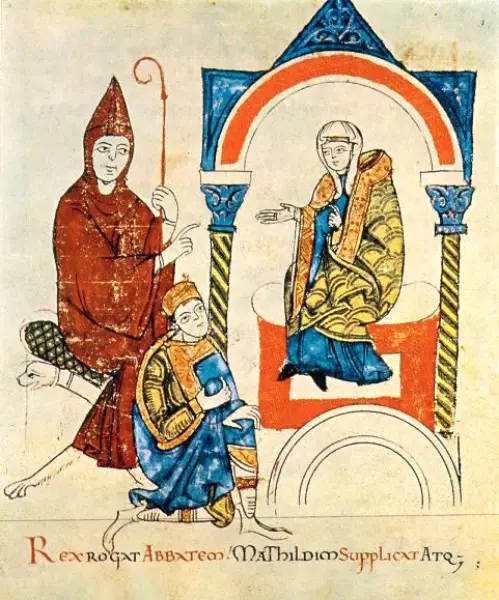
The young monk's vocation ripened swiftly into public charge. In 1048 he traveled in the company of Toul's bishop — the pope-elect Bruno von Egisheim-Dagsburg — on the road to Rome, where consecration as Leo IX awaited Bruno, and so the prior of Cluny observed the universal Church's machinery at close hand. The next year, 1049, the community's choice fell on Prior Hugh as abbot, Odilo's successor, and in the months following he sat at the Council of Reims. That election set him, scarcely out of youth, over the largest monastic congregation in Christendom, a commonwealth of priories spread through France and across her borders. Sixty years he would govern it, until 1109, in one of the longest and weightiest abbacies the Middle Ages knew. The great gatherings of the reforming Church summoned him: he stood at the Council of Tours in 1054 — the year Rome and Constantinople broke — and in March of 1058 he kept vigil in Florence at the deathbed of Pope Stephen IX. Monk to the marrow, he nonetheless turned into a figure whom popes, emperors, and kings had to reckon with, for every house under him prayed without ceasing on their behalf.
§ Biography
Building the Greatest Church in Europe
Under this abbot, ambition reshaped the spiritual and material map of Europe. To his drive belongs Cluny's third abbey church — for centuries the biggest edifice anywhere on the continent — its construction underwritten by Ferdinand I of León together with Henry I of England, and its high altar dedicated in October of 1085 by Pope Urban II, who had headed Cluny's priors before his rise, standing in Hugh's company. In stone the building proclaimed the rank of the congregation he steered. His reach crossed frontiers as firmly. In 1089 he planted St Pancras Priory, the pioneer Cluniac foundation on English ground, setting his congregation down beyond the Channel. And when Clementia of Burgundy, once married, made over to him the Flemish monastery of St. Bertin, the donation carried the Cluniac congregation past the Loire's northern bank and set monastic renewal in motion across Flanders. With the Iberian monarchs Ferdinand I and with Alfonso VI — León and Castile's kings — he kept up firm ties, threading his congregation into the Christian kingdoms of the peninsula. Through every undertaking he stayed what the novitiate had formed: a Benedictine whose command of men was simply prayer enlarged to continental scale.
§ Biography
Mediator, Saint, and Monument
Diplomacy absorbed the abbot's final decades. Godfather to Henry IV, emperor of the Romans, he put himself between the emperor and Gregory VII in their bitter struggle, and though his mediation failed, the very attempt measures the exceptional confidence both camps lodged in the aged abbot. For the Church he undertook repeated embassies to Germany and Hungary, and his sway over Pope Urban II — a man who had held the Cluny priorate beneath him — ranked him among the dominant personalities of the late 1000s. On the evening of Easter Monday in 1109 — 28 April by the calendar — he breathed his last in Cluny's Lady Chapel, in his eighty-fifth year, closing an abbacy of sixty years. Callixtus II enrolled him among the saints on 6 January 1120, scarcely ten years after his death. His feast falls on 29 April, and against fever he has long been invoked. Mourning Christendom could not shield his remains from later outrage: Huguenot raiders in 1575 pillaged or smashed many of his relics, amid the wars that scarred the inheritance of medieval France. The church he raised at Cluny, though, stood for centuries as Europe's largest — the monument that outlasted every revolution.
§ Political influence
Timeline
- 13 May 1024
Born at Semur-en-Brionnais in Burgundy, eldest son of Dalmas I of Semur.
§ Biography
- 1048
Accompanied the pope-elect Bishop of Toul to Rome for his consecration as Leo IX.
§ Biography
- 1049
Elected abbot of Cluny in succession to Odilo and attended the Council of Reims.
§ Biography
- 1054
Attended the Council of Tours.
§ Biography
- Mar 1058
Attended Pope Stephen IX on his deathbed in Florence.
§ Biography
- Oct 1085
Pope Urban II consecrated the high altar of the new abbey church at Cluny.
§ Biography
- 1089
Founded St Pancras Priory in England, the pioneer Cluniac house there.
§ Biography
- 28 Apr 1109
Died at Cluny in the Lady Chapel on Easter Monday evening.
§ Political influence
- 6 Jan 1120
Canonized by Pope Callixtus II.
§ Biography
The Record
- Major works
- Third abbey church of Cluny·Priory of St Pancras in England·Monastic reform in Flanders through the abbey of St. Bertin
- Patron of
- against fever
- Canonization
- Canonized 6 January 1120 by Pope Callixtus II
Prayer
Bibliography
Show 7 sources
- Britannica, The Editors of Encyclopaedia. "Saint Hugh of Cluny". Encyclopedia Britannica.
- Iogna-Prat, Dominique (2002). Order & Exclusion: Cluny and Christendom Face Heresy, Judaism, and Islam. Cornell University Press.
- Kennedy, Thomas. "St. Hugh the Great." The Catholic Encyclopedia Vol. 7. New York: Robert Appleton Company, 1910.
- Bouchard, Constance Brittain (1987). Sword, Miter, and Cloister: Nobility and Church in Burgundy, 980-1198. Cornell University Press.
- Robert, Ulysse (1892). Un pape belge: histoire du pape Étienne X. Bruxelles: Société belge de librairie.
- Stroll, Mary (2004). Calixtus II (1119-1124) a pope born to rule. Koninklijke Brill NV.
- Liebermann, Felix (1902). "The annals of Lewes priory". English Historical Review. 17. Oxford University Press: 83–9.
Profile text adapted from the Wikipedia article, licensed CC BY-SA 4.0.
Pray with this saint every day
Save St. Hugh of Cluny to your favorites, read the full profile, and get feast-day reminders in the Saints app.
Get the Saints AppFree on the App Store for iPhone and iPad