
c. 1140 – 1200·Feast November 16
St. Hugh of Lincoln
Carthusian prior and Bishop of Lincoln
Overview
Hugh of Lincoln — Hugh of Avalon, as he is also styled — was born in Burgundy, became a monk of the Carthusians, and went on to govern the see of Lincoln, England's largest diocese, as one of medieval England's best-loved saints. His birth fell around 1140 in the Alpine village of Avalon; after his mother's early death the Canons Regular at Villarbenoît educated him, he professed at fifteen, and he stood a deacon by nineteen. Craving stricter solitude, he entered the Grande Chartreuse in 1163, where prayer and administrative talent carried his name abroad. In 1179 Henry II — intent on rescuing the Witham Charterhouse, a foundation made in penance for the death of Thomas Becket that was now failing — forced him to take over as its third prior. The see of Lincoln chose him in 1186, and that September, at Westminster, he received consecration. His episcopate kept him riding his nine counties or dwelling among his people; he gave lavishly, chose his clergy with care, rebuilt his cathedral — shaken by an earthquake — in the Gothic manner, and stood between Lincoln's Jews and the persecutions that greeted Richard I's accession. After a French embassy had broken his health, he died in London on 16 November 1200. Honorius III enrolled him among the saints on 17 February 1220; the white swan remains his emblem, and Catholics and Anglicans alike keep his memory.
The Complete Life
A Knight's Son in the Alps
Hugh's birthplace was Avalon, an Alpine village of Imperial Burgundy — southeastern France on today's map — and the year was about 1140. Guillaume, his father, was the sieur d'Avalon, a knight whose layered feudal duties ran upward to the emperor himself. Anne de Theys, the mother, had a name for kindness: she would cleanse the wounds of lepers with her own hands, handing her small son the towels to hold — an image of charity done in person that imprinted itself early on the boy. At about eight he lost her. After her death his father placed him with the Augustinian canons at Villarbenoît, close by, for schooling alongside — in all likelihood — other noble boys; and before long the father too, mourning her and worn with war, withdrew into that same community, handing his lands to the two elder boys, Guillaume and Pierre, both keen for the soldier's path. At fifteen Hugh professed himself a Canon Regular, ranked as a novice; by nineteen he was a deacon. Soon afterward came dispatch to Saint-Maximin, a minute parish, to help an aged priest who could scarcely get through the services unaided; and he stayed subject to the prior of Villarbenoît's little community, then just twelve strong.
§ Biography
To the Mother House of the Carthusians
Between the common priest's calling and the monk's, the Canons Regular held a middle station — a way of life of real worth, in the words of the modern scholar David Hugh Farmer, given to restoring neglected things and raising up what had rotted in Church life: parishes served, the young taught, the sick nursed, ruined shrines refurbished. Hugh found joy in this ministry, yet his heart wanted the deeper contemplation obtainable only behind the walls of a secluded monastery. Best of all for that end was the house he entered one day in the company of Villarbenoît's prior: the Grande Chartreuse — the Carthusians' Mother House, sitting in the mountains north of Grenoble. Hugh's hagiographer Adam of Eynsham tells how he stood gazing in awe at a place all but in the clouds, shut away from nearly every earthly clamor, and grasped what a chance it gave for dwelling alone with God — libraries rich, hours long over the books, prayer's silence unbroken; separate cells, one purpose; solitude woven into brotherhood. There, in 1163, Hugh left the canons and put on the Carthusian habit. His twenties belonged mostly to prayer and contemplation, and within those years he was ordained priest. His early thirties brought the procurator's office — the monastery's whole temporal administration — and nearly ten years in it carried his name, as a man of piety and efficiency, across the Channel to Henry II.
§ Biography
Prior of Witham, Bishop of Lincoln
The king had reasons to want precisely such a man. In 1170 Henry had brought about the death of Thomas Becket, his onetime friend, and among the works of penance he undertook stood the founding of three monastic houses in England. One of the three, the Witham Charterhouse in Somerset — the pioneer Carthusian monastery of that country, whose founding colony had come out from the Grande Chartreuse in 1178 or 1179 — was struggling under one prior after another. Told of Hugh by the Count of Maurienne, Henry summoned him to be Witham's third prior. The honor was one Hugh could gladly have missed, since it meant torn from contemplation — and Guigo II, prior of the Grande Chartreuse, fought the nomination too. Not until Reginald Fitz Jocelin, Bishop of Bath, and Jean de Sassenage, Bishop of Grenoble, joined forces did Hugh consent. He came to Witham in 1179 and found huts of wattle, peasants embittered by dispossession, monks short of every promised supply. Treating the mess as a trial, he addressed the king at his hunting lodge without one word of reproach — and royal support followed. Hugh drew up the building plans, won royal approval, and exacted generous compensation for every evicted tenant, governing the thriving house until 1186. In May of that year a council at Eynsham ordered the Lincoln chapter to choose a bishop; Hugh was the choice, and he insisted the canons confirm it in a second election held privately in their chapterhouse. Consecration came on 21 September 1186 at Westminster. At once he showed his freedom from royal control: a royal forester felt his excommunication, and a courtier nominated to a Lincoln prebend was turned away — yet the king's anger he soothed with tact and a gentle jest.
§ Biography
The Swan of Stow
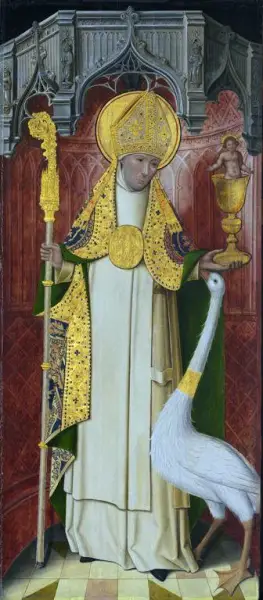
Hugh's spirit showed most plainly in what he loved. His emblem, above all others, is the white swan — kept in memory of the Stow swan (Stow in Lincolnshire being one of the bishops of Lincoln's palaces), a bird whose attachment to the saint ran deep and lasted all his days, even standing guard while he slept. At Lincoln it was his constant companion, trailing after him; and he loved every animal in the monastery gardens, this wild swan eating from his open hand and following at his heel while falling savagely on anyone else who approached its friend. The tale has outlived centuries because it discloses the man: a tenderness fierce and total, given wholly to the one it loved, and a peace with brute creation that could tame a wild bird's savagery. With men, the same gentleness governed him. Confronting Henry II, he reached for humor rather than denunciation; facing the powerful, he could be immovable — thundering excommunication at a royal forester, refusing the king's demanded knights even as his revenues were seized for it. Painters showed him in the Carthusian habit or a bishop's vestments, or holding a chalice from which Christ rises — images of one life in which the monk's solitude and the bishop's service had fused into a single unhurried charity.
§ Iconography
Cathedral Builder and Royal Diplomat
In his episcopate Hugh set an example hard to equal: he stayed close to his flock, living among them or riding his nine counties, open-handed in almsgiving and careful over whom he advanced, while lifting the standard of learning in the cathedral school. Lincoln Cathedral, wrecked by the earthquake of 1185, became his great work: he rebuilt and vastly enlarged it in the new Gothic manner, though death overtook him with the choir barely begun. In 1194 he put up St Mary Magdalen's Church in Oxford afresh. When the crown demanded three hundred knights for a year's French campaigning, he stood firm beside Bishop Herbert of Salisbury in refusal — and royal agents seized the whole revenue of both bishops' offices. Repeatedly, too, the premier bishops of England chose him for embassy to the French court — under Richard first, afterward under John; the journey of 1199 shattered his health. In 1200 he consecrated Oxford's St Giles' Church, where interlocking circles cut into the western tower column are thought to mark the day, and the St Giles' Fair founded for the occasion still meets each September. A few months afterward, while he took part in a national council at London, an unidentified illness seized him; two months on, on 16 November 1200, he died. Lincoln Cathedral received his body. His also, the record adds, was the first — timber — palace for bishops at Buckden in Huntingdonshire, set midway on the road joining Lincoln to London.
§ Biography
Raised to the Altars
On 17 February 1220, not twenty years after his death, Pope Honorius III enrolled him among the saints, and his cult spread swiftly through England and beyond. Sick children, sick people, cobblers, and swans all claim him as patron — a congregation as various as the chapters of his life. The Church of England keeps a Lesser Festival in his honor on 17 November; the Episcopal Church in the United States also remembers him on that date; Catholics keep his feast on 16 November. The story of his life — the Vita — came from the pen of his chaplain Adam of Eynsham, a Benedictine never far from his side; it lies still in manuscript in Oxford's Bodleian Library, one of the great biographies of medieval England, preserving the sayings and gestures by which his sanctity was first recognized. Devotion also took shape in stone. At Avalon, where he was born, the Carthusians in 1895 raised a round tower in the Romantic-Gothic manner to his honor, standing over the ground of the birth-castle — so that the Alpine village of his childhood and the English diocese of his maturity each keep an enduring monument to his name.
§ Veneration
Churches, Colleges, and the Airwaves
The saint's memory stays unusually visible on both sides of the Atlantic. Buckden Towers — heir to his hunting-country palace — has passed, together with the Catholic church of the neighborhood at St Neots, into Claretian hands; Lincoln keeps its own Catholic church of St Hugh. Across England many parish churches bear his name — among them Letchworth's church of St Hugh of Lincoln, which Adrian Fortescue founded. In the United States, congregations honor him at Huntington Station in New York, in Milwaukee, Wisconsin, and at Coconut Grove in Miami, Florida, while Episcopal churches at Elgin, Illinois, and Allyn, Washington, likewise stand under his patronage. Oxford honors him in stone as well: St Hugh's College bears his name, and a statue of 1926 there shows him with an effigy of Lincoln Cathedral in his right hand, his left upon a swan's head — the two achievements and the two loves of his life pressed into one image. Popular culture keeps pace: 2018 brought him to BBC Radio 4 as the hero of Colin Bytheway's drama The Man who bit Mary Magdalene, with David Jason playing the relic-hunting bishop whose searches were to serve the raising of Lincoln Cathedral. Eight hundred years on, the bishop of the swan still holds affection on two continents.
§ Legacy
Timeline
- 1140
Born at Avalon in Imperial Burgundy, son of Guillaume, sieur d'Avalon.
§ Biography
- 1163
Left the Canons Regular of Villarbenoît to become a Carthusian at the Grande Chartreuse.
§ Biography
- 1179
Arrived in England to serve as third prior of Witham Charterhouse in Somerset.
§ Biography
- 25 May 1186
Elected Bishop of Lincoln by the cathedral chapter, confirming the choice in a second chapterhouse election.
§ Biography
- 21 Sep 1186
Consecrated Bishop of Lincoln at Westminster.
§ Biography
- 1194
Rebuilt St Mary Magdalen's Church in Oxford.
§ Biography
- 1200
Consecrated St Giles' Church in Oxford, commemorated by a cross cut into the tower column.
§ Biography
- 16 Nov 1200
Died in London two months after falling ill at a national council, and was buried in Lincoln Cathedral.
§ Biography
- 17 Feb 1220
Canonized by Pope Honorius III.
§ Veneration
In Their Own Words
I have not lost confidence in you, lord king. Rather do I sympathize with you because so many occupations and distractions prevent you concerning yourself with your soul's salvation. You are indeed very busy, but with God's help you will complete the good work you have begun.
How much you remind me of your cousins of Falaise
The Record
- Major works
- Witham Charterhouse (third prior)·Rebuilding and enlargement of Lincoln Cathedral in the Gothic style·St Mary Magdalen's Church, Oxford·St Giles' Church, Oxford (consecration)·First Bishop's Palace at Buckden
- Patron of
- sick children·sick people·cobblers·swans·Roman Catholic Diocese of Nottingham
- Symbols
- white swan·bishop's attire·chalice from which Christ emerges
- Canonization
- Canonized 17 February 1220 by Pope Honorius III
Prayer
Bibliography
Show 7 sources
- Woolley, Reginald Maxwell (1927). "Chapter I. Early Days". St. Hugh of Lincoln. London: Society for promoting Christian Knowledge.
- Marson, Charles Latimer (1901). Hugh, Bishop Of Lincoln: A Short Story Of One Of The Makers of Mediaeval England. London: Edward Arnold.
- Thurston, Herbert (1898). The Life of Saint Hugh of Lincoln. London: Burns and Oates.
- Farmer, David Hugh (1985). Saint Hugh of Lincoln. London: Darton, Longman & Todd. ISBN 978-0-232-51641-8.
- Coppack, Glyn; Aston, Michael (2002). Christ's Poor Men: The Carthusians in England. Tempus. ISBN 9780752419619.
- "CATHOLIC ENCYCLOPEDIA: Saint Hugh of Lincoln". www.newadvent.org.
- Fryde, E. B.; Greenway, D. E.; Porter, S.; Roy, I. (1996). Handbook of British Chronology (Third revised ed.). Cambridge: Cambridge University Press.
Profile text adapted from the Wikipedia article, licensed CC BY-SA 4.0.
Pray with this saint every day
Save St. Hugh of Lincoln to your favorites, read the full profile, and get feast-day reminders in the Saints app.
Get the Saints AppFree on the App Store for iPhone and iPad