
died 1170·Feast November 17
St. Hugh of Noara
First Cistercian Abbot of Novara in Sicily
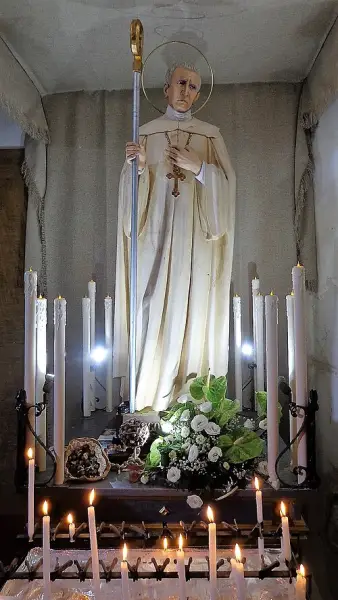
Overview
Hugh of Noara — written also Hugh of Novara, Ugo of Novara, or Hugo of Novara — was French by birth, a Cistercian religious formed among the disciples of Bernard of Clairvaux, and the planter of his order in Sicily. As a young religious he had numbered among the twenty who left Cîteaux in Bernard's company to rear the Abbey of Clairvaux. Near that decade's end — the years 1130 to 1140 — Roger II of Sicily, moved by political calculation, wanted monks of Clairvaux for his kingdom; Bernard at first said no, then sent monks from Moterola in Spain, who settled first in Calabria at Santa Maria della Sambucina, hard by Cosenza, southern Italy's earliest Cistercian abbey. Hugh came among them. When King Roger next desired the white monks to finish a monastery begun near Novara di Sicilia, the community moved into a valley the friars named Bona, and Hugh headed the house as first abbot — the monastery of Maria Santissima Annunziata, afterward the Abbey of Santa Maria di Novara Vallebona, Sicily's pioneer Cistercian community. Under him the house throve, gathered relics of many saints to the island, and seeded Cistercian foundations across Sicily. He died at Novara di Sicilia on 17 November; the town acclaimed him its patron in 1666.
The Complete Life
A Disciple of Bernard
France gave Hugh his birth, but Bernard of Clairvaux gave his early monastic life its direction: the young religious stood among the twenty who left the Abbey of Cîteaux in Bernard's company to found Clairvaux, placing him in the reform's first generation. Near the close of the decade 1130–1140 came a request from Roger II of Sicily: stirred by political calculation, the king wanted monks of Clairvaux for his island realm. Bernard declined at first, then dispatched a band from Moterola in Spain, which settled in Calabria at the ancient house of Santa Maria Requisita Nucis — a foundation of the year 550 — reborn afterward as Sambucina Abbey by Cosenza, the earliest Cistercian abbey of the Italian south. Hugh, French by nation, traveled with those monks. The venture typified Cistercian expansion in that age: white monks carried into strange lands a discipline of prayer and labor that recast church and countryside alike. For Hugh the southern journey meant every prospect of return cut off — a lifetime on an island far from the Burgundian valleys that had shaped him, in obedience to his order's missionary instinct and the trust of its greatest abbot.
§ Biography
Founding Vallebona
King Roger next desired the white monks to bring to completion a monastery whose construction near Novara di Sicilia had started in 1137. Out of Sambucina the community moved to the house standing in a valley of Novara's territory, on ground known as San Basilio, where Cistercians took the place of the Basilian monks. In keeping with their custom they christened the valley Bona — good — for its gentle climate and its rich soil. Hugh stood at the head of the house, dedicated to Maria Santissima Annunziata and known afterward simply as Santa Maria di Novara Vallebona Abbey, as its first abbot — the pioneer Cistercian community of Sicily. His companions in the work were the monks Paul, Eligius, and Mark, the last destined to follow him in the abbacy. The undertaking prospered under his government: the monastery reached structural completion in 1167 and canonical erection in 1171, and though it began as Sambucina's junior house it soon outranked its mother. For Novara he gathered numerous relics of the saints, most of which rest today beneath the reliquary altar of the church of Sant'Ugo abbot — the Abbazia di Sant'Ugo — at Novara di Sicilia. From Vallebona Cistercian teaching fanned out over the island, giving rise to Santa Maria di Novara at Badiazza, to Roccamadore's abbey of Santa Maria, and to Santa Maria di Altofonte.
§ Biography
Patron of a Sicilian Town
After long years Hugh died at Novara di Sicilia on 17 November; the precise year of his passing is unknown, though by 1175 his successor Mark appears in documents as the monastery's prior. The Roman Martyrology keeps his liturgical memory on 17 November, recording that Hugh, dispatched by Bernard himself, planted the Cistercian Order in that island and in Calabria. The town acclaimed him its patron in 1666. His feast is kept in the town on 16 August, and on 17 November — or the Sunday right after — at the abbey church of Saints Basil and Mark where the community of St. Mary of Novara worships. On the November feast his relics are carried out for public veneration from the Badiavecchia — Sant'Ugo's abbey — to the royal abbey called Santa Maria la Noara. In drought the people of Novara call upon him, a patronage fit for an abbot whose monks chose a fertile valley and made it yield. An ivory casket unearthed at Santa Maria di Novara and thought to have belonged to Hugh himself is dated around 1140; its fine inlay marks it precious, and with it a cylindrical wooden casket and an oval one, likewise reckoned his gifts. All three came from the Islamic workshops then at work in Sicily, and the Cathedral Museum of Santa Maria Assunta exhibits them.
§ Veneration
Timeline
- 1137
Construction of a monastery near Novara di Sicilia was begun, which the Cistercians would later complete.
§ Biography
- 1167
The monastery of Vallebona, of which Hugh was first abbot, was structurally completed.
§ Biography
- 1171
The monastery was canonically erected.
§ Biography
- 1175
His successor Mark is documented as prior of the monastery.
§ Biography
- 1666
Proclaimed patron saint of Novara di Sicilia.
§ Veneration
The Record
- Major works
- Abbey of Santa Maria di Novara Vallebona, the first Cistercian monastery in Sicily
- Patron of
- Novara di Sicilia·against drought
- Canonization
- Pre-congregation saint; his liturgical memory is recorded in the Roman Martyrology on 17 November
Prayer
Bibliography
Show 4 sources
- "Saint Hugh of Noara". Patron Saint Index.
- "St. Hugh of Noara". Catholic Online.
- Pitrè, Giuseppe. "Feste patronali in Sicilia", Volume unico. Torino - Palermo: Carlo Clausen, 1900.
- Loud, G. A. The Latin Church in Norman Italy. Cambridge, 2007.
Profile text adapted from the Wikipedia article, licensed CC BY-SA 4.0.
Pray with this saint every day
Save St. Hugh of Noara to your favorites, read the full profile, and get feast-day reminders in the Saints app.
Get the Saints AppFree on the App Store for iPhone and iPad