
died 730·Feast April 9
St. Hugh of Rouen
Carolingian archbishop and abbot of Normandy
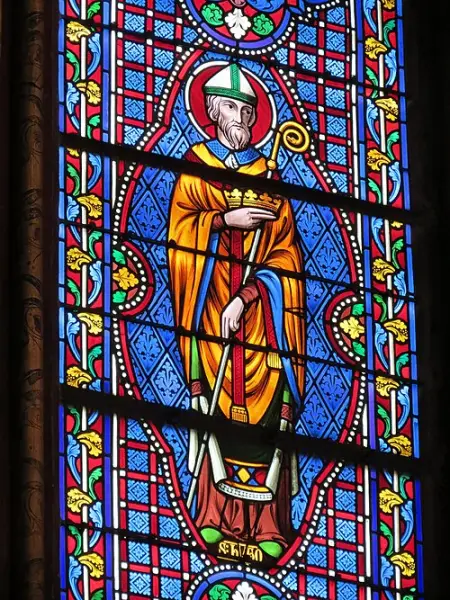
Overview
Hugh of Rouen, dead by 730, came from the very summit of the Carolingian aristocracy: his parents were Duke Drogo of Champagne and the wife he had taken, Anstrudis. Through his father he descended from Pepin of Heristal and Plectrude; through his mother, from Waratton and Ansfledis — and both his grandfathers had been mayors of the palaces, the power standing behind the Frankish kings. His grandmother Ansfled brought him up while Drogo governed Champagne far away. Jumièges Abbey was granted to him while he was yet a layman; in 718 he put on the monk's habit there, in the days of Abbot Cochin. Metz's diocese afterward made him its vicar-general, and in 722 the archbishopric of Rouen, its seat empty, fell to him by election. His ecclesiastical burdens multiplied fast: 723 brought Fontenelle Abbey into his care, and in 724 he added the administration of Paris and Bayeux to his own diocese. The income of these many offices he spent on the advancement of devout and learned causes. Toward life's end he went back to Jumièges and breathed his last there on 9 April 730, in whose soil he was laid. In the ninth century his relics found refuge at Haspres, carried inland before Viking hands could desecrate them.
The Complete Life
Born into the House of the Mayors
Hugh belonged to the house that was quietly absorbing the Frankish kingdom. Duke Drogo of Champagne was his father, Anstrudis his mother; on the father's side his grandparents were Pepin of Heristal and Plectrude, on the mother's Waratton and Ansfledis. Both Waratton and Drogo had worn the office of mayor of the palaces — effective ruler of the Frankish realms under their fading kings. His upbringing mirrored the alliances such a house required: with Drogo occupied as duke in far-off Champagne, grandmother Ansfled supervised the boy's rearing. The modern historian Paul Fouracre points to Hugh's schooling as a case demonstrating how large a part women had in the fortunes of Frankish families — and in political life at large — grandmothers and mothers holding children, estates, and alliances together while the men campaigned and governed. Neither his birthplace nor his birth year does the record supply. What it does show is a young nobleman marked out for the church in place of the sword, holding the patronage of a great Neustrian monastery even before his conversion, and set on a path joining Carolingian prestige to the church's service.
§ Life
From Layman to Monk and Vicar-General
The form of Hugh's entry into religion was unusual. Jumièges Abbey — the celebrated monastery on the Seine — had been made over to him while he still stood among the laity, so that the house was his charge before he belonged to it. In 718 he crossed from patron to professed religious, taking the monk's habit at Jumièges beneath Abbot Cochin — a striking act for one of his rank, trading the warrior aristocrat's career for the cloister's obedience. Profession did not end his public burdens; it bent them. Metz's diocese afterward made him its vicar-general, placing an episcopal city's administration in the hands of a monk of ducal blood — fitting enough, since the family of his grandfather Pepin counted Arnulf of Metz among its ancestors. The sequence of his life — benefactor, then monk, then administrator — shows how the great houses staffed the church from their own households. Hugh brought to episcopal office a monk's habits and a ruling family's instincts, and the years that followed his elevation would demand both of them in the fullest measure a Frankish bishop could supply.
§ Life
One Man, Four Churches
The year 722 brought election to Rouen's now headless archbishopric, the metropolitan see of Normandy's heartland. What followed, recorded concisely by the sources, reads like a study in the concentrated ecclesiastical power of the age. Fontenelle Abbey — among the richest and most influential houses of the region — passed under his charge in 723, abbatial government stacked atop archiepiscopal office. In 724 he went further still, taking Paris and Bayeux into his administration alongside his own: three episcopal sees, and with them oversight of monastic communities, resting on one man. Where this accumulation led is plain: the income of all these offices he turned toward the advancement of devout and learned causes, so that plural office paid for devotion and education rather than private display. In an age when family ambition treated bishoprics as inheritances, Hugh's administration stands where reform and power meet: the same stacking of offices that later centuries would condemn was, in his hands, the very machinery by which an impoverished church was financed, staffed, and defended across a broad sweep of the Frankish world, from the Seine to the Bessin's coast.
§ Life
Return to Jumièges
When life's evening came, Hugh withdrew to the monastery where his religious life had begun, going back to Jumièges after decades of multiplied office. There he died on 9 April 730, and there his brethren laid him — the ducal monk buried among his own. The community kept his memory, and his cult took root in the generations after; the church honors him as a saint, keeping his feast on 9 April, the day of his death. His remains were not left in peace. In the ninth century, as the Northmen ravaged the Neustrian coasts and their monasteries, his relics found a refuge at Haspres, carried inland beyond the raiders' reach before they could be desecrated — a second exile, undergone on his behalf long after his death, as the church guarded what it could no longer defend. That translation's story belongs to the larger tragedy and resilience of Frankish monasticism in the Viking age, when the relics of saints traveled inland like treasure and like seed. In life Hugh had yoked the greatest secular house of his day to the church's service; in death he was joined permanently to the monasteries whose patron and monk he had been.
§ Life
Timeline
- 718
Entered Jumièges Abbey as a monk under Abbot Cochin, having been endowed with the abbey while still a layman.
§ Life
- 722
Elected to the vacant Archdiocese of Rouen.
§ Life
- 723
Accepted charge of Fontenelle Abbey.
§ Life
- 724
Took on the administration of the dioceses of Paris and Bayeux together with his own.
§ Life
- 9 Apr 730
Died at Jumièges, where he had retired towards the end of his life, and was interred there.
§ Life
The Record
- Major works
- Administration of the dioceses of Rouen, Paris, and Bayeux·Governance of Jumièges Abbey and Fontenelle Abbey
- Canonization
- Pre-congregation saint; his feast is kept on 9 April
Prayer
Bibliography
Show 6 sources
- Schieffer, Rudolf. Die Karolinger. W. Kohlhammer, Stuttgart 2000.
- St. Augustine's Abbey (Ramsgate, England). "Hugh of Rouen". Book of Saints, 1921. A. & C. Black, 5 September 2013.
- Fouracre, Paul. The Age of Charles Martel. Harlow, Pearson Education Ltd, 2000.
- Ordericus Vitalis. "Chronicle of St. Evroult", The Ecclesiastical History of England and Normandy, Volume 4, H.G. Bohn, 1856.
- Delaney, John J. Dictionary of Saints. Crown Publishing Group, 2005. ISBN 9780385515207.
- "April", The Roman and British Martyrology, O'Neill and Duggan, 1846.
Profile text adapted from the Wikipedia article, licensed CC BY-SA 4.0.
Pray with this saint every day
Save St. Hugh of Rouen to your favorites, read the full profile, and get feast-day reminders in the Saints app.
Get the Saints AppFree on the App Store for iPhone and iPad