
died c. 682·Feast March 25
St. Humbert of Maroilles
Missionary bishop and first Abbot of Maroilles
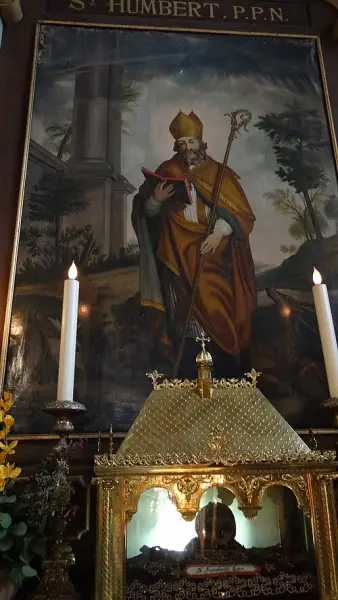
Overview
Humbert of Maroilles, whose death came around 682, was a Frankish monk, a bishop for the missions, and founder and first abbot of Maroilles Abbey. His birthplace was Mézières-sur-Oise, at the start of the seventh century, and his parents Evrard and Popita were people of rank. Trained as a Benedictine at Laon, he was expected by his kin to rise to a bishop's throne; instead, his parents' death pulled him back to his estates, and for long years a lord's comforts dulled his monastic purpose. Recovery came through Bishop Amandus, who brought him on pilgrimage to Rome and gained him as pupil and fellow-worker in the missions. From Pope Martin I he received ordination as a bishop for the missions, laboring above all in the Low Countries. The year 652 saw him join in founding Maroilles Abbey, of which he became first abbot. A second Roman journey brought him home with holy relics and a carved image of the Mother of God, whom he set over the abbey church as patroness under the invocation of Our Lady of the Afflicted — Notre Dame des Affligés — of Maroilles. Around 682 he died at Maroilles, Saint Curcodomus succeeding him, and Canada's Ottawa counts him among its patrons.
The Complete Life
A Noble Son's Long Detour
Mézières-sur-Oise saw Humbert's birth as the seventh century opened; Evrard and Popita, his parents, were people of noble rank. They pointed him toward the church, and at Laon he underwent training as a Benedictine monk — a formation his family read in one direction only: the mitre, confidently, would come his way. The turning away began with grief. When his parents died, Humbert went back to the family estates at Mézières-sur-Oise to sort out the inheritance, and there the old world reclaimed him. Rich tables, soft lodging, a retinue of servants, the chase and its pleasures — a lord's existence drew his mind off the monastic rule, and in that soft captivity he stayed for a great many years. The record is candid about the lapse in a way hagiography seldom is: the future abbot and bishop passed a long season of manhood entangled in property and pleasure, far from the cloister that had shaped him. His story preserves, from its opening chapters, the truth that a vocation can be postponed by comfort — and recovered only when a powerful summons breaks in.
§ Life
The Pilgrimage That Recalled Him
The summons came by way of Bishop Amandus, the great missionary of the Frankish north, who one day carried Humbert off on pilgrimage to Rome. That journey accomplished what years of intention had not: Humbert attached himself to the bishop as his pupil and fellow-worker, binding his life to the most demanding churchmanship of his century. Thus his Laon formation was joined to an apostolic project, for Amandus toiled among the peoples at the Frankish world's margins. Aldegundis, the celebrated abbess, numbered among his friends as well — another saint whose circle overlapped his own in the Christianizing of the country between the Somme and the Meuse. In due course Pope Martin I consecrated him a bishop for the missions — the career his family had foreseen, achieved in a form they never guessed: not a comfortable Frankish see but a mandate for the frontier, with the Low Countries as his chief field. The man who had lingered years among Mézières's distractions became an itinerant bishop of the untamed north; and the Roman pilgrimage that recalled him remained the pattern of a life spent moving between the church's center and its unfinished edges.
§ Life
Founder and First Abbot of Maroilles
In 652 Humbert joined in founding a monastery at Maroilles and stood at its head as first abbot, planting in the woodlands of what is now northern France a house that would endure a thousand years. The foundation married his two callings: missionary bishop and Benedictine abbot at once, a combination typical of the age's apostles, who fought rural paganism with monasteries as much as with preaching. His Roman devotion showed again on a second journey to the apostolic see, from which he came home carrying holy relics and a carved statuette honoring the Mother of God; in her honor he dedicated the abbey church as Notre Dame des Affligés — Our Lady of the Afflicted — of Maroilles, entrusting the young house to her intercession for all who suffer. The dedication fixed the abbey's identity: a refuge for the afflicted at Christian civilization's edge. Under his government the community took root, and when his strength gave out the succession passed in peace to Saint Curcodomus — the sign of an established monastery, not a fragile mission. Maroilles thus began its long history as the fruit of a reclaimed vocation, founded by a man who had nearly lost his way and found it again on the Roman road.
§ Life
Death at Maroilles
Around the year 682 Humbert died at Maroilles, closing a life that had run from the noble houses of Mézières-sur-Oise to the mission fields of the Low Countries and the papal city. The community he had founded buried him, and the abbacy went to Saint Curcodomus, his successor, under whose care the young monastery grew on. Humbert did not live to see the abbey's later splendor, nor its ruin: the French Revolution dealt the abbey its mortal blow more than eleven centuries after his death, though buildings of the monastery still stand at Maroilles today, mute witnesses to the foundation of 652. His memory outlasted the stones. Vendegies au Bois gave his name to its parish church, and across the ocean the Canadian capital Ottawa acknowledges him as patron — a patronage that carried the Frankish abbot's name to banks of a river he could never have imagined. Artists remembered him in striking images: a star shining on his forehead, a bear carrying his baggage, an angel marking a cross upon his brow or showing him the Cross itself — signs of a sanctity tradition found wild, angelic, and luminous at once.
§ Life
Timeline
- 652
Co-founded Maroilles Abbey and became its first abbot.
§ Life
- 682
Died at Maroilles around this year; Saint Curcodomus succeeded him as abbot.
§ Life
The Record
- Major works
- Maroilles Abbey (co-founder and first abbot)
- Patron of
- Ottawa, Canada
- Symbols
- star on his forehead·bear carrying his baggage·angel making a cross on his brow·angel showing him the Cross
- Canonization
- Pre-congregation saint; venerated in the Catholic and Eastern Orthodox churches
Prayer
Bibliography
Show 7 sources
- "Patron Saints Index: Saint Humbert of Pelagius".
- "Saint Humbert", Nominis.
- "St. Humbert - Saints & Angels - Catholic Online".
- Monks of Ramsgate. "Humbert of Marolles". Book of Saints, 1921. CatholicSaints.Info, 5 September 2013.
- Tandonnet, François. "Paths of Men, Way of God", Diocèse de Cambrai.
- "St. Curcodomus - Saints & Angels - Catholic Online".
- "Vendegies-au-Bois". Chemin faisant en Avesnois, 2019-06-01.
Profile text adapted from the Wikipedia article, licensed CC BY-SA 4.0.
Pray with this saint every day
Save St. Humbert of Maroilles to your favorites, read the full profile, and get feast-day reminders in the Saints app.
Get the Saints AppFree on the App Store for iPhone and iPad