
1582 – 1637·Feast November 27
St. Humilis of Bisignano
Franciscan lay brother and counselor of popes
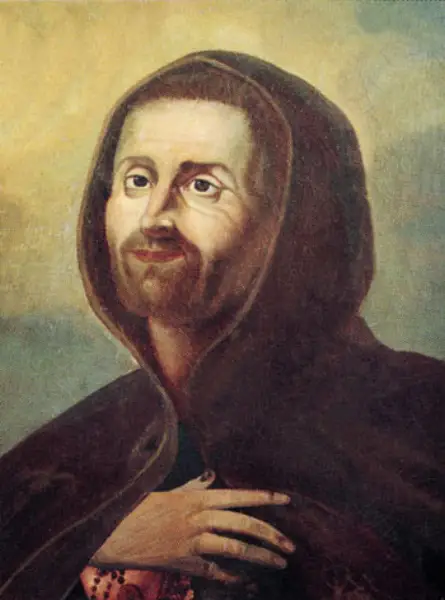
Overview
Humilis of Bisignano — in baptism Luca Antonio Pirozzo — was a friar of the Franciscans, famous throughout his own lifetime as a mystic and worker of wonders. He was born on 26 August 1582 at Bisignano in Calabria, to Giovanni Pirozzo and to Ginevra Giardino, and grew up conspicuously devout: at Mass every day, and going to Holy Communion whenever the discipline of the age allowed — an uncommon practice in that era. At about eighteen he heard the call to religious life, yet only in 1609, at twenty-seven, did he present himself to the Reformed Friars Minor — a strict-observance branch of the order — receiving the habit at their Mesoraca novitiate and the name by which history knows him. His vows came on 4 September 1610, and his life passed in the lowly domestic tasks of a lay brother. Though he could not read, he could set out the faith's profoundest teachings plainly, even for the kingdom's Inquisitor; his ecstasies, tested again and again by superiors, were judged true. The order's Minister General took him along on a visitation of southern Italy and Sicily, and Rome afterward summoned him to counsel Gregory XV and Urban VIII. Death found him at Bisignano on 26 November 1637; John Paul II canonized him in 2002.
The Complete Life
The Boy Who Turned His Cheek
Luca Antonio Pirozzo was born in 1582 — 26 August, the infobox records — at Bisignano, a city of the Calabrian interior, then the seat of its own principality. Giovanni Pirozzo and Ginevra Giardino were his parents, ordinary townspeople of a Calabrian hill town. The boy's religiosity announced itself early, and in concrete habits: prayer was his constant occupation, he attended Mass every single day, and he received Holy Communion whenever the discipline of the period allowed — rarely granted to laity in that age. Public life put his character to the test. In his youth someone dealt him a savage blow across the face in the town piazza, and his answer — turning the other cheek, literally — became the talk of Bisignano and the sign of what his religious name would one day say: Humilis, the humble one. The episode belongs to a long tradition of sanctity read through meekness under insult; but with Luca the gesture was no isolated drama, for it matched a patience and simplicity that those around him observed throughout his formation. A young man of prayer, of daily Mass, of meekness shown in public, he was marked for the friary long before he entered it.
§ Life
A Long Awaited Habit
Ecstasy had marked Humilis from boyhood onward, and within the Franciscan life these experiences deepened and multiplied. The order met them with scrutiny, not credulity. Set to the domestic tasks that fell to lay brothers, he was also put again and again by his superiors to chores and trials aimed at sizing up his character and testing whether the reported experiences were genuine. The examination reached the church's summit: though wholly unable to read, the unlettered friar could lay out some of the faith's profoundest teachings with perfect clarity before examining officials — before the kingdom's Inquisitor himself, no less. That pairing, of ecstasy with orthodoxy, of simplicity with wisdom, formed his reputation: his contemporaries regarded him everywhere as a mystic given to wonders. His fellow friars came to a deep respect grounded in close observation — his gentleness, his innocence of mind. The doctrine he could expound so clearly he seems to have possessed the only way open to him: not through books, but through prayer before the Eucharist he had attended daily from boyhood and the crucified Christ whom the Franciscans set ever before his eyes.
§ Life
From the Friary Kitchen to the Vatican
Humilis's name could not stay shut up in Calabria. Benigno de Genova, Minister General of the Friars Minor between 1618 and 1625, picked him as companion for the canonical visitation of the order's friaries in southern Italy and Sicily — a journey that showed the humble lay brother to his whole province and to its highest superior. After that service Rome called him, and there he became a trusted counselor to Gregory XV and afterward to Urban VIII — an astonishing role for a man who could neither read nor write, and a striking measure of how that era's church weighed holiness alongside learning. Through the Roman years his usual lodging was San Francesco a Ripa, a friary where he kept up the same life of prayer and lowly service that Calabria had formed in him. His mission's arc ran from Bisignano's town piazza — where he had turned his cheek beneath a blow — to the side of two popes who sought his counsel; yet the constant was never position but the mystical intimacy with God that made his conversation worth the attention of learned and simple alike.
§ Life
Ecstasy Tested and Proven
At about eighteen Luca Antonio felt the pull toward religious life, yet various reasons — the record does not name them — held him back for close to a decade. In 1609, aged twenty-seven, he finally offered himself to the Reformed Friars Minor, a strict-observance branch of the order whose community lived at the medieval Convento di Riforma — the Friary of the Reform — in his own Bisignano. That very year the novitiate received him, ranked as a lay brother; it stood at Mesoraca, in Crotone's province, and there he took the religious habit and the name history keeps: Humilis. The probationary year was not smooth — he had to get the better of various difficulties during those months of trial, though what they were the record leaves unsaid. Having persevered, on 4 September 1610 he at last pronounced his vows, becoming a full member of the Order. The lay brother, nearly thirty and a decade in arriving, had grasped at last the life he wanted — and he would hold it for the remaining twenty-seven years of his life without ever letting go.
§ Life
Home to Die
After long years away Humilis went home, the circle of his life closing where it had opened. Death came at Bisignano in 1637, on 26 November, in his fifty-fifth year; his body was laid to rest among the friars' graves beside their house in the city of his birth — the Convento di Riforma where he had received the habit some twenty-seven years earlier. His tomb there became the natural center of his cult, and the friary remains his principal shrine. The homecoming for death is a fitting emblem of the whole story: the boy of Bisignano who counseled popes in Rome finished as simply and locally as he had begun, a Calabrian friar among his own people. The city that had watched his cheek turn under a blow in the piazza now kept his memory with devotion. The cause that followed — venerable, blessed, saint — began among those who had known him or his immediate successors, and it ended on a scale no Calabrian lay brother could have imagined, when the pope who canonized him in 2002 held him before the whole church as a model of humility and mystical prayer.
§ Life
Three Centuries to the Altar
The drive to canonize Humilis began in the mid-seventeenth century, within a generation of his death, and moved through the measured stations of the Roman process. Venerable was the title Pius VI gave him in 1780. Nearly a hundred years on, Leo XIII beatified him in Rome on 29 January 1882; the canonization process itself got under way on 13 January 1887. The last step took longest of all: John Paul II inscribed him in the catalogue of saints on 19 May 2002 at the Vatican, better than 360 years after his death and 220 after the declaration of heroic virtue. The intervals teach their own lesson — the patience of the church's procedures, and the persistence of a cult that never lapsed in Calabria or among the Franciscans. His feast falls on 27 November, near the anniversary of his death. The Archdiocese of Cosenza-Bisignano and the Franciscan Order venerate him with special care, and his relics are honored at the Convento di Riforma in Bisignano, in Cosenza's province. Among the confessors and religious raised to the altars, Humilis stands as the unlettered brother whose wisdom popes trusted — and whose humility the church has made forever memorable.
§ Veneration
Timeline
- 26 Aug 1582
Born Luca Antonio Pirozzo at Bisignano in Calabria, son of Giovanni Pirozzo and Ginevra Giardino.
§ Life
- 1609
Entered the Reformed Friars Minor at the age of twenty-seven, receiving the habit at the novitiate of Mesoraca.
§ Life
- 4 Sep 1610
Took his religious vows, entering the Friars Minor as a full member.
§ Life
- 26 Nov 1637
Died at Bisignano and was buried among the friars' graves at their friary in the city of his birth.
§ Life
- 1780
Declared venerable by Pope Pius VI.
§ Veneration
- 29 Jan 1882
Beatified in Rome by Pope Leo XIII.
§ Veneration
- 13 Jan 1887
Cause for his canonization formally opened.
§ Veneration
- 19 May 2002
Enrolled among the saints by John Paul II at the Vatican.
§ Veneration
The Record
- Canonization
- Beatified 29 January 1882 by Pope Leo XIII; canonized 19 May 2002 in Vatican City by Pope John Paul II
Prayer
Bibliography
Show 5 sources
- "Homily of John Paul II".
- "Umile da Bisignano". Vatican News Service.
- "St. Humilis Of Bisignano", Irish Franciscans.
- Index ac status causarum beatificationis servorum dei et canonizationis beatorum. Typis polyglottis vaticanis, January 1953, p. 95.
- "Saint Humilis of Bisignano" at Patron Saints Index.
Profile text adapted from the Wikipedia article, licensed CC BY-SA 4.0.
Pray with this saint every day
Save St. Humilis of Bisignano to your favorites, read the full profile, and get feast-day reminders in the Saints app.
Get the Saints AppFree on the App Store for iPhone and iPad