
c. 1226 – 1310·Feast May 22
St. Humility
Founder of the Vallumbrosan nuns of Faenza
Overview
St. Humility, known in the world as Rosanna Negusanti, was born into a noble family of Faenza around 1226 and became the founder of the Vallumbrosan nuns. Married at fifteen to the nobleman Ugoletto dei Caccianemici, she lost both of her children in infancy, and in 1250 she and her husband made the extraordinary decision to enter religious life together at the double monastery of Saint Perpetua near Faenza, where she took the name Humilitas. Four years later she withdrew into a walled cell attached to the Vallumbrosan church of Saint Apollinaris and lived there as a recluse for twelve years, her example drawing young women of the city who wished to build cells near hers and live under her guidance. Summoned from her solitude at the abbot-general's request, she raised a Vallumbrosan house outside Faenza in 1266 and governed it as abbess; in 1282 she carried the observance to a second Florentine convent honoring Saint John the Evangelist, dying there on 22 May 1310. She left Latin sermons and verses in honor of the Virgin Mary, and Pope Clement XI confirmed her ancient cult in 1720. and in 1942 her native Faenza took her as its co-patron.
The Complete Life
Rosanna of Faenza
The woman who would be known to history as St. Humility began life as Rosanna Negusanti, a daughter of the nobility of Faenza, a city of Romagna with old ties to the imperial past. Around 1241, when she was about fifteen years old, she was married to a nobleman named Ugoletto dei Caccianemici, and for a time she lived the ordinary existence of a married woman of her class. Two children were born to the couple, and both died in infancy — a double bereavement that marked a turning point in the life of the young mother. Grief did not drive husband and wife apart; it drove them together toward God. In 1250 they resolved on a course rare then as now: to enter religious life side by side. Together they joined the double monastery of Saint Perpetua near Faenza, where Rosanna became a canoness and took the religious name Humilitas — humility, the virtue that would give her both her identity in religion and her name on the calendar of the saints. The marriage that had been her first vocation now yielded, without rancor, to a shared pursuit of the common search for God.
§ Biography
Twelve Years Behind a Wall
After four years in the common life at Saint Perpetua, Humility heard a stricter call. In 1254 she embraced the anchorite's discipline, taking up residence in an anchorhold beside the Vallumbrosan church of Saint Apollinaris in Faenza, and there she lived as a hermit and recluse for twelve years. The anchoress's cell was a small territory of renunciation: one room, a walled doorway, a window toward the church, and a lifetime of prayer offered on behalf of the city outside. Yet even seclusion could not contain the influence of her sanctity. Her example drew young women of the city, who begged leave to raise cells beside her own and to place themselves under her direction, so that the solitary gradually became, without ever abandoning her intention, the mother of a community. Those twelve years formed the pattern of her entire life — the alternating rhythm of withdrawal and responsibility, of prayer in secret and governance in public — that would distinguish her foundations. When at length the abbot-general of the Vallumbrosan order came seeking, he found not a recluse to be left alone but a foundress already surrounded by followers.
§ Biography
Two Monasteries and a Congregation of Nuns
In 1266, at the request of the abbot-general, Humility left her cell to undertake the work for which she is remembered: the founding of a Vallumbrosan monastery for women outside Faenza, which came to be called Santa Maria Novella alla Malta. She became its abbess, and under her government the house gave permanent form to the community that had gathered around her anchorhold. Sixteen years later she repeated the achievement on a larger stage. In 1282 she founded a second convent, this one at Florence and dedicated to Saint John the Evangelist, extending the Vallumbrosan observance to the greatest city of Tuscany. The Florentine house was worthy of its city: it was decorated by the painter Buonamico Buffalmacco, whose work made the convent a place of beauty as well as discipline, and it was solemnly consecrated in 1297 by Bishop Francesco Monaldeschi. Humility spent the remainder of her life in this Florentine foundation, governing it as she had governed the house at Faenza. From her twin foundations and the communities formed around her cell, the congregation of Vallumbrosan nuns took its shape, owing to her its existence and its rule of life.
§ Biography
Preacher, Poet, and Mother of Nuns
Humility was not only an administrator of monasteries but a teacher whose voice reached beyond her walls. She left behind a body of writings that places her among the literate religious women of the thirteenth century, and two of her works were especially celebrated. The first was a cycle of nine sermons in Latin, which she both composed and preached — a striking exercise of authority for a woman of her era, delivered in the scholarly tongue of the Church. The second was her Lauds to the Virgin Mary, verses in praise of the Mother of God that joined the devotional poetry of her age to the liturgical life of her communities. Her spirituality joined the contemplative inheritance of the anchorhold, learned in twelve years of reclusion, with the practical wisdom of the abbess's office; the same woman who had prayed alone at Saint Apollinaris now directed the prayers of others and answered for their daily bread. The name she took at Saint Perpetua remained the truest summary of her character: humility, practiced in grief, in enclosure, in office, and in the quiet authority of a foundress beloved by her nuns.
§ Biography
The Last House in Florence
The final decades of Humility's life were passed at the Florentine convent of Saint John the Evangelist, the second and grander of her foundations. She had built it in 1282, seen it adorned by the brushes of hired painters, and watched it consecrated in 1297 by Bishop Francesco Monaldeschi; by then the house stood complete, a permanent home for the Vallumbrosan sisters of the city and for the foundress herself in her old age. There she died on 22 May 1310, having lived through nearly the whole of the thirteenth century and a decade beyond it. Her death, like her life, joined the two halves of her vocation: she ended her days not in the solitary cell where her religious life had begun, but in the midst of the community her obedience had created, surrounded by the nuns who called her founder and mother. The date of her passing, 22 May, became the day on which the Church would afterward keep her memory each year, and the Florence convent remained the first home of her cult until later centuries moved her remains elsewhere.
§ Biography
The Ancient Cult Confirmed
Four centuries after her death, the Church formally ratified the devotion that the nuns of Faenza and Florence had never allowed to fade. On 27 January 1720, in Saint Peter's Basilica in Rome, Pope Clement XI confirmed the ancient cult of Humility, the canonical act by which a long-standing popular devotion is raised to the honors of the altar. Such confirmations are the Church's acknowledgment that a saint has been venerated from time immemorial, and in her case the judgment merely registered a fact the Vallumbrosan order had always known. Altars dedicated to her stood in both of the monasteries she had founded within the Vallombrosan Congregation, permanent witnesses to the gratitude of the sisters who prayed in her houses. Civic honor followed ecclesiastical recognition: in 1942, more than two centuries after the canonization, she was declared co-patron of Faenza, her native city, joining her name to the public life of the place where Rosanna Negusanti had been born and where Humilitas had first taken her name. Her feast is celebrated on 22 May, the anniversary of her death at Florence.
§ Biography
Relics, Images, and a City's Patron
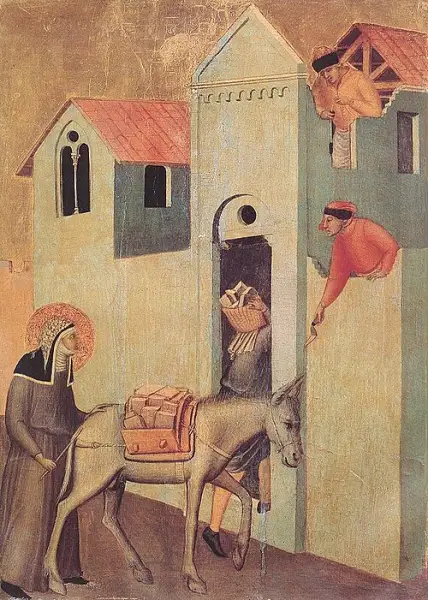
The memory of St. Humility has been carried by artists as much as by historians. The Florentine convent she founded inspired some of the earliest independent images of a woman saint in Italian painting, and her figure appears in the altarpiece of Beata Umiltà painted by Pietro Lorenzetti, now in the Uffizi, as well as in an image attributed to Andrea Orcagna at San Michele a San Salvi, made around 1350. In these works she appears as a nun, the attribute by which she is still recognized. Her remains, kept first at the Florentine house, were translated in 1972 to the Monastery of the Holy Spirit at Bagno a Ripoli on the outskirts of Florence, where the Vallumbrosan tradition she served continues to keep them. In Faenza she ranks as co-patron of the city, honored on her feast of 22 May. The congregation she founded endured as one of the distinctive expressions of religious life for women within the Vallombrosan family, and her Latin sermons and Marian verses preserve the voice of a thirteenth-century foundress who taught, governed, and sang the praise of the Virgin in her own words.
§ Biography
Timeline
- 1226
Born Rosanna Negusanti to a noble family of Faenza
§ Biography
- 1250
Entered the double monastery of Saint Perpetua near Faenza together with her husband
§ Biography
- 1254
Withdrew into an anchorhold beside the Vallumbrosan church of Saint Apollinaris in Faenza
§ Biography
- 1266
Founded a Vallumbrosan monastery outside Faenza, later called Santa Maria Novella alla Malta, and became its abbess
§ Biography
- 1282
Established a second convent in Florence, honoring Saint John the Evangelist
§ Biography
- 1297
The Florentine convent was consecrated by Bishop Francesco Monaldeschi
§ Biography
- 22 May 1310
Died at the convent of Saint John the Evangelist in Florence
§ Biography
- 27 Jan 1720
Pope Clement XI confirmed her ancient cult at Saint Peter's Basilica in Rome
§ Biography
- 1942
Declared co-patron of the city of Faenza
§ Biography
- 1972
Her relics were translated to the Monastery of the Holy Spirit at Bagno a Ripoli near Florence
§ Biography
The Record
- Major works
- Nine Latin sermons·Lauds to the Virgin Mary in verse
- Patron of
- Faenza
- Symbols
- depicted as a nun
- Canonization
- Canonized January 27, 1720 by Pope Clement XI at Saint Peter's Basilica, Rome
Prayer
Bibliography
Show 3 sources
- Borrelli, Antonio. Santa Umiltà, Santi e beati: February 5, 2003 (in Italian)
- Webster, Douglas Raymund. "Vallumbrosan Order." The Catholic Encyclopedia Vol. 15. New York: Robert Appleton Company, 1912
- Vasari, Giorgio. The Lives of the Painters, Sculptors and Architects. Trans. A. B. Hinds. New York: Everyman's Library. 1980. Vol. 1, Pp. 109-122
Profile text adapted from the Wikipedia article, licensed CC BY-SA 4.0.
Pray with this saint every day
Save St. Humility to your favorites, read the full profile, and get feast-day reminders in the Saints app.
Get the Saints AppFree on the App Store for iPhone and iPad