
martyred 1226·Feast October 31
The Hundred Thousand Martyrs of Tbilisi
Martyrs of the Khwarazmian Sack of Tbilisi
Overview
The Hundred Thousand Martyrs of Tbilisi are the Christian citizens of Georgia's capital whom the Georgian Orthodox Church honors as saints, put to death when the Khwarazmian sultan Jalal al-Din stormed Tbilisi in 1226. An anonymous Georgian chronicle of the fourteenth century, the Chronicle of a Hundred Years, preserves their story: it tells how the victims died rather than give up their Christian faith, and puts their number at one hundred thousand. Jalal al-Din had shattered the Georgian kingdom at Garni in 1225 and took the capital the following spring, while Queen Rusudan and her court fled. His soldiers plundered the city and slaughtered its Christian inhabitants, and Muslim historians of the period, Ibn al-Athir and Nasawi, confirm that Christians who would not accept Islam were killed at the sultan's command. The most notorious act of that day came at the bridge over the Mtkvari, where the icons of Christ and the Mother of God were thrown down to be trampled; those who would not profane them were beheaded. The Georgian church keeps their memory on 13 November, or 31 October by the old calendar.
The Complete Life
Georgia Before the Storm
The Christians of Tbilisi died in a catastrophe that overtook their kingdom at the height of its medieval civilization. In 1225 the Khwarazmian sultan Jalal al-Din, a fugitive from the Mongols who had carved a new dominion out of Persia and the Caucasus, met the Kingdom of Georgia in battle for the first time. At Garni his army inflicted a shattering defeat on the Georgians, and Georgian writers mark that battle as the close of their country's medieval golden age. Jalal al-Din pressed his advantage the following year, marching on Tbilisi itself, the capital where Georgian kings and queens had ruled a realm that stretched across the Caucasus. Queen Rusudan, who inherited the throne of her brother George IV, abandoned the city with her court, leaving its defense to the garrison and townspeople. The anonymous Georgian chronicle that preserves the martyrdom, conventionally called the Chronicle of the Hundred Years' Part and written in the following century, frames what followed as a trial of the capital's Christian population, and the Musilm historians Ibn al-Athir and Nasawi, who were closer to the sultan's own circles, describe the same conquest.
§ History
The Fall of the Capital
The Georgian forces left to hold Tbilisi resisted fiercely when Jalal al-Din's army arrived before its walls, but on 9 March 1226 the defenses were broken, aided by part of the city's own Muslim population. What followed was among the darkest days in the city's long history. The victorious Khwarazmian troops plundered Tbilisi and put its Christian inhabitants to the sword, and the fourteenth-century chronicler confessed that language itself failed before the ruin: his lament, preserved in the Georgian Lives of the Saints, speaks of infants torn from their mothers and killed at the very bridge over the river. Among those who recorded the slaughter were two Muslim historians, Ibn al-Athir and Nasawi — Jalal al-Din's own secretary and biographer — who attest that Christians were killed at the sultan's command for refusing his faith. In the Sioni Cathedral, the principal church of the capital, the sultan had the dome torn down and set his own throne in its place, a deliberate enthronement of conquest where the altar had stood.
§ History
The Test of the Icons
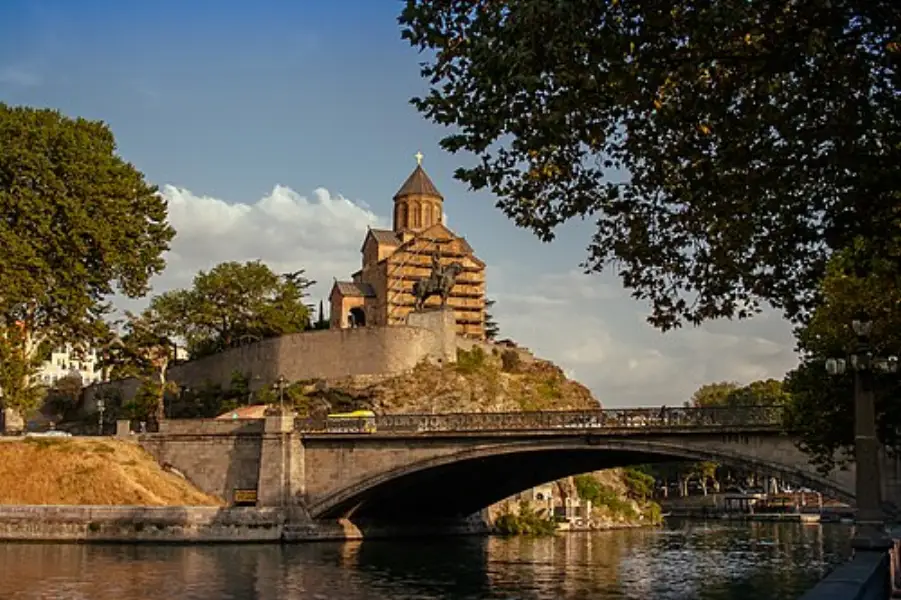
The form of the martyrdom was devised as a public test of faith. At Jalal al-Din's order, the icons of Christ and of the Virgin Mary were carried out of the Sioni Cathedral and laid upon the bridge over the Mtkvari river, so that every Christian crossing into the city was forced to choose: step on the sacred images and accept Islam, or refuse and die. The arrangement made apostasy a physical act performed in sight of the whole population, and made the bridge, traditionally identified with the Metekhi bridge of old Tbilisi, into a place of judgment. The chronicler records that those who would not profane the icons were beheaded on the spot, and the title by which the victims are remembered, the Hundred Thousand Martyrs, preserves the scale of their refusal. The Armenian historian Kirakos Gandzaketsi, writing in the thirteenth century, adds his own testimony to the campaign of compulsion, tells how the sultan's army compelled the Georgians to accept Islam, mistreated the women, tore down churches, and did away with the sign of the cross wherever it went.
§ History
The Number and the Memory
The extraordinary figure of one hundred thousand dead comes from the medieval Georgian chronicler himself, who wrote the number as at'ni bevrni, a phrase in which at'ni denotes ten and bevrni, a word that ordinarily means much or many, carries an older sense of ten thousand, derived ultimately from an Old Persian term. Whatever the exact count, the memory of the massacre became fixed in the calendar of the Georgian church, which venerates the victims as saints on 13 November, corresponding to 31 October on the old calendar. Modern Tbilisi still points to the Metekhi bridge, in the shadow of the Metekhi church, as the traditional site of the killing, and the image of Christians who would not walk over the face of Christ has remained one of the defining stories of Georgian resistance, retold whenever the country's endurance of invasion is remembered. The martyrdom stands beside the better-known martyrdom of the Dominican martyrs of the same era as a witness of a whole city rather than a single hero.
§ History
Timeline
- 1225
Jalal al-Din's army crushes the Georgians at the Battle of Garni, ending Georgia's medieval flowering
§ History
- 1226
Jalal al-Din marches on Tbilisi, driving Queen Rusudan and her court to flight
§ History
- 9 Mar 1226
His forces break into the city with help from local Muslims after a fierce defense
§ History
- 9 Mar 1226
The sack of Tbilisi begins; Christian inhabitants are massacred at the order of the sultan
§ History
- 9 Mar 1226
Icons of Christ and the Virgin are set on the Mtkvari bridge; those refusing to trample them are beheaded
§ History
In Their Own Words
Words are powerless to convey the destruction that the enemy brought: tearing infants from their mothers' breasts, they beat their heads against the bridge, watching as their eyes dropped from their skulls
The Record
- Symbols
- Icons of Christ and the Mother of God trampled at the bridge·The Metekhi bridge, site of the martyrdom
- Canonization
- Pre-congregation; commemorated in the Georgian Orthodox Church on 13 November (O.S. 31 October)
Prayer
Bibliography
Show 6 sources
- Machitadze, Archpriest Zakaria (2006). "The Hundred Thousand Martyrs of Tbilisi (†1227)". In The Lives of the Georgian Saints. pravoslavie.ru. Retrieved 2012-11-13.
- Minorsky, Vladimir. "Tiflis". In M. Th. Houtsma and E. van Donzel (1993), E. J. Brill's First Encyclopaedia of Islam, 1913–1936, p. 756. Brill. ISBN 90-04-08265-4.
- Boyle, J. A. (1968). The Cambridge History of Iran, vol. 5, p. 328. Cambridge University Press. ISBN 0-521-06936-X.
- Metreveli, Roin (ed., 2008). Kartlis Tskhovreba, p. 541. Artanuji. ISBN 978-9941-10-086-4. (in Georgian)
- Karim, Khadija (June 2024). "Dominion of Khwarazmshah Jalal al-Din and the Mongol Rule in Azerbaijan" (PDF). Reconstructing the Past: Journal of Historical Studies. 2 (2): 77–91.
- Gvozdanović, Jadranka (1992). Indo-European Numerals, p. 315. Walter de Gruyter. ISBN 3-11-011322-8.
Profile text adapted from the Wikipedia article, licensed CC BY-SA 4.0.
Pray with this saint every day
Save The Hundred Thousand Martyrs of Tbilisi to your favorites, read the full profile, and get feast-day reminders in the Saints app.
Get the Saints AppFree on the App Store for iPhone and iPad