
died 8 March 871·Feast March 8
St. Hunfrid of Prüm
The Bishop in the Storm of Thérouanne
Overview
Hunfrid of Prüm, remembered in English tradition as Saint Humphrey, was a Benedictine monk of the east Frankish empire who rose to govern a battered frontier church as bishop of Thérouanne. Born into the Carolingian aristocracy — the son of Count Alberich and Huna, with ties to the founders of Hornbach and, through them, to the future Salian emperors — he took the habit at Prüm Abbey, where he was a fellow monk of Saint Ansbald and helped bury the dying emperor Lothair I. Elected bishop of Thérouanne in 856 with the confirmation of Pope Nicholas I, he found his diocese systematically ravaged by Norse raiders sailing deep inland. At Whitsuntide the monks of Saint-Bertin were tortured and killed, and the bishop himself had to flee his city. Yet he never abandoned his flock in spirit, earning the name by which hagiography remembers him: the Bishop in the Storm. When he begged Rome to relieve him, Nicholas refused with the famous comparison of a pilot deserting his ship. Hunfrid returned, rebuilt, sold church treasures to feed his people, governed Saint-Bertin as abbot from 864, took part in the great councils of Charles the Bald's reign, and died at Prüm on 8 March 871.
The Complete Life
A Lord's Son at Prüm
Hunfrid was born into the highest rank of Carolingian society, the son of Count Alberich and his wife Huna, within an aristocratic kindred connected to the founders of the monastery of Hornbach. His brothers were named Henry, Alberich like his father, and Heriric; the last of these was nephew to Count Werner, a tie that fastened the family into the Widonid network of the Rhineland nobility. The kindred held broad lands in eastern Francia and Lotharingia, and the church career Hunfrid pursued in the west opened connections to several Carolingian kings that his relatives turned to lasting political account. Through Werner's line the family even became ancestral to the Salian dynasty, whose most famous member, Conrad II, wore the imperial crown from 1027 to 1039 — a genealogy running eleven generations from the founders of Hornbach through Otto I, Liutgard, Conrad the Red, and Otto of Worms. Hunfrid himself chose the monastic path, traveling to Prüm Abbey to take the Benedictine habit. There he lived as a fellow monk of Saint Ansbald, the future rebuilder of the house, and in 855 he stood among the brethren when the aged emperor Lothair I arrived seeking to end his days as a monk; the emperor lived only six days more, and the brothers laid him to rest in the abbey church of the Holy Saviour.
§ Family and background
Called to Thérouanne
Within a year of Lothair's burial, providence turned Hunfrid's life in an unexpected direction. Saint Folkwin, the bishop of Thérouanne in distant Gaul, died, and the choice of the church fell upon the Prüm monk — a man who, by his own account, shrank from the dignity. Despite his reluctance he was elected in 856 to succeed Folkwin, and the appointment was confirmed by Pope Nicholas I himself, placing the Rhenish aristocrat at the head of one of the northernmost dioceses of the Frankish church. He found the see in terrible condition. Norse companies had learned to row their ships far up the rivers of the low country, descending where the water carried them upon a countryside they systematically ruined: fields laid waste, towns and villages put to the torch, and church property struck with particular violence. The diocese of Thérouanne, exposed on the road between the sea and the Frankish interior, stood directly in their path. The simple monk from Prüm, ordained for contemplation, now found himself responsible for a people who were being hunted — the beginning of the trial that would give him his name in the calendar of sanctity.
§ Episcopal career
The Bishop in the Storm
The blow fell at Whitsuntide, when Northmen seized the great abbey of Saint-Bertin at Saint-Omer, plundered it, set it ablaze, and tortured to death the four monks found in charge. The raiders then attacked Thérouanne itself, and Bishop Hunfrid fled for his life. Hagiographic tradition has never denied the flight; what it honors is everything around it. In an age when a shepherd who ran might reasonably be despised, the tradition judged him by the whole of his conduct: he left his city when staying meant certain death, but he never deserted his flock in spirit. Wherever he could reach the frightened people of his diocese he brought them consolation, found shelter for those driven from their homes, and labored without pause to keep the scattered remainder of the church together while the Northmen burned on. It was in these years that he earned the title by which he is still remembered — the Bishop in the Storm. Broken and discouraged, he wrote to Pope Nicholas I asking leave to resign and return to Prüm. The pope answered with sympathy and refusal, telling him that a pilot who deserts the ship in a calm does wrong, but far worse is the one who abandons it in troubled waters. Nicholas held that his flight was justified, but ordered him to stand ready to return the moment it became possible.
§ The Bishop in the Storm
Blood on the Linen and the Councils of the Kingdom
When the raiders finally withdrew, Hunfrid came back to a ruined diocese and set about raising it from the ashes. He persuaded the people to come home, directed the rebuilding of their sanctuaries, and sold the church's own valuables so that all of them might eat. With Abbot Adelard he restored the burned monastery of Saint-Bertin, and when Adelard died the bishop was chosen to succeed him, governing the abbey from 864 while still shepherding Thérouanne. His spirituality showed itself in liturgy as much as in administration. On 15 August 862 a servant of Thérouanne, ironing his master's shirt for Mass, saw blood begin to flow from under the iron; the bishop ordered the marked garment kept in the cathedral as a relic and decreed that the Feast of the Assumption be solemnly observed as a holy day across the diocese, establishing what became a great feast of his whole province. The same pastoral energy carried him into the governance of the Frankish church at large: he subscribed the acts of the Council of Tusey against the predestination controversy, signed the charters rebuilding Saint-Martin of Tours after the Norse destroyed it, stood witness at Verberie in the affair of Bishop Rothad, and at Soissons in 866 joined the letters pleading with Rome for colleagues expelled from their sees by the same savagery he knew at home.
§ The Assumption miracle of 862
Loss, Gift, and Last Journey
Hunfrid's fidelity did not shield him from politics. In 868 King Charles the Bald stripped him of the abbey of Saint-Bertin by force, determined to install his own man, a secular canon named Hildwin. The bishop submitted and continued to serve his diocese, but the loss marked the close of his abbacy. In that same year his brother Heriric, on the eve of a Roman pilgrimage, endowed Prüm Abbey with estates at Bingen, Weinsheim, and Glan on the Nahe, seeking the salvation of his own soul and that of his brothers Hunfrid, Henry, and Alberich, together with their parents; fifty-five witnesses subscribed the charter, the bishop first among them. Not long after, Hunfrid set out on a journey of his own to Rome, to pray at the tombs of the two apostles. The road was dangerous, and he set his affairs in order beforehand, taking with him a monk named Guntbert as companion and scribe. Near Bingen on the Rhine he donated another estate to Prüm — a quiet act that bound the bishop of a French see to the abbey of his youth to the end. He did not long survive the project: on 8 March 871 he breathed his last at Prüm, three years beyond his expulsion from Saint-Bertin, far from the storm-swept diocese he had held for fifteen years.
§ The 868 gift and pilgrimage
The Saint of the Northern Coast
Veneration of Hunfrid began at once. Soon after his death in 871 he was honored as a saint, and his cult spread across northern France, taking its place beside a whole family of holy bishops of the old diocese of Thérouanne. In 1108, more than two centuries after his burial, Bishop John of Thérouanne solemnly exhumed the relics, and his head was enshrined for veneration at Saint-Omer. Other remains were carried to Ypres in 1553, but the wars of the sixteenth century were merciless: during the Eighty Years' War, anti-Spanish rebels desecrated and burned the relics in 1563, so that the saint's bodily presence in the world was largely consumed a second time. The Bollandist Acta Sanctorum, the great critical compilation of the hagiographers, documents his feast on 8 March together with the devotion of the canons of Saint-Omer to their four beloved bishops: Audomarus, commemorated on 9 September; Erkembode on 12 April; Folquin on 14 September; and Hunfrid himself. In the liturgical memory of the Pas-de-Calais he stands not as a solitary figure but as one bishop among a constellation — the storm-driven pilot whose ship, in the end, came home to harbor.
§ Death and veneration
In Glass, Gold, and Parchment
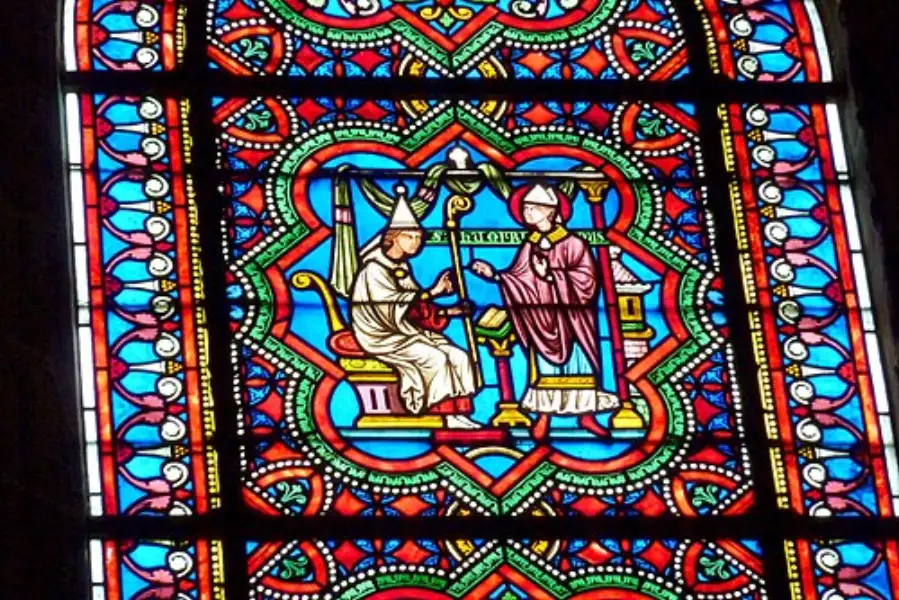
The memory of Hunfrid survives in striking material forms. A gilded reliquary casket of 1850 in Arras Cathedral, shaped like a miniature Gothic church and studded with rubies, sapphires, emeralds, and opals, carries painted panels of the four saints of Thérouanne, with Sanctus Hunfridus in the rightmost panel in episcopal vestments and halo. At Saint-Omer, a hagiographic window produced in 1872–1875 by the glazier Antoine Lusson, working from Auguste Steinheil's cartoons, shows him in the uppermost panel at the moment of his consecration as Bishop of Thérouanne, above Folquin and Erkembode; the window belongs to a protected series of five depicting the saints of the old diocese, registered by the French Ministry of Culture in 1980. An older and more unexpected monument stands in America: the luxury manuscript of the Capitulary of Quierzy now at Yale's Beinecke Library, written about 875, addressed its text to Hunfrid by name, and its illuminated initials mark a document probably prepared for Charles the Bald's own court. Scholars still debate whether it was made at Reims or Sens, but its existence proves that four years after his death the storm-bishop of Thérouanne was a name of weight in the government of the Frankish church.
§ Artistic depictions
Timeline
- 856
Elected Bishop of Thérouanne on the death of Saint Folkwin, his appointment confirmed by Pope Nicholas I
§ Episcopal career
- 857
The Capitulary of Quierzy is issued in a version addressed to him alongside counts Ingiscalc and Berengar
§ The New Haven manuscript
- 22 Oct 860
Subscribes the acts of the Council of Tusey and two charters for Saint-Martin of Tours, convened against the Norse devastation
§ Conciliar participation
- 864
Chosen Abbot of Saint-Bertin on the death of Abbot Adelard, ruling the abbey while remaining bishop
§ Return and reconstruction
- Jun 862
Signs the acts of the Council of Pîtres-Soissons and the Saint-Denis royal charter on monastic privileges
§ Conciliar participation
- 15 Aug 862
Blood miracle at Thérouanne; he decrees the Assumption a solemn holy day throughout his diocese
§ The Assumption miracle of 862
- Oct 863
Witnesses the Synod of Verberie, signing the royal judgment in the case of Bishop Rothad of Soissons
§ Conciliar participation
- 18 Aug 866
Subscribes the synodal letters to Pope Nicholas I at Soissons, appealing for bishops driven from their sees by the Norse
§ Conciliar participation
- 868
Removed by force from the abbacy of Saint-Bertin at the command of King Charles the Bald, who installs Hildwin
§ Removal from Saint-Bertin
- 868
His brother Heriric grants estates at Bingen, Weinsheim, and Glan to Prüm Abbey for the family's souls, with Hunfrid among the witnesses
§ The 868 gift and pilgrimage
- 8 Mar 871
Dies at Prüm on 8 March and is shortly venerated as a saint
§ Death and veneration
- 13 Apr 1108
His relics are solemnly exhumed at the order of Bishop John of Thérouanne
§ Death and veneration
- 1553
Relics are transferred to Ypres
§ Death and veneration
- 1563
Rebels opposed to Spanish rule destroy the relics by fire amid the Eighty Years' War
§ Death and veneration
In Their Own Words
Do you not know, dearest brother, that if it is dangerous for the pilot to desert the ship when the sea is calm, it is far worse if he abandons his post in troubled waters?
The Record
- Major works
- Decree establishing the Feast of the Assumption as a holy day throughout the Diocese of Thérouanne
- Symbols
- Holding a crozier in his left hand and a ship in his right hand
- Canonization
- Pre-congregation; venerated as a saint soon after his death in 871, with his cult spreading through northern France
Prayer
Bibliography
Show 9 sources
- Innes, Matthew (2000). State and Society in the Early Middle Ages: The Middle Rhine Valley, 400–1000. Cambridge: Cambridge University Press, pp. 218–219, 264–265.
- Butler, Alban. "St. Humphrey, or Hunfrid, Bishop of Thérouanne". Butler's Lives of the Saints, Vol. March.
- Monumenta Germaniae Historica: Concilia, Vol. 4. Munich: MGH, pp. 21, 37, 39, 114, 117, 168, 217–220.
- Annales Bertiniani, p. 61.
- Heinen, Semih (1 November 2018). "Manuscript of the Month November 2018: New Haven, The Beinecke Library, MS 413". Capitularia — Edition of the Frankish Capitularies. University of Cologne.
- Nelson, Janet L. (1986). "Legislation and Consensus in the Reign of Charles the Bald". Politics and Ritual in Early Medieval Europe. London: Hambledon Press, pp. 202–227. ISBN 978-0907628552.
- Acta Sanctorum, Vol. March 1. Brussels: Société des Bollandistes, pp. 789–792.
- Van Drival, E. (1860). Le trésor sacré de la cathédrale d'Arras.
- "Verrière hagiographique (baie 14): Scène de la vie de saint Hunfrid; Saint Folquin; Saint Erkembode". Ministère de la Culture — Plateforme Ouverte du Patrimoine.
Profile text adapted from the Wikipedia article, licensed CC BY-SA 4.0.
Pray with this saint every day
Save St. Hunfrid of Prüm to your favorites, read the full profile, and get feast-day reminders in the Saints app.
Get the Saints AppFree on the App Store for iPhone and iPad