
96 – 108·Feast July 3
St. Hyacinth of Caesarea
Child Martyr of the Court of Trajan
Overview
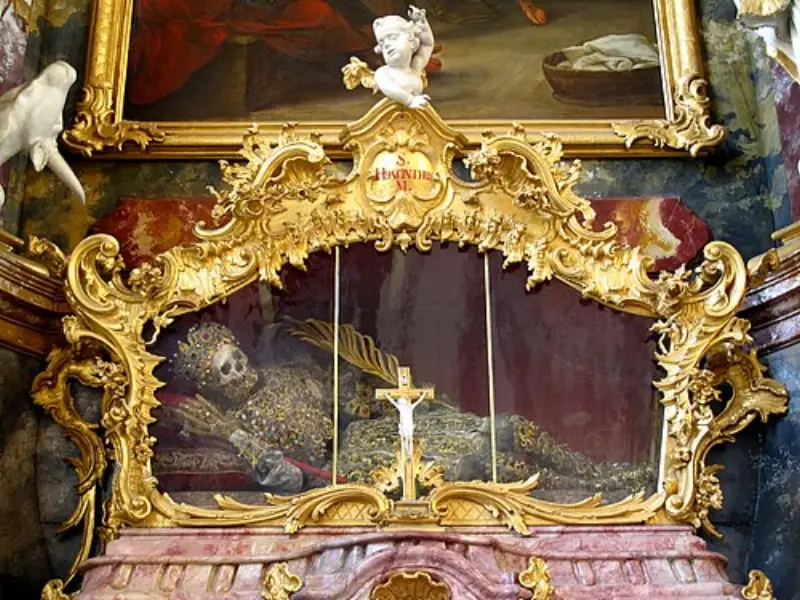
Hyacinth, in Greek Hyakinthos, was a Christian boy of the early second century whom both the Eastern Orthodox and Roman Catholic Churches honor as a martyr. Born in 96 at Caesarea in Cappadocia into a believing family, he was sent as a child to serve at the imperial court in Rome, where he was appointed assistant to the chamberlain of the emperor Trajan. His refusal to join the ceremonial sacrifices offered to the official Roman gods drew the attention of the imperial household, and when he was denounced as a Christian he confessed his faith openly. Cast into prison, he endured repeated scourgings and torments, and his jailers finally tried to break him with food: he was given nothing that had not first been blessed in sacrifice to the idols, meat which Christian law forbade him to touch. Rather than eat what had been offered to demons, the twelve-year-old chose to starve, and he died in Rome in 108. Tradition holds that his keepers saw angels at his side, comforting the dying boy and bestowing a crown upon him. His relics were later carried back to Caesarea, while a jeweled skeleton venerated as his is preserved at Fürstenfeld Abbey in Bavaria.
The Complete Life
A Boy from Caesarea
Hyacinth's story begins far from the city where he would die. He was born in 96 at Caesarea, the chief city of Cappadocia in eastern Asia Minor, today the Turkish town of Kayseri, into a family that already belonged to the Christian faith in the generations immediately after the apostles. Tradition, which is the only source for his life, relates that his family's standing made possible an extraordinary appointment: while still a boy he was brought into the palace on the Palatine to assist the chamberlain who served the emperor Trajan, one of the most powerful rulers of the ancient world. Such positions brought a captive of the provinces into the very center of Roman religious ceremony, for the imperial household lived amid a constant round of sacrifices to the gods of the state. The Acts of the Apostles had already ruled, a generation after the Council of Jerusalem, that Christians must not eat food that had been offered to idols, and it was precisely on this ground that the young Cappadocian's conscience would be put to the test before he had reached the age of a man.
§ Legend
Servant at the Imperial Court
In the palace the boy's faith declared itself quietly at first, and then unavoidably. Members of the imperial household came to notice that Hyacinth took no part in the ceremonial sacrifices offered to the official Roman gods, an omission impossible to overlook in a servant whose duties touched the emperor's own chamber. The attendance of every member of a great household at the civic rites was taken as a matter of course, and abstention read as impiety toward the gods who guarded Rome. When the boy was denounced as a Christian, he did not excuse himself, minimize his faith, or seek the shelter of his youth: he proclaimed his belief in Christ openly before his accusers. For this confession he was thrown into prison, and the authorities of the household subjected him to a long series of scourgings and tortures intended to force him back to the worship of the gods. The servant of the chamberlain had become, in the eyes of the Church, a confessor — one who had testified to Christ with his body — and the account of his passion records that neither the whip nor the dungeon moved him from his first answer.
§ Legend
The Test of Forbidden Food
The final assault on the boy came not through the whip but through the table. His jailers resolved to serve him only food that had been blessed in sacrifice to the Roman gods, knowing that the Christian law — grounded in the decree of the Council of Jerusalem recorded in the fifteenth chapter of Acts, which forbade believers to eat what had been offered to idols — placed such meat under a strict prohibition. The choice before the prisoner was stark: eat and live, or abstain and die. Hyacinth refused everything set before him, and in this way the young confessor, whom no torment had broken, was slowly starved to death in his cell at Rome, dying in the year 108 at the age of twelve. Legend tells that the jailers, watching the dying boy, were granted a sight of the truth of his confidence: angels came to comfort him and placed a crown upon his head, the martyr's crown that his tormentors could not see. The image of the child sustained by heaven while his persecutors watched has made this one of the most tender of the early Roman martyrdoms, a passion won not by sword but by an empty table and a steadfast heart.
§ Legend
Relics from Rome to Bavaria
After his death the martyr's remains were honored in Rome, and in time his relics were transferred back to the city of his birth, Caesarea in Cappadocia. Another bodily witness to his cult stands far to the north: in the church of the former Cistercian abbey of Fürstenfeld in Bavaria, still in use after the abbey itself was secularized in 1803, there rests a human skeleton encrusted with jewels, shown in a gilt case of glass bearing the inscription S. HYACINTHUS M., Saint Hyacinth the Martyr. When the body first reached Fürstenfeld, no record preserves, one of the richly dressed bodies of named early martyrs that decorated the churches of the German-speaking world. Modern writers have looked on these catacomb saints with an ambivalent eye; the art historian Paul Koudounaris has remarked that such skeletons could have been anyone in life, yet were drawn from the earth and lifted to the heights of glory. The boy of Caesarea is also to be distinguished from his namesakes: the third-century martyr Hyacinth who died around 257, and Saint Hyacinth of Poland, the medieval Dominican missionary, as well as the many places and persons called by his name — Jacinto in Spanish, Giacinto in Italian, Hyacinthe in French — that his cult has left across the map of Europe.
§ Legend
Timeline
- 96
Born at Caesarea in Cappadocia into a Christian family
§ Legend
- 108
Sent to Rome, where he serves as an assistant to the chamberlain of Emperor Trajan and is noticed for refusing the sacrifices to the Roman gods
§ Legend
- 108
Denounced as a Christian, imprisoned, and subjected to repeated scourgings and torments
§ Legend
- 108
His jailers see angels comforting him and placing a crown upon his head as he lies dying
§ Legend
- 108
Dies of starvation in Rome at the age of twelve, having refused food sacrificed to idols
§ Legend
- 1803
Fürstenfeld Abbey, keeper of a jeweled skeleton venerated as his, is secularized, though its church remains in use
§ Legend
In Their Own Words
could have been anyone, but they were pulled out of the ground and raised to the heights of glory
The Record
- Symbols
- Jewel-encrusted skeleton in a gilded glass case labeled S. HYACINTHUS M.·Angels bestowing a crown
- Canonization
- Pre-congregation; venerated since antiquity by the Eastern Orthodox and Roman Catholic Churches
Prayer
Bibliography
Show 6 sources
- "Jealousy that kills". Orthodox Church in America, Department of Christian Education.
- Watkins, Basil. The Book of Saints. London: Bloomsbury Publishing, 2015, p. 321. ISBN 9780567664150.
- "Martyr Hyacinth of Caesarea, in Cappadocia". Orthodox Church in America.
- "Saints Peter and Paul Serbian Orthodox Church".
- Flight, Tim (29 January 2019). "The World's Strangest Catholic Relics". History Collection. Retrieved 26 July 2022.
- Nuwer, Rachel (1 October 2013). "Meet the Fantastically Bejeweled Skeletons of Catholicism's Forgotten Martyrs". Smithsonian. Retrieved 26 July 2022.
Profile text adapted from the Wikipedia article, licensed CC BY-SA 4.0.
Pray with this saint every day
Save St. Hyacinth of Caesarea to your favorites, read the full profile, and get feast-day reminders in the Saints app.
Get the Saints AppFree on the App Store for iPhone and iPad