
c. 1185 – 1257·Feast August 17
St. Hyacinth of Poland
Dominican Apostle and Reformer of Poland
Overview
Hyacinth of Poland, born Jacek Odrowąż around 1185, was a Dominican priest and missionary remembered as the Apostle of the North. A nobleman of Silesia, kin to the Odrowąż family and a close relative of Blessed Ceslaus, he studied at Kraków, Prague, and Bologna, where he earned the title of Doctor of Law and Divinity before taking a prebend at Sandomierz. Accompanying his uncle Iwo Odrowąż, bishop of Kraków, on a journey to Rome, he saw a miracle worked by Dominic of Osma and joined the new Order of Preachers together with Ceslaus and two of the bishop's attendants. At Santa Sabina he was among the first students of the Dominican studium that would one day grow into the Angelicum, and in 1220 he received the habit from Dominic in person. Sent back across the Alps to plant the Order in Poland and Kyiv, he raised monastery after monastery along the road, placing his companions over them one by one until he alone walked on to Kraków. Tradition credits him with preaching through Scandinavia and the Baltic lands, into Prussia and the lands of Rus, and even to Greece and Scotland. He died at Kraków on 15 August 1257 and was canonized by Clement VIII in 1594.
The Complete Life
A Nobleman of Silesia
The future apostle of the North came into the world in comfort and rank. Born around 1185 at the castle of Lanka, near Kamień in Silesia, he was the son of Eustachius Koński, a lord of the noble House of Odrowąż, and a close kinsman of Ceslaus, who would share his religious life. The family gave him the best education the age offered: he pursued his studies in Kraków, then in Prague, and finally at Bologna, where the celebrated law schools of Italy won from him the double title of Doctor of Law and Divinity. Returning to his homeland he was provided with a prebend at Sandomierz, an administrative center of the Polish southeast — a comfortable ecclesiastical position of the kind that usually ended a career. His path turned instead on kinship: his uncle Iwo Odrowąż had become bishop of Kraków, and when the bishop traveled to Rome, his accomplished nephew went with him. In the eternal city the young doctor of laws stood within reach of a movement that would soon carry the Gospel to the ends of Europe — the Order of Preachers gathered around the Spaniard Dominic of Osma.
§ Life
The Habit from Dominic
In Rome, Hyacinth claimed to have seen a miracle performed by Dominic himself, and the sight decided his life. Together with Ceslaus and two attendants of the bishop of Kraków, Herman and Henry, he sought entry into the new order. The papacy had just given the friars a home: Honorius III invited Dominic and his followers to reside at the ancient basilica of Santa Sabina on the Aventine, which they occupied by early 1220, having previously worked from the convent of San Sisto Vecchio, granted to Dominic around 1218 as a base for the reform of the Roman nuns. Hyacinth and his three companions stood in the first company to take up residence at the convent, and their names belong to the earliest generations of students in the order's studium at Santa Sabina — the school that in time would grow into the College of Saint Thomas at Santa Maria sopra Minerva and, in the twentieth century, the Pontifical University of Saint Thomas Aquinas. After a novitiate shortened by circumstances, Hyacinth and his confrères received the habit of the Order from Dominic's own hands in 1220, a distinction few of the first generation could claim.
§ Life
Apostle of the North
The young friars were dispatched northward with a single commission: establish the Order of Preachers in Poland and Kyiv. The journey home became itself a campaign of foundations. Wherever Hyacinth and his three companions halted, a new monastery rose, and at each he left one of his confrères as superior — until, arriving within sight of Kraków, he found himself the only one still on the road. From that base his labors spread through Northern Europe, carrying the faith into country after country along the Baltic and beyond. Later tradition assigned him the conversion of Scandinavia and the Baltic coasts, of Prussia, of the Rus' lands, even of Scotland and Greece, a map so vast that sober historians hesitate: these journeys are heavily disputed and find no support in the earliest Lives of the saint. What is certain is the work at home — he labored to reform the women's monasteries of his native Poland, and the Dominican province he planted endured as one of the lasting fruits of Dominic's generation. He died at Kraków on 15 August 1257, having spent nearly four decades as a friar and become the Order's great name in the Slavic North.
§ Life
The Virgin and the Ciborium
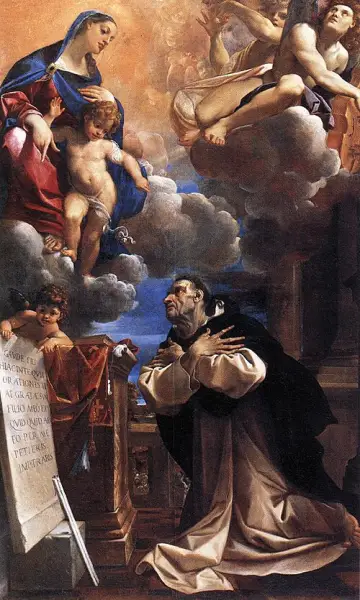
The miracle by which the whole world knows Hyacinth occurred amid the flames of a collapsing city. During the siege of Kyiv in 1240, as the friars prepared to flee the invaders, Hyacinth went to the chapel to rescue the ciborium holding the Blessed Sacrament from the tabernacle. As he lifted it, he heard the voice of Mary asking that she too be taken. The statue of the Virgin in the chapel was a massive figure of stone, far beyond his ordinary strength, yet he raised it together with the ciborium and carried both to safety without effort. The scene fixed his iconography forever: wherever his image appears, he stands holding the Mother of God in one hand and the vessel of the Eucharist in the other — represented by a monstrance, though such vessels were not yet invented in the thirteenth century. The pairing is a whole spirituality in miniature: Mary and the Sacrament, the Mother and the Bread, carried together out of the fire. Behind it stands the conviction, dear to the Dominicans from the beginning, that the preaching of the Word draws its power from devotion to the altar and confidence in the Virgin — and that grace makes light what nature finds impossible.
§ Legend
Raised to the Altars
Hyacinth was buried in the Basilica of the Holy Trinity at Kraków, the great Dominican church of the city, where his tomb rests in a chapel dedicated to his memory. Veneration of the apostle of the North grew steadily among the Poles, the Lithuanians, and the peoples his friars had evangelized, and more than three centuries after his death the Church passed its judgment: on 17 April 1594 Pope Clement VIII enrolled him among the saints. His feast was fixed on 17 August, close to the anniversary of his death, and Dominican churches from Kraków to Quito took up his cult. In 1686 Pope Innocent XI added a formal patronage, naming him protector of Lithuania, the Grand Duchy whose lands bordered the mission field of his lifetime; popular devotion added more, seeing in the saint who carried the Eucharist through flood and fire a helper of those in danger of drowning, and even a patron of those who labor with their strength. On the colonnade of Saint Peter's Square his statue stands among the founders and missionaries of the Church, the nobleman from Silesia who gave the North its Dominican inheritance.
§ Veneration
The Saint of the Pierogi
No Polish saint is loved in a homelier key than Hyacinth. Two legends bind him to the pierogi, the filled dumplings of the Polish kitchen. In July 1238, visiting the village of Kościelec, he found the people ruined by a hailstorm that had flattened their crops and left famine at the door; he told them to pray, and the next morning the fields stood restored, whereupon the villagers cooked pierogi from the rescued grain in gratitude. A second legend has him feeding the starving with pierogi during the hunger that followed the Mongol invasion of 1241. From these tales grew the old Polish cry of the desperate — Święty Jacku z pierogami!, Saint Hyacinth with his dumplings! — an exclamation still understood wherever Polish is spoken. His memory remains built into the calendar of his homeland: Kraków opens its annual Pierogi Festival on his feast day of 17 August, and the victor carries home a statuette of the saint. Across the Atlantic, the Basilica of Saint Hyacinth in Chicago stands among the great churches his Polish emigrants raised in his honor, keeping the apostle of the North at the heart of the diaspora.
§ In culture
Timeline
- 1185
Born c. 1185 at the castle of Lanka near Kamień, in Silesia, into the noble Odrowąż family, his father being Eustachius Koński
§ Life
- 1220
Enters the convent of Santa Sabina in Rome with the first community Pope Honorius III settled there
§ Life
- 1220
Receives the habit of the Order of Preachers from Dominic himself after a shortened novitiate
§ Life
- 13 Jul 1238
At Kościelec his prayer restores crops destroyed by a hailstorm; the grateful people offer him pierogi
§ Legend
- 1240
During the siege of Kyiv he carries the ciborium and a heavy stone statue of the Virgin to safety
§ Legend
- 1241
In the famine that follows the Mongol invasion he is said to feed the hungry with pierogi
§ Legend
- 15 Aug 1257
Dies at Kraków on 15 August
§ Life
- 17 Apr 1594
Canonized by Pope Clement VIII on 17 April
§ Veneration
- 1686
Pope Innocent XI declares him a patron of Lithuania
§ Veneration
The Record
- Major works
- Foundation of the Dominican Order in Poland and Kyiv·Reform of the women's monasteries of Poland
- Patron of
- Lithuania·Those in danger of drowning·Weight lifters
- Symbols
- Statue of the Blessed Virgin Mary·Monstrance or ciborium
- Canonization
- Canonized 17 April 1594 by Pope Clement VIII
Prayer
Bibliography
Show 10 sources
- Stracke, Richard (2015-10-20). "Saint Hyacinth: The Iconography". Christian Iconography.
- Mershman, Francis (1910). "St. Hyacinth". The Catholic Encyclopedia. Vol. 7. New York: Robert Appleton Company.
- Fabyan Windeatt, Mary (2009). St. Hyacinth of Poland. Charlotte, North Carolina: TAN Books. ISBN 978-0895554222.
- "Ostensorium (Monstrance)". Catholic Encyclopedia.
- "St. Hyacinth". Saints.SPQN.com. 2008-12-26.
- "Św. Jacku z pierogami". Gazeta Wrocławska (in Polish). 2009-08-21.
- "O cudach św. Jacka, który karmił krakowian pierogami". Gazeta Krakowska (in Polish). 2013-08-15.
- DiPippo, Gregory (2011-08-17). "The Dominican Church of the Holy Trinity in Krakow". New Liturgical Movement. Retrieved 2011-10-18.
- "20th Pierogi Festival". Kraków Travel. Retrieved 24 October 2024.
- "Pierogi Fest". Cruising Kraków. Retrieved 24 October 2024.
Profile text adapted from the Wikipedia article, licensed CC BY-SA 4.0.
Pray with this saint every day
Save St. Hyacinth of Poland to your favorites, read the full profile, and get feast-day reminders in the Saints app.
Get the Saints AppFree on the App Store for iPhone and iPad