
1585-1640·Feast January 30
St. Hyacintha Mariscotti
Franciscan Sister of Viterbo Who Turned from Luxury to the Poor
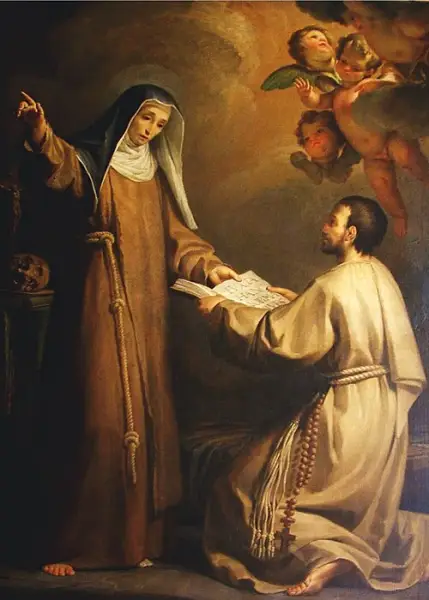
Overview
Hyacintha Mariscotti, baptized Clarice into the noble Marescotti family of Vignanello, spent her youth drawn more to worldly comfort than to the piety of her earliest years. Educated at the Franciscan Third Order monastery of St. Bernardino in Viterbo, she entered that community herself at twenty, after the marchese she had hoped to marry chose her younger sister instead. She later admitted that she took the veil chiefly to hide her disappointment, and for a decade she lived comfortably, hoarding private food, wearing a habit of fine cloth, and coming and going as she pleased, all while keeping a genuine faith and a tender devotion to the Virgin Mary. A severe illness brought her confessor to her cell, and the luxuries he found there moved him to summon her to fidelity to her vows. His rebuke changed her completely: she exchanged her costly clothes for an old tunic, went barefoot, fasted on bread and water, and kept long vigils. When plague struck Viterbo she nursed the sick so devotedly that her renown spread, and she founded two confraternities, the Sacconi, to aid convalescents, prisoners, the shy poor, and the aged. She died at Viterbo on 30 January 1640.
The Complete Life
A Noble Childhood in Vignanello
The child baptized Clarice was born into one of the great houses of the Roman border country. Her father, Count Marcantonio Marescotti, traced his line to Marius Scotus, a military commander who had served the Emperor Charlemagne; her mother, Countess Ottavia Orsini, came from a family whose forebear had created the celebrated Gardens of Bomarzo. While still young, Clarice was sent with her sisters Ginevra and Ortensia to the Monastery of St. Bernardino, where the sisters of the Franciscan Third Order Regular undertook the girls' education. In early youth she was remarked for her piety, and her family could reasonably hope for a holy future for her. Yet as she grew toward womanhood her character changed: she became frivolous and worldly. Neither an education within a monastic cloister nor an escape from death at seventeen that those around her judged almost miraculous sufficed to root her early devotion again. Her elder sister Ginevra, by contrast, chose to remain at the monastery after her studies, entering the community as a religious sister under the name Immacolata, and so the household already knew the path Clarice would one day take.
§ Life
An Entrance Chosen Through Disappointment
At twenty Clarice fixed her hopes on marriage with the Marchese Capizucchi, but he passed her over in favor of her younger sister Ortensia. Stung by the slight, she entered the Viterbo house that had once schooled her, and in religion took the name Hyacintha. Honesty about her own motives marked her later years: she admitted that she had taken the veil only to conceal her chagrin and that she had no intention of surrendering the luxuries of the world she had known. For ten years she lived in a way quite contrary to the spirit of her vows. She kept a hidden stock of delicacies against the common table, dressed in cloth far finer than her state allowed, and received callers and paid visits whenever she pleased. And yet the picture is not simply one of lukewarmness. Through all those years she held to a strong faith, followed the daily round of monastic life with regularity, and cherished a tender devotion to the Virgin Mary. Her vocation, half-heartedly embraced, waited for the hour that would turn it entirely to God. Her sister's marriage had wounded her pride, and the cloister became, at first, a place in which to nurse it.
§ Life
Nursing the Plague-Stricken and Founding the Sacconi
Hyacintha's penance soon overflowed into charity. When plague broke out in Viterbo she won renown for the tireless care she gave its victims, entering houses that contagion and dread had emptied of other helpers. Out of this service grew two confraternities whose members came to be called the Oblates of Mary, or the Sacconi. One of these bodies, resembling in its aims the later Society of St. Vincent de Paul, collected alms destined for the convalescent, for the poor whose shame barred them from begging, and for those held in prison; the other found housing for the elderly, giving a roof to men and women at the end of life who had no one left to care for them. The range of her concern is striking: the recovering sick, the hidden poor, captives, and the elderly. Her foundation work gave the wealthy and comfortable of Viterbo a structured way to serve those they would otherwise never have met, and it bound her own converted energy permanently to the corporal works of mercy. The Sacconi gave Viterbo's faithful a lasting instrument of charity, one that outlived Hyacintha herself and kept her name joined to the works of mercy for centuries after her death.
§ Life
Conversion at the Hands of a Sick Confessor
The turning came through an illness, and not her own. The priest who served as confessor to the monastery fell gravely sick, and even from that bed of weakness he came to her cell carrying Holy Communion himself. What he found there shocked him: a display of luxuries unfitting for a bride of Christ in a Franciscan house. What he found there shocked him: a display of luxuries unfitting for a bride of Christ in a Franciscan house. He admonished her to keep faith with the profession she had made. The rebuke struck home, and Hyacintha's change was total. She gave away her costly garments and clothed herself in an old tunic. She abandoned shoes altogether, ate little beyond bread and water, and wore out the night hours in watchfulness. The woman who had guarded her comforts now embraced voluntary hardship with the same energy she had once spent on elegance. Her earlier devotion to Mary, which had survived the years of laxity, now animated a rigorous penitential spirit. Her conversion embodies the Franciscan conviction that no fall is final and that a genuine turning of the heart shows itself at once in concrete renunciation, visible simplicity, and unremitting prayer.
§ Life
A Death Marked by the People's Love
By the time death came, on 30 January 1640, Hyacintha's reputation for holiness among the people of Viterbo was immense. At her wake, the evidence of that love took an extraordinary form: her religious habit had to be changed three times over, so many were the mourners cutting off pieces to treasure as relics. The instinct of the crowd is the surest verdict on her life. The sister who had once entered the cloister in wounded pride, dressed in fine cloth, died clothed in the memory of years of service to the sick, the poor, and the imprisoned. She was fifty-four years old, and the last period of her religious life had been a living proof that the cloister can forgive and even welcome its own failures. Her body was laid to rest in Viterbo, where the tomb of the saint would soon become a place of recourse for the faithful and, in time, the center of her enduring cult. Viterbo understood at once what it had lost: the crowds at her wake treated her as a saint already, and the relics they cut from her habit were the first fruits of a devotion that has never ceased.
§ Life
From Beatification to the Altars of the Universal Church
Recognition followed the people's verdict. In 1726, less than a century after her death, Pope Benedict XIII beatified Hyacintha in Rome, the capital of the Papal States that had enclosed her whole earthly life. Eight decades later, on 14 May 1807, Pope Pius VII canonized her, again in Rome, enrolling the Franciscan sister among the saints of the universal Church. The intervals between death, beatification, and canonization tell their own story: a local Viterbo devotion that never faded through the eighteenth century, tested and confirmed by two successive pontificates across a turbulent age for Italy. Today she is honored in the Catholic Church as a virgin of the Third Order Regular of St. Francis, listed among the long line of Franciscan women whose holiness flowered within the penitential tradition of the seraphic founder. Both stages of her elevation took place in the same city where the popes reside, binding her canonization history permanently to the see of Peter. The cause moved through the ordinary stages of the Roman process, sustained by the unbroken devotion of Viterbo and of the Franciscan family that claims her among its chief glories.
§ Veneration
The Saint of Viterbo Whose Name the Church Still Bears
The church of Hyacintha's old monastery in Viterbo keeps her body today as an object of veneration, a house no longer a monastery but now bearing the saint's own name. There the faithful may still pray before the body of the woman whom the crowds of 1640 had already treated as a saint. Her feast is kept on 30 January, the anniversary of her death, and she stands in the catalogue of virgin saints of the Catholic Church alongside figures from Cecilia to Faustina Kowalska. For the Franciscan Third Order Regular she remains a particular glory: proof that the observance her order professes can be embraced late, after failure, and still reach heroic measure. For the city of Viterbo she is a local patron whose confraternities kept her works of mercy alive in institutional form. Her story continues to speak to anyone whose vocation began in mixed motives and who wonders whether such a beginning can end in sanctity. Her life answers that it can, decisively and completely. Few saints of her century offer so clear a proof that holiness depends less on the purity of a beginning than on the completeness of a turning.
§ Veneration
Timeline
- 16 Mar 1585
Born at Vignanello in the Province of Viterbo and baptized Clarice.
§ Life
- 30 Jan 1640
Died at Viterbo with a reputation for holiness so great that mourners cut her habit to pieces for relics.
§ Life
- 1726
Beatified in Rome by Pope Benedict XIII.
§ Veneration
- 14 May 1807
Canonized in Rome by Pope Pius VII on 14 May.
§ Veneration
The Record
- Major works
- Two confraternities in Viterbo whose members were called the Oblates of Mary or 'Sacconi': one gathered alms for convalescents, for the poor ashamed to beg, and for prisoners; the other procured homes for the aged
- Canonization
- Beatified in 1726 by Pope Benedict XIII in Rome; canonized on 14 May 1807 by Pope Pius VII in Rome
Prayer
Bibliography
Show 3 sources
- Mershman, Francis. "St. Hyacintha Mariscotti." The Catholic Encyclopedia, Vol. 7. New York: Robert Appleton Company, 1910.
- Foley, Leonard, OFM. "St. Hyacintha of Mariscotti." Saint of the Day. Franciscan Media.
- Herbermann, Charles, ed. (1913). "St. Hyacintha Mariscotti." Catholic Encyclopedia. New York: Robert Appleton Company.
Profile text adapted from the Wikipedia article, licensed CC BY-SA 4.0.
Pray with this saint every day
Save St. Hyacintha Mariscotti to your favorites, read the full profile, and get feast-day reminders in the Saints app.
Get the Saints AppFree on the App Store for iPhone and iPad