
c. 664 - c. 690·Feast September 18
St. Hybald
Seventh-Century Abbot and Hermit of Lindsey
Overview
Hybald, also recorded as Higbald, Hibald or Hygbald, was a seventh-century Anglo-Saxon abbot and hermit whose recorded activity runs from about 664 to about 690. The Venerable Bede, in his Ecclesiastical History, commended Hybald as an abbot in Lindsey of outstanding holiness and self-mastery, a man continent above his fellows. Scholars writing in the Dictionary of Christian Biography conjectured that his monastery was the Benedictine house at Bardney. He counted Saint Chad among his friends and, by tradition, was granted a prophetic vision of that bishop's death; afterward he followed Chad's example and withdrew to the eremitical life. He died around 690 and was buried at the Lincolnshire village that still preserves his name, Hibaldstow, 'the place where St Hygbald is buried.' A shrine raised near his grave drew pilgrims until the English Reformation destroyed it. When the ruined church was rebuilt in 1864, workmen came upon an early stone coffin holding the bones of a man of powerful build, a crozier lying beside them, and these were judged to be very probably his. Three further Lincolnshire churches, at Ashby de la Launde, Manton, and Scawby, are dedicated to him.
The Complete Life
The Abbot Whom Bede Remembered
Everything certain about Hybald rests on a single line of the Venerable Bede, who in his Ecclesiastical History describes him as a most holy and continent man holding office as an abbot in Lindsey. That kingdom, covering much of modern Lincolnshire, had its great spiritual center at Bardney, and the Dictionary of Christian Biography, published in the late nineteenth century, conjectured that this Benedictine abbey was Hybald's own monastery. If so, he governed a house with a storied past: it was at Bardney in 679 that Osthryth, queen of Mercia, sought to enshrine the relics of her uncle St. whom the monks initially would not admit, since Oswald had once conquered their kingdom, until a beam of light appearing over the body in the night changed their minds. Hybald's personal sanctity was bound up with the circle of Saint Chad, the apostle of Mercia, whose follower he was. He enjoyed the friendship of that holy bishop and, according to the tradition recorded of him, was granted a prophetic vision foretelling Chad's death, a sign of the intimacy in prayer the two men shared.
§ Life and legacy
Death, Burial, and the Village That Keeps His Name
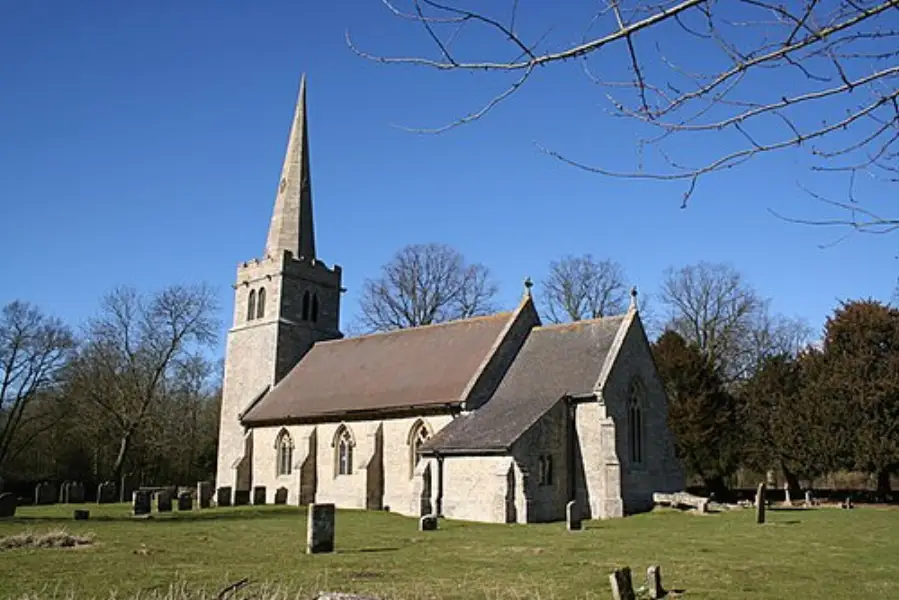
Hybald followed his friend Chad's example in the end, leaving behind the ordinary structures of monastic life to live as a hermit, and he died around the year 690. He was buried in a Lincolnshire village whose very name is his monument: Hibaldstow, meaning the place where St Hygbald is buried. After his canonization a shrine was built near the grave to house his relics, and it became a goal of pilgrimage, drawing the faithful for the better part of a millennium until the English Reformation brought the shrine's destruction. Remarkably, the saint's body itself remained undisturbed beneath the parish church. When the building's dilapidated chancel was rebuilt in 1864, workmen uncovered an early stone coffin in which lay the bones of a strongly built man, and beside them a crozier, the staff of a churchman. The heritage record of the find remarks that these were very likely the bones of St. Hibald himself, the man named by Bede. Hardly any Anglo-Saxon saint can point to so direct a line from a seventh-century burial to a modern discovery. The crozier in the coffin argued that the grave was that of an abbot or bishop, precisely as Bede had said.
§ Life and legacy
Churches and Feasts of a Lincolnshire Saint
Hybald's memory endures in the landscape of Lincolnshire. Besides Hibaldstow itself, three parish churches are dedicated to him: at Ashby de la Launde, at Manton, and at Scawby, each a medieval witness to a cult that flourished wherever his name was carried. The great church at Hibaldstow, destroyed and rebuilt across the centuries, still stands over the grave that gave the village its name, and the discovery of 1864 gives the tradition unusually concrete support in the form of a stone coffin and a crozier. Liturgically he is kept on 18 September in the Catholic West, while the Orthodox calendar remembers him on 14 December, a double observance reflecting his veneration on both sides of the old division between the churches. His standing rests finally on the testimony of Bede, the most reliable of all Anglo-Saxon witnesses, who judged this one abbot of Lindsey worth naming in the Ecclesiastical History as holy and continent. For the pilgrim, the rebuilt church at Hibaldstow remains a place to stand where the saint's bones were found. In the gap between Bede's two lines, Hybald stands for the unnamed holiness of the early English church, remembered wherever he was loved.
§ Life and legacy
Timeline
- 664
Traditional birth date, recorded as about 664; the same year Saint Chad, whose follower he became, died.
§ Life and legacy
- 690
Died around this year and was buried at the Lincolnshire village of Hibaldstow, whose name preserves the memory of his grave.
§ Life and legacy
- 1864
When the ruined church at Hibaldstow was rebuilt in 1864, workmen found a stone coffin with the bones of a strongly built man and a crozier beside them, almost certainly his.
§ Life and legacy
In Their Own Words
most holy and continent man who was an abbot in Lindsey
The Record
- Canonization
- Pre-congregation; venerated as a saint from the medieval period in both the Catholic and Eastern Orthodox Churches
Prayer
Bibliography
Show 5 sources
- Farmer, David. The Oxford Dictionary of Saints, Fifth Edition Revised. Oxford: Oxford University Press, 2011, p. 84.
- Bunson, Matthew and Stephen Bunson. Our Sunday Visitor's Encyclopedia of Saints. Huntington: Our Sunday Visitor Publishing, 2003, p. 404.
- Bede. Ecclesiastical History of the English People, Book III.11; trans. Leo Sherley-Price, Penguin Classics, 2008, p. 160.
- Historic England. "St Hybalds, Hibaldstow (63488)." Research records (formerly PastScape). Retrieved 23 March 2013.
- "CatholicSaints.Info - Blog Archive - Saint Hygbald."
Profile text adapted from the Wikipedia article, licensed CC BY-SA 4.0.
Pray with this saint every day
Save St. Hybald to your favorites, read the full profile, and get feast-day reminders in the Saints app.
Get the Saints AppFree on the App Store for iPhone and iPad