
died 326·Feast March 31 (Eastern Orthodox); November 14 (Roman Catholic)
St. Hypatius of Gangra
Hieromartyr Bishop of Gangra and Wonderworker
Overview
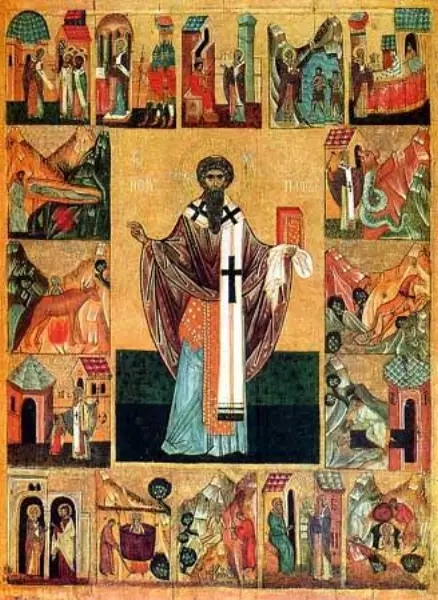
Hypatius of Gangra was a titular bishop of Gangra, a city of Asia Minor that lies in modern Turkey, and one of the hieromartyrs of the age of the first councils. He took part in the First Ecumenical Council, standing beside Saint Athanasius the Great in opposition to the Arian heresy that threatened to divide the Church. Very little is recorded of his life, but the manner of his death fixed his memory. one of the women in the attacking band crushed his skull with a stone and dealt the mortal blow. Tradition relates that she went mad immediately afterward, striking herself with the same stone, and recovered only when she was brought to the saint's grave. Christians found his body, and the people of Gangra buried their beloved archpriest. His relics soon became famous for numerous miracles, and for this reason he is invoked as a Wonderworker. The Church honors him as a hieromartyr, and his feast is kept by East and West alike in thanksgiving for a witness that cost him his life.
The Complete Life
A Bishop at the First Council
Hypatius shepherded the church of Gangra, an important city of Asia Minor, as its bishop, and his title to remembrance rests chiefly on the great assembly in which he shared. He was present at the First Ecumenical Council, the gathering summoned to answer the Arian teaching that the Son of God was a creature rather than coeternal with the Father. There Hypatius took his place among the defenders of the Nicene faith, supporting Saint Athanasius the Great against the Arian party. To stand with Athanasius in those years was to accept obloquy, exile, and danger, since the Arian cause enjoyed long stretches of imperial favor and its opponents paid repeatedly for their firmness. Whatever else his episcopate contained, this single recorded choice identifies Hypatius as a confessor of the divinity of Christ, willing to hold the dangerous line when many wavered. His flock in Gangra knew him as their beloved archpriest, and the fidelity he showed at the council was the same fidelity he would carry to its final consequence on the road home. For a bishop of a modest Anatolian see, a place in that assembly was itself a mark of the esteem in which he was held.
§ Hypatius of Gangra
Martyrdom on the Road from Constantinople
The sources preserve little of Hypatius's daily life as a bishop, but they record his death in detail. In the year 326, journeying from Constantinople toward Gangra, he fell into an ambush in a desolate stretch of the road. His attackers were followers of Novatus and Felicissimus, men of the rigorist and divisive movements that troubled the early Church, and they treated the bishop with brutality: they threw him into a muddy swamp, and one of the women among them picked up a rock and struck him on the head, delivering the blow that killed him. The narrative then takes a turn the tradition clearly intends as judgment and mercy at once. The woman immediately went mad and began beating herself with the same stone, and she regained her sanity only when her companions brought her back to the tomb of the saint she had slain. Some Christians found the bishop's body where it had been left and hurried to the city of Gangra to report what had happened. Tradition has kept the details of that final journey with unusual precision, down to the swamp into which the bishop was thrown.
§ Death
The Wonderworker of Gangra
The inhabitants of Gangra came out from their city and buried the man they called their beloved archpriest, and from his tomb his cult spread at once. The relics of Hypatius became famous for numerous miracles, so many and so celebrated that the Church gave him the title Wonderworker, an epithet reserved for saints whose intercession was manifestly powerful. The story of the woman healed at his grave after her madness set the pattern: the martyr's remains were not a mute memorial but a place where the broken were made whole, and the afflicted sought them out accordingly. His veneration took firm root in both the great traditions of Christianity. The Eastern Orthodox Church celebrates him on March 31, recording his feast in the Great Synaxaristes, while the Roman Catholic Church keeps his memory on November 14. In later centuries his name attached itself to the Hypatian Monastery, where a fifteenth-century Russian icon of the saint testifies to the reach of his cult far beyond the city of his see and martyrdom. The healing of his assailant at the tomb became the emblem of his cult: the martyr's power, exercised in mercy upon his own attacker.
§ Death
The Record
- Canonization
- Pre-congregation; honored as a hieromartyr from the early centuries
Prayer
Bibliography
Show 3 sources
- Great Synaxaristes. "Ὁ Ἅγιος Ὑπάτιος ὁ Ἱερομάρτυρας Ἐπίσκοπος Γαγγρῶν. 31 Μαρτίου." ΜΕΓΑΣ ΣΥΝΑΞΑΡΙΣΤΗΣ (in Greek).
- "Saints.SQPN: Hypatius of Gangra."
- "Catholic Online: Hypatius of Gangra."
Profile text adapted from the Wikipedia article, licensed CC BY-SA 4.0.
Pray with this saint every day
Save St. Hypatius of Gangra to your favorites, read the full profile, and get feast-day reminders in the Saints app.
Get the Saints AppFree on the App Store for iPhone and iPad