
late 5th - 6th century·Feast Unknown
St. Hywel the Great
Legendary Breton Prince and Welsh Patron Saint
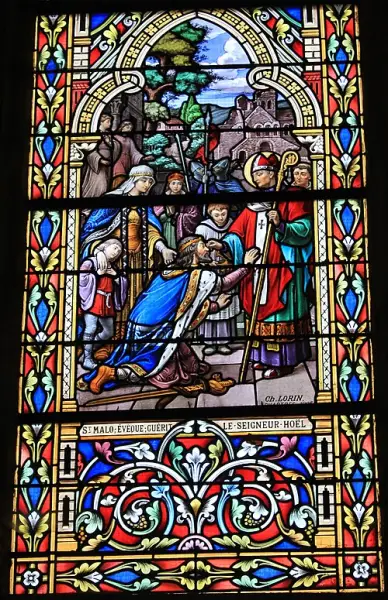
Overview
Hywel the Great, remembered in Breton as Hoel I Mawr, in Latin sources as Hoelus or Hovelus, and in later romance as Sir Howel, was a late fifth- and early sixth-century member of the ruling dynasty of Cornouaille in Brittany. The historical Hywel was a son of Budic II, king of Cornouaille. through nearly all that time an usurper from the wider kin occupied Budic's throne, and the exiled household lived at the Dyfed court of King Aergol Lawhir in Britain. Restored to Brittany, he may have ruled Cornouaille jointly with his father, but he appears to have predeceased Budic, leaving his young son Tewdwr as heir. In Welsh tradition and the Matter of Britain he grew into a king of Brittany, kinsman and most loyal ally of Arthur, credited with helping him conquer Gaul, and finally a Knight of the Round Table. Geoffrey of Monmouth fixed him in this role, and the Tristan romances made him father of Iseult of the White Hands.
The Complete Life
A Childhood of Exile in Dyfed
The historical Hywel was born into the royal house of Cornouaille, the Breton realm in the northwest peninsula of Gaul, as a son of Budic II. through nearly all of his boyhood an usurper from the wider kin occupied the throne, and the exiled household lived across the channel at the court of Aergol Lawhir in Dyfed. Exile in southwestern Wales shaped the saint's earliest legend. It was during this period, the sources relate, that Hywel was credited with founding the church of Llanhowell, now within the parish of Llanrhian in Pembrokeshire, and it was there, as Saint Hywel, that a local cult came to venerate him as its patron, the only part of Britain where his memory took root as a saint rather than a king. The pattern is a familiar one in the Celtic world: a prince of one shore, stranded on another, leaves behind a dedication that outlives every chronicle of his reign. Whatever else his life held, the church at Llanhowell is the one foundation history confidently assigns to him. The cult that grew at Llanhowell looked back to these years of exile, when the prince far from home became the churchman of another people.
§ Life
Heir of Cornouaille and Joint Ruler
The family's fortunes eventually turned, and Budic II was restored to his home in Cornouaille, with Hywel at his side. In the restored kingdom Hywel may have shared rule with his father, a joint reign that would have prepared him for the throne of one of Brittany's principal realms. He never exercised it alone: the sources indicate that he seems to have died before the succession could pass to him, cutting short the career that the title Hoel I Mawr, Hoel the Great, preserves. His death left a young son, Tewdwr, as Budic's heir, and the boy's inheritance proved fragile. Budic sought the support of his neighbor Macliau for Tewdwr's succession, but the arrangement ended badly; after Budic's death Macliau invaded, and Tewdwr was forced into exile in Penwith, at the far tip of Cornwall. Thus the historical Hywel belongs to that somber class of saints whose sanctity was fixed in a life of disruption, an heir who never reigned, a founder without a monastery, a father whose son lost all that had been gathered for him. In the genealogies his line continued through Tewdwr, carrying the blood of Cornouaille's kings into later Welsh history.
§ Life
The Cult of Saint Hywel in Wales
Hywel's veneration is tied to the land of his exile rather than the kingdom of his birth. Llanhowell in Llanrhian, Pembrokeshire, bears his name to this day, and its parish church, Eglwys Llanhywel, is the visible monument of his cult. it carries a Grade II* listing, a status given only to buildings of particular importance. A second Welsh dedication, Llanllowell in Monmouthshire, was originally ascribed to him as well, though it is now considered dedicated to Saint Llywel instead. Modern students of the Welsh saints have kept his memory alive in scholarship: Sabine Baring-Gould and his collaborators devoted pages of The Lives of the British Saints to him in 1908, and his cult is registered in the standard repertories of British dedications. He remains one of those saints whose historical outline is faint but whose parish, porch, and listed church still anchor him firmly in the landscape. Whatever the historicity of the founder, the dedication has kept his name in daily speech on the Pembrokeshire coast for a thousand years. In the liturgical calendars his name stands beside the other saints of the Welsh and Breton churches, honored most of all where his church still stands.
§ Legacy
Hoel the Great in Arthurian Legend
If history gave Hywel little space, legend gave him a kingdom. In Welsh mythology and the Matter of Britain he appears as a king of Brittany and a relative of Arthur, sometimes his nephew, sometimes his cousin, and always among the king's most loyal allies, credited with helping him conquer Gaul. Early Welsh tradition records his campaigns in Arthur's company: landing at Southampton, his army assisted at the Battle of Dubglas, at the Siege of Caer Ebrauc, which is York, and at the Battle of Cat Celidon Coit, before being besieged in its turn at Dumbarton Castle. He was said to have fought at Mount Badon and then to have conquered France for Arthur, who moved his court to Paris. He was made one of Arthur's knights, Sir Howel of the Round Table, in the Welsh tales The Dream of Rhonabwy, Peredur son of Efrawg, and Geraint and Enid. The Tristan romances of Beroul and Thomas of Britain made him duke of Brittany and father of Iseult of the White Hands, the wife Tristan married for her name. History gave him one foundation; romance gave him a kingdom; between the two, the parish by the Pembrokeshire sea still keeps his memory.
§ Legend
Timeline
- 1136
Geoffrey of Monmouth's pseudohistorical History of the Kings of Britain, written about 1136, fixed Hywel's place in the Arthurian story.
§ Legend
- 1908
Baring-Gould and his collaborators treated his cult in The Lives of the British Saints, volume III.
§ Legacy
- 2001
David Nash Ford's essays on Hywel and his family appeared at the Early British Kingdoms website.
§ References
The Record
- Major works
- Foundation of Llanhowell (now in Llanrhian), Pembrokeshire, during his exile in Dyfed
- Patron of
- Llanhowell (Llanrhian), Pembrokeshire
- Canonization
- Pre-congregation; revered by a local cult as patron saint of Llanhowell in Pembrokeshire
Prayer
Bibliography
Show 7 sources
- Ford, David Nash. "Hoel I Mawr." Early British Kingdoms, 2001. Retrieved 1 December 2014.
- Ford, David Nash. "Tewdwr Mawr." Early British Kingdoms, 2001. Retrieved 1 December 2014.
- Ford, David Nash. "Budic II." Early British Kingdoms, 2001. Retrieved 1 December 2014.
- Geoffrey of Monmouth, translated by Lewis Thorpe. The History of the Kings of Britain. London: Penguin Books, 1966. ISBN 0-14-044170-0.
- Curtis, Renée L. (trans.). The Romance of Tristan. Oxford: Oxford University Press, 1994. ISBN 0-19-282792-8.
- Baring-Gould, Sabine, et al. The Lives of the British Saints: The Saints of Wales and Cornwall and Such Irish Saints as Have Dedications in Britain, Vol. III, pp. 288 f. London: Chas. Clark, 1908.
- British Listed Buildings. "Church of St Hywel, Llanhowell, Llanrhian."
Profile text adapted from the Wikipedia article, licensed CC BY-SA 4.0.
Pray with this saint every day
Save St. Hywel the Great to your favorites, read the full profile, and get feast-day reminders in the Saints app.
Get the Saints AppFree on the App Store for iPhone and iPad