
c. 450 - c. 540·Feast June 6
St. Iarlaithe mac Loga
Founder of the School of Tuam and Patron of the Archdiocese
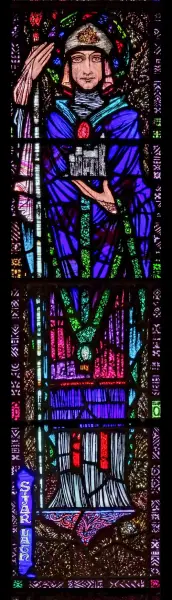
Overview
Iarlaithe mac Loga — anglicized as Jarlath — was an Irish priest and scholar of Connacht, remembered as the father of the School of Tuam and as the founding saint of its archdiocese. He belonged to the Conmhaicne, the people who ruled most of what became the parish of Tuam, and died full of days on 26 December, around the year 540, at about ninety years of age. No medieval biography of him survives; his life must be assembled from genealogies and martyrologies, from the Irish Lives of Brendan of Clonfert, and from the memoir John Colgan compiled in the seventeenth century. These sources tell of a student of St Benignus at Kilbennen, the founder of a first monastery at Cluainfois near Tuam, and a man who in mid-life left his own foundation to study under Enda of Aran before retiring at last to Tuam, where the wheel of his chariot broke. His monastic school drew scholars from all parts of Ireland, among them Brendan of Ardfert and Colman of Cloyne. In a poem credited to Cuimmín of Coindeire his generosity and life of prayer are praised — three hundred genuflexions by night and three hundred by day — and the Orthodox synaxaria credit his asceticism with the gift of prophecy.
The Complete Life
Two Saints Named Jarlath
Two saints of the name stand in the Irish genealogies: Jarlath son of Lugh (Iarlaithe mac Loga), the founder of Tuam, and, secondly, Jarlath son of Trian, a bishop of Armagh. The founder of Tuam is said to have been one of the Conmhaicne, the people who held most of the ground on which the parish of Tuam would later stand, while the other is placed among the Dál Fiatach of east Ulster and set down as Armagh's third bishop, following Patrick's heir Benignus, with the Annals of Ulster and Innisfallen recording his death in the year 481. In the two medieval Irish Lives of Brendan, the pedigree of the founder of Tuam is traced through Lug, Trén, Fiacc, and Mochta, with the Lismore copy of that First Life carrying the line still further back. Because both Lives substitute one ancestor for another, Séamus Mac Mathúna judges that they descend from a lost original that had merged the genealogies of the two men. Dónall Mac Giolla Easpaig goes further, suggesting the two Jarlaths might even be one and the same person, since each appears in the sources as third bishop of Armagh, and placename evidence from the Tuam area points to a strong Patrician and Armagh influence there from the earliest Christian period.
§ Background
Student of Benignus, Founder of Cloonfush
The memoir that John Colgan drew up in his Acta Sanctorum Hiberniae of 1645 records that Jarlath studied under St Benignus at Kilbennen, himself a disciple of St Patrick. From that schooling he went on to found his first monastery at Cluainfois, the Cloonfush of today, near Tuam, though his principal seat came to be Tuam itself. His fame as a teacher did not make him self-sufficient: despite his renown, he left Cloonfush around the year 495 to study under Enda of Aran, one of the great masters of Irish monasticism. In the 520s he retired to Tuam, choosing it, the tradition says, as the spot where his chariot's wheel gave way. He is included in the second order of the Irish saints, a classification which implies that his life must have ended before the year 540. A later note in the sources on the place-name observes that the first element of Tuaim Dá Ualann referred to a pagan burial-ground, so that Tuam joins the company of early churches planted on ground the older religion had held sacred — the ground on which Jarlath set his final foundation was already ancient, and, in the older religion, holy.
§ Foundation of Tuam
The Broken Wheel and the School of Tuam
Jarlath figures prominently in the medieval Irish Lives of Brendan, which tell how the celebrated navigator came to Connacht to study under the famous old master. One day, the Lives say, Brendan counseled his aging master to quit the school and set out in a newly built chariot, driving on until its two hind shafts broke, because at that place would be the spot of his resurrection and of the resurrection of many after him. Jarlath bowed before what he saw as his pupil's divine nature and surpassing wisdom, offering himself into his service for ever and ever, and accepted the counsel gladly. The journey did not take him far: the shafts broke at Tuaim da Ghualann, the Mound of Two Shoulders, which is Tuam. His monastic school there is said to have attracted scholars from every part of Ireland, including Brendan of Ardfert and Colman of Cloyne. By making Brendan so central an actor in Tuam's founding, the Lives imply a see joined to Annaghdown yet standing beneath it — an assertion modern scholars read as reflecting circumstances of the twelfth century, for Tuam became the principal see of Connacht only at the Synod of Kells-Mellifont in 1152.
§ Brendan's Irish Lives
Three Hundred Genuflexions
The devotional portrait of Jarlath that the Irish tradition preserves is drawn chiefly by the poet Cuimmín of Coindeire, whose verse on the saints of Ireland — a poem Ó Cléirigh's Martyrology of Donegal also cites — commends Jarlath's generosity and constancy in prayer: by night three hundred genuflexions, and three hundred more by day. The same Martyrology preserves his foretelling of the men who would succeed him as abbot, naming three heretical bishops and a Máel among them. The Orthodox Great Synaxaristes, in its hagiography of him, likewise ties such asceticism and unceasing prayer to the prophetic gift he received. Behind these testimonies stands the figure the Brendan legend also shows: an old teacher humble enough to bow to the wisdom of his own student, and mobile enough, at the end of his life, to set out on the road in a chariot and let God choose the place of his burial by the breaking of a wheel. Discipline, generosity, prophecy, and obedience form the whole ascetic program the tradition assigns him. Such was the discipline that won him his prophetic name among the saints of Ireland.
§ Foundation of Tuam
Full of Days
Jarlath died, as the sources say, full of days, on 26 December, around the year 540, having reached the age of about ninety years. His death closed a life that the church lists had already fixed between recognized bounds: as abbot of Tuam, in the sequence that begins with him, he is reckoned to have governed from about 520 until his death, and was succeeded by Nuada ua Bolcain. The earliest commemoration of the saint was kept at midwinter: an annotation to the Félire Óengusso, together with other martyrologies, records his feast-day as 25 or 26 December, the season of his death. In time the principal feast moved to the summer: the date now observed is 6 June, marking the day his relics were carried to the church raised in his honor beside the cathedral of Tuam. There his relics, shut in a shrine of silver, gave the thirteenth-century church its name, Teampul na scrín, the church of the shrine; in 1415 it was united as a perpetual vicarage to the prebend of Kilmainemore. The translation of his relics became the feast his diocese still keeps, while the older midwinter commemoration is remembered beside it.
§ Feast-day
The Wheel on the Crest
The broken wheel of Jarlath's last journey became the heraldic symbol of Tuam itself, and it appears on the crest of many local organizations, including the Tuam Town Council. The saint's memory in the town was renewed in modern times: the first St Jarlath's Festival, organized by the Energise Tuam community group, was held on Saturday 7 June 2008, with a pageant and parade from Tuam Cathedral through the streets, an art contest in the schools carrying his story to a new generation, and street entertainment. His name has traveled far beyond Connacht. In Dublin, the Cabra district keeps his name on St Jarlath Road; Catholic parishes in Oakland, California, in Yarragon, Australia, and in Jos, Plateau State, Nigeria, all bear his name. In Chicago, the church of St Jarlath stood for over a century before its demolition in 1969. From a school begun beside a broken chariot wheel in sixth-century Connacht, the founder of Tuam gave his name to dioceses, parishes, and towns on three continents. In each of these places, and in Tuam itself, the broken wheel remains the mark of his hand.
§ Jarlath in the 21st century
Timeline
- 450
Born in Connacht around this year; the sources record that he died in about 540 at roughly ninety years of age
§ Brendan's Irish Lives
- 495
Left his monastery at Cloonfush, despite his fame, to study under Enda of Aran, around this year
§ Foundation of Tuam
- 520
Retired to Tuam in the 520s, settling where his chariot's wheel gave way
§ Foundation of Tuam
- 26 Dec 540
Died on 26 December, full of days, at about ninety years old
§ Brendan's Irish Lives
- 1415
The church of Teampul na scrín, raised beside the cathedral over his silver shrine, was united as a perpetual vicarage to the prebend of Kilmainemore
§ Feast-day
- 7 Jun 2008
The first St Jarlath's Festival was held in Tuam, with a pageant and parade setting out from Tuam Cathedral into the town's streets
§ Jarlath in the 21st century
In Their Own Words
take me into thy service for ever and ever
three hundred genuflexions every night, and three hundred genuflexions every day
The Record
- Major works
- Monastic School of Tuam·Monastery of Cluainfois (Cloonfush), near Tuam
- Patron of
- Archdiocese of Tuam
- Symbols
- A broken chariot wheel
- Canonization
- Pre-congregation; counted among the second order of Irish saints, which implies a life prior to the year 540
Prayer
Bibliography
Show 6 sources
- Delaney, John J. (1980). "Jarlath (d. c. 550)". Dictionary of Saints. New York: Doubleday. p. 326. ISBN 9780385515207.
- Mac Giolla Easpaig, Dónall (1996). "Early Ecclesiastical Settlement Names of County Galway", Galway: History and Society. Interdisciplinary essays on the history of an Irish county, ed. Gerard Moran. Dublin: Geography Publications. pp. 795-815.
- Martyrology of Donegal, ed. J. H. Todd and W. Reeves, The Martyrology of Donegal, a calendar of the saints of Ireland. Dublin, 1864. pp. 348-49 (26 December).
- Charles-Edwards, T. M. (2007). "Connacht, saints of (act. c. 400 - c. 800)", Oxford Dictionary of National Biography. Oxford University Press, Sept 2004: January 2007.
- Grattan-Flood, W. "Catholic Encyclopedia: St Jarlath". New Advent. Retrieved 3 May 2006. Originally in The Catholic Encyclopedia (1910). Vol. 8. New York: Robert Appleton Company.
- Mac Mathúna, Séamus (2006). "The Irish Life of Saint Brendan: Textual History, Structure and Date", The Brendan Legend. Texts and versions, ed. Glyn Burgess and Clara Strijbosch. Leiden, Boston: Brill. pp. 117-58.
Profile text adapted from the Wikipedia article, licensed CC BY-SA 4.0.
Pray with this saint every day
Save St. Iarlaithe mac Loga to your favorites, read the full profile, and get feast-day reminders in the Saints app.
Get the Saints AppFree on the App Store for iPhone and iPad