
died 23 April 500·Feast April 23
St. Ibar of Beggerin
Early Irish Bishop and Patron of Beggerin Island
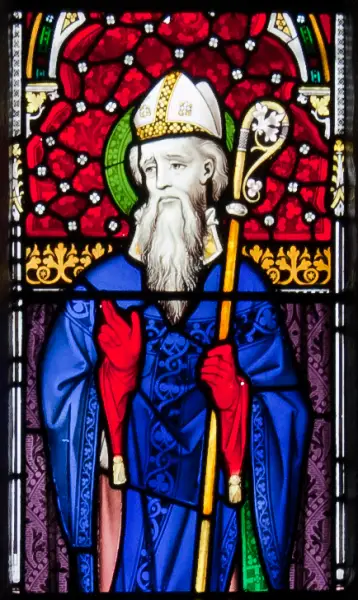
Overview
Ibar mac Lugna — his name given also as Iberius or Ivor — was an early Irish saint and bishop, patron of Beggerin Island in Wexford Harbour, and one of the commanding figures of Irish Christianity in the generation around St Patrick. He is sometimes reckoned among the Quattuor sanctissimi Episcopi — four bishops whom tradition calls the holiest of the age before Patrick in Ireland, together with Ailbe, Ciarán, and Déclán, though the four may merely have been his contemporaries. Born to noble blood of the Ui Echach of east County Down, he was trained first in a druidic school before seeking the new monastic learning of Gaul at Lérins. Returning to Ireland, he planted communities on one of the Aran Islands, at plain Geshille in County Offaly, and finally at Beggerin, where his retreat filled with disciples — the Litany of Aengus names the three thousand confessors gathered under his rule. At first unwilling to yield to Patrick, he afterwards submitted and became his disciple. He preached through what is now County Wexford and died on 23 April in the year 500, the day on which his feast is still observed.
The Complete Life
Of Noble Birth
The Annals of the Four Masters give Ibar a noble birth, descended from the tribe of the Ui Echach, who occupied the east of County Down in the north of Ireland. His family was bound to the royalty of the south: Mella, his sister, was wed to Hua-Carbmiac, king of Hy-Kensellagh — the kingdom that took in all of the present County Wexford together with a considerable part of Wicklow and Carlow. Through that marriage his kindred reached into the very region where he would one day preach and die. His early schooling lies, the sources concede, in deep obscurity, though they tell that his education began in an important druidic school — a detail that makes his later career a striking instance of the old learning of Ireland passing over into the new. The boy formed in the schools of the pagan teachers became one of the bishops whom Irish tradition numbered among the holiest of the generation that prepared the way for Patrick, and the patron of an island sanctuary in the south-east that would bear his name.
§ Life
From the Druids to Lérins
The turn in Ibar's life came when disciples of Martin of Tours first showed themselves in Ireland, carrying with them the monastic spirit of Gaul. Wanting to learn more of this new teaching at its source, Ibar traveled to Armorica, the Breton coast of Gaul, and spent some time at Lérins Abbey, the celebrated island monastery off the Provençal shore. There, the sources judge, his road must have crossed that of Ciarán of Saigir, another of the great pre-Patrician or near-Patrician figures of the Irish church, whose path crossed his in the narrow sea-lanes between Ireland and Gaul. When he returned from Lérins he was not alone: he came back accompanied by companions who formed the first community he established, planted on an island of Aran, in Galway Bay off Ireland's western shore. The western settlement, though, was brief. From there he transferred his monastery to the plain of Geshille, in Offaly, in the midlands, and then took up his final abode at Beggerin, raising there an oratory and a cell for himself — the island retreat in Wexford Harbour that his memory would sanctify for good.
§ Life
The Master of Three Thousand Confessors
The Life of Saint Abbán states that Ibar's retreat at Beggerin was soon peopled with disciples gathered from every quarter of Ireland, while the Litany of Aengus names the three thousand confessors who took his rule upon them — a number that, exact or not, measures the fame of the school he gathered on a small island. His relations with the apostle of Ireland were at first uneasy: he showed no eagerness to submit to Saint Patrick and his successors, though he afterwards submitted and became his disciple. The sources caution that accounts of this submission may originate in the interest of Armagh in claiming precedence over the other religious centres of Ireland, which could also demonstrate early bishops of its rank. In his old age his nephew, the boy saint Abbán, came to Beggerin at the age of twelve and accompanied his uncle to Rome. Moninne, later the founder of Killeavy, is said to have traveled to Leinster to become his disciple before taking up her own foundation. Ibar preached in the present County Wexford, and his death was chronicled to the year 500, on 23 April.
§ Life
Patron of Wexford
Beggerin Island — Begerin — in Wexford Harbour counts Ibar as its patron, the ground of his final monastery, though the place itself has changed under his memory: formerly an island in the north of the harbour, it has long since been reclaimed from the water. He is also the patron saint of the town of Wexford. There the Church of Ireland parish church is named St Iberius' Church, in the Latin form of his name, and is believed to stand upon a site that Ibar himself used for an oratory — so that worship has continued, in one form or another, on the ground he hallowed for over a millennium and a half. His name lives in the ordinary life of the town as well: Wexford town's own St. Ibar's–Shelmaliers Camogie Club plays under his name. Of the bishops sometimes said to have preceded Patrick in Ireland, Ibar is the one whose island, church, and town still carry him in their names. Of the bishops whom Irish tradition remembers before Patrick, none is so closely bound to a single harbour and its town.
§ Legacy
The Record
- Major works
- Oratory and cell at Beggerin·First monastic community on one of the Aran Islands·Monastery at plain Geshille, County Offaly
- Patron of
- Beggerin Island, Wexford·Town of Wexford
- Canonization
- Pre-congregation; venerated from the earliest Irish church, sometimes counted among the four most sacred bishops said to have preceded Saint Patrick in Ireland
Prayer
Bibliography
Show 6 sources
- Odden, Einar. "The Holy Ibar of Begerin (d. 500)", Roman Catholic Diocese of Oslo.
- "The Life of St. Abbán", Bethada Naem nÉrenn, vol. II. Ed. and trans. Charles Plummer. Oxford: 1922.
- Charles-Edwards, T. M. "Ulster, saints of (act. c. 400 - c. 650)", Oxford Dictionary of National Biography, Oxford University Press, 2004; online edn, Jan 2007.
- Lee, Sidney, ed. (1891). "Ibhar". Dictionary of National Biography. Vol. 28. London: Smith, Elder & Co.
- Grattan-Flood, William. "St. Ibar." The Catholic Encyclopedia. Vol. 7. New York: Robert Appleton Company, 1910. 19 Jul. 2013.
- "St. Ibars Camogie History - Shelmaliers GAA".
Profile text adapted from the Wikipedia article, licensed CC BY-SA 4.0.
Pray with this saint every day
Save St. Ibar of Beggerin to your favorites, read the full profile, and get feast-day reminders in the Saints app.
Get the Saints AppFree on the App Store for iPhone and iPad