
c. 770 - 825·Feast September 4
St. Ida of Herzfeld
Carolingian Widow and Benefactor of the Poor in Westphalia
Overview
Ida of Herzfeld, born about 770 and dead on 4 September 825, was a Saxon noblewoman who, once Egbert her husband died in 811, gave her whole life to the poor. Closely related to the Carolingian house — Sabine Baring-Gould makes her a granddaughter of Bernard, son of Charles Martel — she was a count's daughter schooled at the court of Charlemagne, where the emperor chose for her Egbert, a favorite of his household, and endowed her with a great fortune in estates. The marriage was apparently a happy one; together the two built the church of Herzfeld in Westphalia, and she reportedly founded the church at Hovestadt. Left a widow at a young age, she built a portico over the grave of Egbert, at the south side of the Herzfeld church, and lived there a life of prayer and works of charity, day by day filling a stone coffin with food for the poor. She was reportedly the mother of Warin, abbot of Corvey, of Count Cobbo the Elder, and of Addila, abbess of Herzfeld. She died on 4 September 825 and was buried at Herzfeld — the first shrine of pilgrimage Westphalia knew; she was canonized on 26 November 980.
The Complete Life
Kin of the Carolingians
Ida's precise parentage is disputed, yet on the essential point the sources agree: she stood within the circle of the Carolingian dynasty that ruled the Franks. Sabine Baring-Gould records that she was granddaughter to Bernard, child of Charles Martel by his wife Gundlindis, which would place her in the bloodline of the most powerful family in western Christendom. What the sources concur on is that she was the daughter of a count and that her schooling was at Charlemagne's own court — the school of kings, in an age when the imperial court gathered about it the learning and the politics of Europe. It was there that the emperor disposed of her future: he chose for her Egbert, a lord dear to his court, and settled great estates on her to repay all that her father had given. Whatever the exact web of kinship, Ida belonged by birth and upbringing to the circle that was welding Saxony, recently conquered, into the Christian empire, and she carried that mission into her new home. Her story belongs, from its first pages, to the world the Carolingians made in Saxony.
§ Life
A Marriage of the Court
The marriage arranged by Charlemagne proved, the biographies say, an apparently happy one. Ida and Egbert built together the church of Herzfeld in Westphalia — a name sometimes recorded in the old documents as Hirutveldun — planting the Christian faith in Saxon soil by the most tangible of acts, the raising of a church. To the marriage children were born: Ida is reported to have been the mother of Warin, who became abbot of Corvey from 826 to 856, of Count Cobbo the Elder, and of a daughter, Addila or Mathilde, who became abbess of Herzfeld — a household in which sons took the cloister and the county and a daughter the abbess's chair. Her own Life became, in later tradition, a text quoted in support of the teaching that the union of husband and wife within marriage carries a spiritual meaning as well as a bodily one, the Holy Spirit working in the two joined in one flesh an interior love directed toward celestial realities. Court marriage it was, but the tradition insists it was also a sacramental one.
§ Life
The Widow at the Portico
In 811 Egbert died, and Ida, still young, wore widow's black. They laid him to rest along the southern side of the Herzfeld church their hands had raised, and there Ida chose to make her home: she raised a portico over his grave and lived in it thenceforth a life devoted to prayer and to works of charity. The biographies record among her acts of kindness a custom that became her emblem — each day she filled a stone coffin with food and gave it to the poor, turning a vessel of death into a daily table for the hungry. In the same spirit of quiet foundation she is said to have established the church at Hovestadt, in Westphalia, extending the work she and Egbert had begun together. The later Life written by the monk Uffing placed at the center of her sanctity her exemplary endurance — the suffering she bore in divine trust through widowhood and loss. Prayer over a husband's grave, bread for the poor from a coffin of stone: her widowhood was itself her principal work. Charity, not cloister, was the form her holiness took.
§ Life
First Pilgrim of Westphalia
Ida's death came on 4 September 825; her burial followed in the Herzfeld church, beside the husband whose grave she had tended for fourteen years. The place of her burial proved momentous for the Christianization of the Saxon lands: the church at Herzfeld became the first pilgrimage site in all of Westphalia, drawing the devotion of a region only two generations removed from its conquest by her kinsman Charlemagne. That a Saxon duchess of Carolingian blood should have become the first object of pilgrimage in Westphalia carries its own significance — the faith she had carried into Saxony by marriage now drew Saxons to her tomb. The date of her death, 4 September, became the day of her feast, and it remains the calendar marker of her memory. Her body rested in the church that she and Egbert had raised together, the two of them joined in death as in the work of their lives, at the center of what would grow into the pilgrimage village of Herzfeld in the Westphalian countryside. The Saxon countryside had its first holy place, and it was hers.
§ Veneration
The Vita of Uffing
More than a century and a half after her death, in the year 980, Uffing, a monk of Werden Abbey, set down the Vita sanctae Idae Hertzfeldensis, the Life that fixed the shape of her legend for later ages. Uffing's account focuses on her exemplary life, and in particular on the suffering she endured in divine trust — the widowhood, the losses, and the daily discipline of charity borne as a form of faith. In the same year, on 26 November, Ida was canonized, the formal recognition of the cult that had grown at her tomb in Westphalia. The pairing of the Life and the canonization in 980 marks the moment when the local memory of a charitable widow was received by the wider church: her story was written down and her name entered the calendar in a single season. Through all the later retellings — from Baring-Gould's Victorian Lives to the Butler tradition — the substance has remained what Uffing preserved: a noblewoman of the imperial court who chose a portico over a grave and made it a school of prayer.
§ Veneration
The Deer of Herzfeld
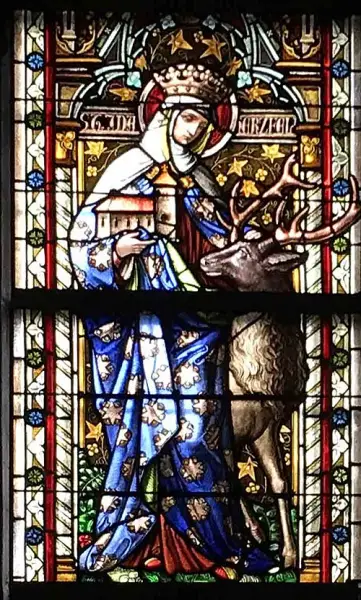
Ida's cult has never left Herzfeld. In 2011 Rome raised the pilgrim church of St. Ida at Herzfeld, in the municipality of Lippetal, to the rank of minor basilica, a formal acknowledgment of the pilgrimage tradition she founded. Every September the village keeps the folk festival of Ida Week in memory of the saint: in the course of the week the saints' bones go in solemn procession through the village, and afterward the Ida Blessing is granted. In art Ida is frequently shown either with a church in her hands or beneath a dove that hovers over her head. The deer in which she is often portrayed carries a historical meaning: through the thirty-two years of war between Frank and Saxon, Ida took the Saxon people under her protection, and the deer represents the Saxons harried by the Franks — the hunted creature sheltered by the saint of the conqueror's own house. Even today the deer stands in the coat of arms of Herzfeld. She is invoked as patron of pregnant women, brides, and widows, and of the poor and the weak. Nine centuries after her death, the village still moves to the rhythm of her feast.
§ Veneration
Timeline
- 770
Born around this year, a daughter of a count and close kinswoman of the Carolingian house
§ Life
- 811
Her husband Egbert died; burial followed on the south side of the church of Herzfeld that they had built together
§ Life
- 4 Sep 825
Died on 4 September; burial in the Herzfeld church followed
§ Veneration
- 980
Uffing, a monk of Werden Abbey, set down the Vita sanctae Idae Hertzfeldensis, centered on her exemplary life and the suffering she endured in divine trust
§ Veneration
- 26 Nov 980
Canonized on 26 November
§ Veneration
- 2011
The pilgrim church of St. Ida at Herzfeld in Lippetal was raised to the rank of minor basilica
§ Veneration
In Their Own Words
At the moment when the two are united in one flesh, there is present in them a single and similar operation of the Holy Spirit: when they are linked together in each other's arms in an external unity, which is to say, a physical unity, this indivisible action of the Holy Spirit inflames them with a powerful interior love directed towards celestial realities.
The Record
- Major works
- Church of Herzfeld, Westphalia·Church at Hovestadt, Westphalia·Portico built over her husband's grave at Herzfeld
- Patron of
- Pregnant women·Brides·Widows·The poor and the weak
- Symbols
- A church·A dove hovering over her head·A deer
- Canonization
- Canonized on 26 November 980
Prayer
Bibliography
Show 4 sources
- Baring-Gould, Sabine. "S. Ida, W.", The Lives of the Saints. J. Hodges, 1882, p. 50.
- Butler, Alban. "Saint Ida, Widow", Lives of the Fathers, Martyrs, and Principal Saints, 1866.
- Hillmann, Clemens. Die Kirche und Grabstätte der heiligen Ida von Herzfeld. Herausgegeben von der katholischen Pfarrgemeinde St. Ida Herzfeld, dcv druck Werl, 2. erweiterte und aktualisierte Auflage, 2003.
- Der Soester Anzeiger über die Große Identracht 2015 in Herzfeld, veröffentlicht am 13. September 2015.
Profile text adapted from the Wikipedia article, licensed CC BY-SA 4.0.
Pray with this saint every day
Save St. Ida of Herzfeld to your favorites, read the full profile, and get feast-day reminders in the Saints app.
Get the Saints AppFree on the App Store for iPhone and iPad