
c. 1140 – 1226·Feast November 3
St. Ida of Toggenburg
Heraldic countess turned hermit of Fischingen
Overview
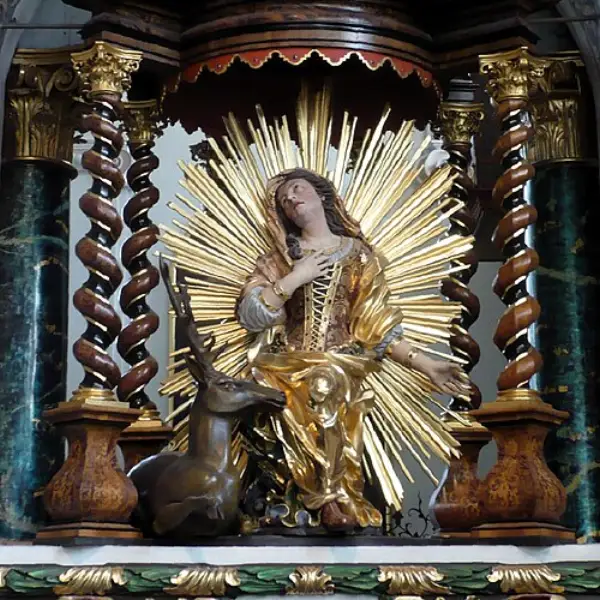
Ida of Toggenburg, who bears the alternative names Idda, Ita, Itha, Itta, Ydda, Judith, or Gutta of Fischingen, was a holy woman of Switzerland who lived from about 1140 until 3 November 1226. Born a daughter of the counts of Kirchberg near Ulm, she entered the lesser nobility of the region through marriage to a Count of Toggenburg. Her legend tells how a stolen wedding ring led her husband to suspect her of unfaithfulness; cast out of the castle, she was preserved from harm and eventually cleared of the charge. Choosing not to return to married life, she withdrew to a hermitage at Au beside the abbey of Fischingen, where she passed her remaining years in prayer. A tamed stag was said to guide her to the monastery church, and this image became her emblem. Veneration at Fischingen is documented from the fifteenth century onward, and in 1724 Pope Benedict XIII approved her cult for the entire Diocese of Constance. She remains a beloved figure of Swiss popular piety, honoured as a patroness against headaches and in matters of pregnancy, and remembered through legends, chronicles, sagas, and even a nineteenth-century novel.
The Complete Life
A Count's Daughter of Kirchberg
The Ida whom popular devotion remembers was, according to legend, the daughter of a count of Kirchberg, a lordship situated near the imperial city of Ulm. Around the middle of the twelfth century she was given in marriage to a count of Toggenburg, a union that bound the two noble houses of the region together. Later documents, composed after 1562, give the husband the name Heinrich, though the earliest traditions leave him unnamed. Her story as it has come down to us belongs less to chronicle than to legend, and the writers of the fifteenth century onward shaped it with the tools of hagiographical romance. A separate thread of historical research identifies a twelfth-century Ida who was married first to a Diethelm of Toggenburg and then, in a second marriage, to a Gottfried of Marstetten; scholars have suggested that this woman was countess of Homburg and that her reputation for holiness gave rise to the cult tradition. Whether one legendary countess stands behind the stories or several historical women have been woven into a single figure, the memory that survived is of a noblewoman whose married life was disrupted by suspicion and who answered that wound not with bitterness but with a radical turn toward God.
§ Hagiography
The Ring, the Raven, and the Call
The heart of Ida's legend is the tale of the stolen ring. On her wedding day, so the story runs, a raven snatched the ring from her hand and carried it to its nest. A bird catcher later recovered it, and when the count saw the ring on the man's hand he leapt to the conclusion that his wife had been unfaithful with the catcher. His fury was swift and terrible: he had the bird catcher put to death and hurled Ida from a window of his castle. God, who knew her innocence, preserved her miraculously from the fall, and she fled into the wilderness. In time a divine wonder restored her to her home, and the truth of the charge was made plain; the error was wholly cleared away. Yet Ida did not ask to be reinstated as a countess. She resolved instead to devote the rest of her days to God as a hermit. When she first made her way to the monastery of Fischingen nearby for Mass, a stag ran before her, and it was said to bear twelve rings on its antlers. A huntsman who witnessed the sight carried the report back to her husband, whose heart at last repented of his cruelty.
§ Hagiography
Hermit at Au Beside Fischingen
Convinced at last of his wife's innocence, the repentant count of Toggenburg provided for her a hermitage at Au, close to the monastery of Fischingen, and there Ida settled into the hidden life she had chosen. According to the chronology that Abbot Franz Troger assembled in 1704 from local records and tradition, she spent the years from 1218 to 1226 in residence at the abbey's precincts, her last eight years folded into the rhythm of its prayer. The stag that had first led her to the monastery church continued in the popular memory to accompany her; it was said that the creature often guided her to worship, its antlers gleaming with the twelve rings that had become her sign. There she lived until 3 November 1226, when she died, as the tradition records, in the odor of holiness. The community and the surrounding people honoured her as a saint from the beginning, and her grave at Fischingen became the centre of a devotion that, though unwritten before the fifteenth century, clearly ran back through the generations to the woman herself and the cave where she had sought God alone.
§ Hagiography
From Local Grave to Diocesan Cult
Ida was venerated as a saint well before any formal process: the tradition records her honoured as such before 1410, although no written evidence of a cult at Fischingen Abbey survives earlier than the fifteenth century. In 1496 the newly re-established monastery dedicated a monumental table tomb to her, which grew so central to the abbey's life that in the eighteenth century it even displaced Our Lady from the monastery's inner shrine. An Ida brotherhood was founded in 1580, and until about 1600 her veneration remained largely local to Fischingen and its neighbourhood, after which it spread through the county of Kirchberg. She was likewise honoured at the Bauen chapel on Lake Lucerne, where a chapel of Saint Ida is first documented in 1561. In 1704 Abbot Franz Troger recast her legend with local data, fixing the birth at 1156, the marriage at 1179, the fall from the fortress at 1191, and the final stay at Fischingen from 1218 to 1226. In 1724 Pope Benedict XIII granted her cult for the entire Diocese of Constance, and the Diocese of Basel still counts her among its saints as patroness of runaway cattle. A small pilgrimage site, St. Iddaburg, rises on a mountain south of the abbey.
§ Cult
Legends, Chronicles, and Literature
Ida's story proved remarkably fertile in German letters. The oldest written life dates from 1481, the work of the humanist Albrecht von Bonstetten, who composed several saints' lives and fixed the shape of her legend for later ages. A German legend drawn from Bonstetten was printed by Sebastian Brant in 1510 in the celebrated collection Der Heiligen Leben. Froben Christoph von Zimmer, writing his Zimmerische Chronik between 1559 and 1566, recounted the counts of Kirchberg and Ita von Dockenburg, born a countess of Kirchberg, preserving an independent strand of the tale. The Brothers Grimm, drawing on Johannes von Müller's Swiss history, included a short text about Ida as number 513 in their German sagas, carrying her story into the mainstream of German folklore. In 1840 Thomas Bornhauser made her the heroine of a novel, Ida von Tockenburg, published in Schwäbisch Hall, and edifying writings about her continued through the nineteenth century, including an 1880 Regensburg pamphlet that presented her life as a companion story to that of Genevieve of Brabant. Modern scholarship, notably Bruno Meyer's 1974 study of the holy Ita of Fischingen, has continued to examine the historical kernel behind the beloved legend.
§ Legends and reception
Timeline
- 1156
Reconstructed chronology of Abbot Franz Troger places her birth at Kirchberg in this year.
§ Cult
- 1179
According to Troger's local reconstruction, she was married to the Count of Toggenburg.
§ Cult
- 1191
The reconstructed legend dates her fall from the fortress window to this year.
§ Cult
- 1218
She began her final residence at Fischingen Abbey, which lasted until her death.
§ Cult
- 3 Nov 1226
Ida died at her hermitage near Fischingen and was immediately honoured as a holy woman.
§ Hagiography
- 1481
Albrecht von Bonstetten composed the earliest surviving written life of the saint.
§ Hagiography
- 1496
The re-established monastery of Fischingen dedicated a monumental table tomb to her.
§ Cult
- 1561
A chapel of Saint Ida at Bauen on Lake Lucerne is documented for the first time.
§ Cult
- 1580
A brotherhood in her honour was founded at Fischingen.
§ Cult
- 1704
Abbot Franz Troger rebuilt her legend with local detail, fixing the dates of her life.
§ Cult
- 1724
Pope Benedict XIII granted her cult for the whole Diocese of Constance.
§ Cult
The Record
- Patron of
- against headaches·for complaints of pregnancy·for finding escaped cattle
- Symbols
- deer with shining antlers·crow·crown
- Canonization
- Her local cult was extended to the whole Diocese of Constance by Pope Benedict XIII in 1724.
Prayer
Bibliography
Show 5 sources
- Schäfer, Joachim. "Biographien: Idda von Toggenburg" (in German). Heiligen Lexikon. Retrieved 27 May 2021.
- Eugster, Erwin (25 October 2012). "Idda von Toggenburg" (in Italian). Translated by Balmelli, Michele. Historisches Lexikon der Schweiz. Retrieved 27 May 2021.
- Meyer, Bruno (1974–1975). "Die heilige Ita von Fischingen". Thurgauische Beiträge zur vaterländischen Geschichte. Vol. 112. pp. 21–97. doi: 10.5169/seals-585258.
- Collins, David J. (2008). "The Holy Recluses". Reforming Saints: Saints' Lives and Their Authors in Germany, 1470-1530. Oxford Studies in Historical Theology. Oxford: Oxford University Press. pp. 51–74.
- Michael Tilly (1990). "Ida von Toggenburg, auch: Idda, Itha, Itta, Ydda, Judith und Gutta". In Bautz, Friedrich Wilhelm (ed.). Biographisch-Bibliographisches Kirchenlexikon (BBKL). Vol. 2. Hamm: Bautz. col. 1251. ISBN 3-88309-032-8.
Profile text adapted from the Wikipedia article, licensed CC BY-SA 4.0.
Pray with this saint every day
Save St. Ida of Toggenburg to your favorites, read the full profile, and get feast-day reminders in the Saints app.
Get the Saints AppFree on the App Store for iPhone and iPad