
c. 1100 – 1167·Feast April 18
St. Idesbald
Cistercian abbot of the Dunes
Overview
Idesbald (c. 1100 – 1167) was a Cistercian monk who rose to become abbot of the abbey of Ten Duinen, the celebrated foundation of Our Lady of the Dunes on the Flemish coast. Born into the orbit of the Flemish court, he spent his youth as a courtier and page in the household of the Count of Flanders, and tradition ties him to the noble house of Van der Gracht, whose lords held Moorsel. In 1135 he embraced ecclesiastical life as a canon priest at Veurne, and fifteen years later he entered the Cistercian abbey of the Dunes, where he served as abbot from 1155 until his death in 1167. He was buried in the abbey church in a lead coffin, and his relics became the object of enduring devotion. When the abbey was plundered in 1577, the monks carried his remains to safety, and when the coffin was opened for inspection in 1623 the body was found incorrupt, a discovery that greatly strengthened his cult. In 1894 the Diocese of Bruges formally approved his veneration. Modern science has complicated the story: radiocarbon testing in 2015 showed that the remains preserved in Bruges date from a later period, and may belong to another abbot of the Dunes.
The Complete Life
A Page at the Court of Flanders
Idesbald was born around the year 1100 into the highest circle of Flemish society. As a young man he served at the court of the Count of Flanders as a page and courtier, receiving the training in manners, horsemanship, and affairs that the sons of the nobility customarily received. Tradition holds that he belonged to, or at least descended from, the noble house of Van der Gracht, lords of Moorsel, a connection that would have placed him close to the centres of power in the county. Nothing in the sources suggests that his youth was unhappy or that his conversion sprang from disgrace; rather, his story belongs to the familiar medieval pattern of the courtier who, having seen the world of princes from within, chose deliberately to renounce it. The abbey he would eventually join, Our Lady of the Dunes, stood in the dunes near the Flemish coast, a foundation whose austerity offered the sharpest possible contrast to the life of a court. Some later writers style him blessed rather than saint, a nuance preserved in the sources themselves, but the devotion that gathered around his memory never doubted the sincerity of the turn he made from palaces to the cloister.
§ Life
Canon, Monk, and Abbot of the Dunes
In 1135, when he was already a man of mature years, Idesbald took the first decisive step away from the court by becoming a canon priest at Veurne, a town not far from the coast. The canonical life, with its common prayer and pastoral duties, prepared him for a deeper renunciation: in 1150 he entered the Cistercian abbey of Our Lady of the Dunes, known as Ten Duinen, and took the white habit of the Cistercian order. His abilities were quickly recognized by the community. In 1155, only five years after his profession, he was chosen abbot of the foundation, and he governed it for twelve years, until his death in 1167. His tenure fell within the great age of Cistercian expansion in the Low Countries, when the order's ideal of plain observance and patient cultivation of marginal land had a particular fitness for the dunes and polders of the Flemish shore. He was succeeded in the abbacy by Walter of Dikkebus. He was laid to rest within the abbey in a coffin of lead, and it was this burial, more than any written work, that anchored his memory in the centuries that followed.
§ Life
An Incorrupt Body and an Approved Cult
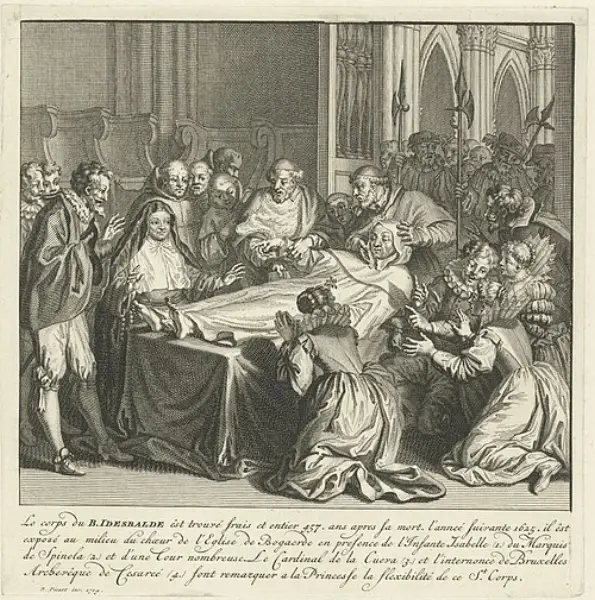
Idesbald never received a formal papal canonization; his cult grew instead from the devotion of the monks who kept his grave and from the striking events that attended his remains. When the Geuzen, the rebel sea-beggars of the Dutch Revolt, plundered Ten Duinen in 1577, the community carried his relics to safety at the monastic grange of Bogaerde. On 13 November 1623 witnesses gathered for the opening of his coffin, an inspection and authentication of the relics, and the body proved incorrupt; for days the remains were shown to streams of visitors. Two years later, while the Infanta Isabella Clara Eugenia made her progress through Flanders, the remains were shown to her and her entourage — Ambrogio Spinola, Cardinal de la Cueva, and the pope's nuncio among them, an occasion recorded in Bernard Picart's engraving of 1714. Revolutionary violence again moved the relics in 1796, when they were brought to Bruges for safekeeping, and in 1830 a chapel of the community of Our Lady of the Potteries received them. In 1894 the Diocese of Bruges issued a decree formally approving his cult, completing his long passage from local abbot to officially honoured blessed.
§ Veneration
Memory, Relics, and a Modern Discovery
Idesbald's name remains fixed in the geography of the Flemish coast: the village of Saint-Idesbald, which won fame as a quarter for artists, takes its name from the abbot of the Dunes. His cult also left material traces, most famously the engraving by Bernard Picart of 1714 depicting the incorrupt body displayed to the court of the Infanta. Yet his story took an unexpected turn in the twenty-first century. In 2015 the lead coffin long thought to hold his remains was opened, and both the lead carbonate of the coffin and the skeletal remains within were subjected to radiocarbon dating. The results showed that the bones date from the later fifteenth or early sixteenth century, far too late for the abbot who died in 1167, and researchers now suggest that the coffin and its occupant are those of some later abbot of the Dunes, perhaps moved for safekeeping amid the disorders of that era. The finding does not erase the medieval devotion, which rested on the memory of a holy abbot rather than on the science of relics, but it stands as a reminder that the cults of the great abbeys often accumulated histories more layered than their first tellers knew.
§ Veneration
Timeline
- 1100
Idesbald was born around this time, apparently into the noble world of the Flemish court.
§ Life
- 1135
He became a canon priest at Veurne, leaving behind his life at court.
§ Life
- 1150
He entered the Cistercian abbey of Our Lady of the Dunes as a monk.
§ Life
- 1155
He began his term as abbot of Ten Duinen.
§ Life
- 1167
He died after twelve years as abbot and was laid to rest within the abbey in a coffin of lead.
§ Veneration
- 1577
Geuzen forces plundered the abbey, and the monks moved his relics to the grange at Bogaerde.
§ Veneration
- 13 Nov 1623
His coffin was opened before witnesses and the body was found incorrupt.
§ Veneration
- 1625
The relics were displayed to Infanta Isabella Clara Eugenia and her court during her progress through Flanders.
§ Veneration
- 1796
His remains were translated to Bruges to keep them from Revolutionary troops.
§ Veneration
- 1830
The remains found a resting place in a chapel of the community of Our Lady of the Potteries.
§ Veneration
- 1894
The Diocese of Bruges officially approved his cult by decree.
§ Veneration
- 2015
The lead coffin was opened and radiocarbon dating showed the remains date to the late fifteenth or early sixteenth century.
§ Veneration
The Record
- Canonization
- His cult was officially approved by a decree of the Diocese of Bruges in 1894.
Prayer
Bibliography
Show 3 sources
- "Beato Idesbaldo delle Dune". santiebeati.it. Retrieved 16 May 2013.
- Van Strydonck, Mark; Boudin, Mathieu; den Brande, Tess Van; Saverwyns, Steven; Van Acker, Jan; Lehouck, Alexander; Vanclooster, Dirk (2016-02-01). "14C-dating of the skeleton remains and the content of the lead coffin attributed to the Blessed Idesbald (Abbey of the Dunes, Koksijde, Belgium)". Journal of Archaeological Science: Reports. 5: 276–284. doi: 10.1016/j.jasrep.2015.11.027.
- Inscription on Bernard Picart's engraving of the occasion (1714).
Profile text adapted from the Wikipedia article, licensed CC BY-SA 4.0.
Pray with this saint every day
Save St. Idesbald to your favorites, read the full profile, and get feast-day reminders in the Saints app.
Get the Saints AppFree on the App Store for iPhone and iPad