
6th or 7th century·Feast April 12 (also October 10)
St. Iestyn
Welsh Hermit and Founder of Churches
Overview
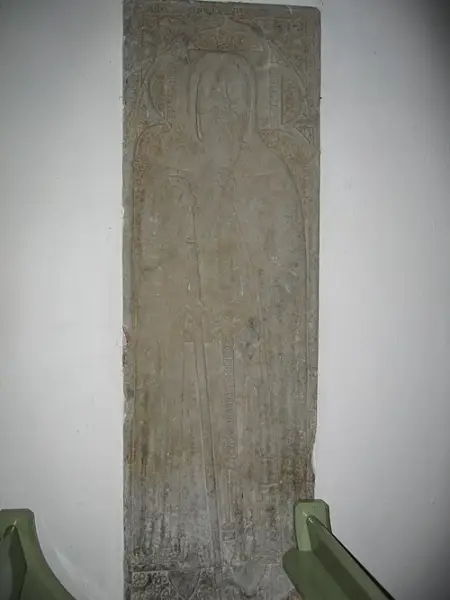
Iestyn, sometimes recorded as Iestin or under the Latin form Justinus, was a Welsh hermit and confessor of the sixth or seventh century who is venerated as a saint. Tradition gives him for a father Geraint ab Erbin, who ruled over Dumnonia, the Celtic realm occupying what is now the southwest corner of England, and counts Cador, Duke of Cornwall, and the saint Cyngar among his brothers. Probably a follower of the Anglesey saint Cybi, he founded two churches in north Wales: one at Llaniestyn in Gwynedd and another at Llaniestyn in Anglesey. He is also linked with a possible foundation at St Just in Roseland in Cornwall, within the sphere of his father's influence, and with a church in Brittany. His memory is preserved most strikingly at the Anglesey church, which keeps a late fourteenth-century carved effigy of the saint in a hooded cloak, holding a staff and an inscribed scroll. His feast was kept on April 12 and October 10 at his Anglesey church and on October 10 in Caernarfonshire, though it does not appear in the Welsh calendars of saints.
The Complete Life
A Prince's Son Who Chose the Hermit's Path
The traditions surrounding Iestyn place him in the highest rank of British society while telling of a life withdrawn from worldly power. The genealogies make him a son of Geraint ab Erbin, who ruled over Dumnonia, the Celtic realm stretching across much of present-day southwest England. His brothers were men of consequence: Cador is remembered as Duke of Cornwall, and Cyngar was himself honoured as a saint, whose memory is preserved in the church of Llangefni on Anglesey. When it comes to dating him, the written sources disagree about when Iestyn lived; some place his flourishing in the early sixth century, others set his activity in the seventh. Whatever the precise decade, the picture of his manner of life is consistent: he was a hermit and a confessor, a holy man renowned for his witness to the faith rather than for martyrdom. Welsh tradition further links him to Cybi, the great saint of Anglesey, and it is probable that Iestyn was his follower and spiritual disciple. A prince's son who might have inherited lordship in Dumnonia instead crossed into north Wales to pursue solitude and holiness, following the pattern of the Celtic saints who renounced rank for the sake of the Kingdom of God.
§ Life and commemoration
Churches in Gwynedd, Anglesey and Beyond
Iestyn's enduring work was the founding of churches, and two of them still carry his name. In Gwynedd he established St Iestyn's Church at Llaniestyn, and in Anglesey he founded another church, likewise called Llaniestyn, which remains the principal focus of his memory. The pattern is a familiar one in the age of the Celtic saints, when a holy man's presence would gather a settlement around him and a Christian community would take root, the place receiving the saint's name in the form of a llan, or enclosed churchyard. His activity may not have stopped at the Menai Strait. Some traditions connect him with the church of St Just in Roseland in Cornwall, a district that lay within the influence of his father's Dumnonian house, which would make his dedication a family inheritance carried into the far southwest. A link has also been drawn to a church in Brittany, beyond the Channel in northern France, a reminder of how the saints of Wales, Cornwall and Armorica formed a single maritime world in which monks, relics and dedications moved freely across the sea.
§ Life and commemoration
The Effigy at Llaniestyn
The most tangible relic of Iestyn's cult is the carved effigy that still rests in his Anglesey church. Dating from the late fourteenth century, it portrays the saint as a figure in a hooded cloak fastened with a brooch, a staff grasped in his right hand, a scroll bearing an inscription in his left. In Latin the carving announces that Iestyn lies here, and it records the names of those who gave the effigy, a detail that links the monument to particular local benefactors. It has been suggested that the carved stone may originally have served as a shrine, the focus of pilgrimage and prayer at the saint's own church. His feast day, curiously, never entered the Welsh calendars of saints, yet it was firmly kept locally: April 12 and October 10 were observed at his church in Anglesey, and October 10 at his church in Caernarfonshire. Iestyn thus belongs to that company of early Welsh saints whose veneration lived on in the soil of particular parishes rather than in national observance, sustained by the fabric of the churches that bore his name.
§ Life and commemoration
The Record
- Major works
- St Iestyn's Church, Llaniestyn, Gwynedd·St Iestyn's Church, Llaniestyn, Anglesey·Possible foundation at St Just in Roseland, Cornwall
- Patron of
- Llaniestyn in Gwynedd and Anglesey
- Symbols
- Hooded cloak fastened with a brooch·Staff·Inscribed scroll
- Canonization
- Pre-congregation; venerated as a Welsh hermit and confessor
Prayer
Bibliography
Show 4 sources
- Baring-Gould, Sabine (1907). The Lives of the British Saints: the Saints of Wales and Cornwall and such Irish Saints as have dedications in Britain. Honourable Society of Cymmrodorion, pp. 293-295
- Williams, Robert (1852). Enwogion Cymru: A biographical dictionary of eminent Welshmen. W. Rees, p. 238
- Jones, Geraint I. L. (2006). Anglesey Churches. Carreg Gwalch, pp. 107-108
- Haslam, Richard; Orbach, Julian; Voelcker, Adam (2009). "Anglesey: Llanddona". The Buildings of Wales: Gwynedd. Yale University Press, p. 145
Profile text adapted from the Wikipedia article, licensed CC BY-SA 4.0.
Pray with this saint every day
Save St. Iestyn to your favorites, read the full profile, and get feast-day reminders in the Saints app.
Get the Saints AppFree on the App Store for iPhone and iPad