
798 – 877·Feast October 23
St. Ignatius of Constantinople
Twice-deposed patriarch of the Byzantine capital
Overview
Ignatius of Constantinople, born Niketas Rangabe in 798, was the son of Emperor Michael I and Empress Prokopia, and became one of the most contested patriarchs in the history of Byzantium. As a boy he was named nominal commander of the Hikanatoi, the new corps of imperial guards, but his life changed violently when his father fell from power in 813: the young prince was castrated on the orders of Emperor Leo V the Armenian, disqualifying him from the throne, and confined to a monastery. There he took the name Ignatius, rose to become abbot, and founded three monasteries on the Princes' Islands. Empress Theodora installed him as Ecumenical Patriarch of Constantinople on 4 July 847 because of his support for the veneration of icons. His patriarchate was twice interrupted: deposed and exiled in 857 after he excommunicated the powerful Bardas, he was replaced by Photius, and the ensuing dispute with the papacy over jurisdiction and the Filioque embroiled both Churches for decades. Restored in 867 under Basil I, he secured the Bulgarian church for Constantinople before dying on 23 October 877, naming Photius himself as successor. Both Catholic and Orthodox churches honour him as a saint.
The Complete Life
A Prince Robbed of His Throne
The man the Church would remember as Ignatius entered the world in 798 as Niketas, son of Emperor Michael I Rangabe and Empress Prokopia, a child of the purple whose path seemed fixed at the summit of Byzantine power. While still a boy he received the nominal command of the Hikanatoi, a newly created corps of imperial guards, an honour that advertised his position as a potential ruler. Fortune turned brutally in 813. His father was deposed, and the new emperor, Leo V the Armenian, moved to extinguish the family's dynastic hopes: fourteen-year-old Niketas was forcibly castrated, rendering him permanently ineligible for the throne, and was in effect imprisoned in a monastery. What was intended as the annihilation of a political rival became, in the providence the Church later saw in it, the doorway to sanctity. Within the monastery the dispossessed prince took the religious name Ignatius and began the long apprenticeship of monastic life. The violence done to his body and his prospects could have bred a lifetime of bitterness; instead the sources show a man who spent the decades after 813 in obscurity and prayer, far from the court that had discarded him.
§ Birth and early life
Monk, Abbot, and Founder
In the monastery Ignatius grew from a confiscated child into one of the respected monastic figures of his generation. He eventually became abbot of his community, exercising over monks the kind of authority the palace had once expected him to exercise over soldiers. Nor did his ambition stop at one house: he founded three monasteries on the Princes' Islands, the archipelago in the Sea of Marmara that Byzantium used as a place of exile for tonsured members of the imperial house. It is a striking choice of ground. On those islands the ruined royalty and disgraced courtiers of Constantinople lived out their days under the monastic habit, and Ignatius, himself a living monument to that practice, planted houses of prayer in their midst. His standing as an abbot and his well-known loyalty to the veneration of icons made him a natural candidate when the patriarchal throne fell vacant after the end of the second iconoclasm. Empress Theodora, who had restored the orthodoxy of images, chose him for the highest ecclesiastical office in the empire, elevating the quiet abbot of the Princes' Islands to the patriarchate of New Rome on 4 July 847.
§ Patriarchate
Patriarch in an Age of Quarrels
Ignatius assumed the patriarchate at a moment when the Church of Constantinople stood amid a tangle of controversies. The Iconoclast Controversy, formally settled at Nicaea in 787, still smouldered, and his appointment as a convinced iconodule anchored the restoration of the holy images while strengthening Empress Theodora against her enemies. Beyond the icon question, the relations between the sees of Rome and Constantinople grew steadily worse: the popes claimed supreme and universal authority over the whole Church, a claim the East rejected, and the two Churches competed bitterly for the conversion of the Slavs and the direction of Bulgaria's new church. Ignatius proved no courtier. He excommunicated Bardas, a high official of the imperial court, on account of incest, and when Bardas exiled the Empress Theodora in his drive for power, Ignatius refused to give the act his blessing. Emperor Michael III, under Bardas's influence, stripped him of the patriarchate and sent him into exile in 857. A synod, convened to give the deposition a legal colour, removed him on the strength of a canon forbidding bishops to be installed by secular authority, and on Christmas Day of 858 Bardas's associate Photius took his place.
§ Patriarchate
Restoration and the Bulgarian Prize
The deposition of Ignatius split the episcopate and drew Rome into the heart of Eastern affairs. Pope Nicholas I questioned Photius's claim, and although legates retried Ignatius at a synod in 861 and upheld Photius, Nicholas repudiated that council, condemned Photius at a synod of his own, and recognized Ignatius as the lawful patriarch. Michael III rejected the papal verdict, and in 867 Photius answered Rome by excommunicating the pope and all Latin Christians, denouncing the Western addition of the Filioque to the Nicene Creed. The same year brought a palace revolution: Michael III was murdered and Basil I took the throne, exiling Photius and restoring Ignatius on 23 November 867. Pope Adrian II condemned the council of 867, and a council held at Constantinople in 869 reinstated Ignatius while demanding submission to Rome, though many eastern bishops stayed away and refused the papal supremacy canons. Ignatius used his restored years to settle the Bulgarian question. Boris I, baptised in 864 after a Byzantine attack, deferred to Constantinople at the Eighth Ecumenical Council of 869, and Ignatius, ignoring a papal warning, appointed an archbishop for Bulgaria, securing that church for the East.
§ Securing Bulgaria for the East
Death, Successor, and Cult
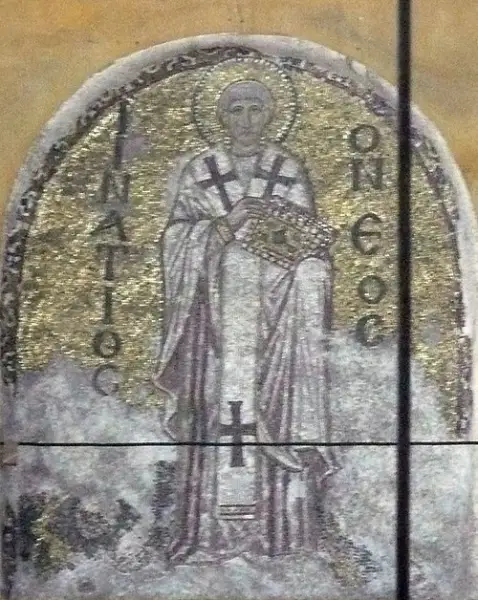
Ignatius died in Constantinople on 23 October 877, having reached the age of seventy-eight or seventy-nine, after thirty years of service interrupted by deposition and exile. His final act was the most surprising of his long career: he named Photius, his great rival and the man who had occupied his throne for nearly a decade, as his successor. When Ignatius died, Photius accordingly returned to the patriarchate, and the Church of Constantinople passed from the hands of one giant of the ninth century into those of another. No formal canonization process is recorded for Ignatius; he belongs to the company of saints acknowledged by the undivided usage of the early Church, venerated from pre-congregation times. The Catholic Church and the Eastern Orthodox Church both honour him, keeping his memory on 23 October, the day of his death. His image stands in the northern tympanon of Hagia Sophia in Istanbul, a mosaic remnant of the age that revered him, and the Menologion of Basil II, made about a century after his death, preserved a painting of his holy passing among the scenes of the liturgical year.
§ After death
The Quarrel That Outlived Him
The patriarchate of Ignatius stands at the root of the long estrangement between the Churches of Rome and Constantinople. His deposition gave Nicholas I the occasion to assert a universal jurisdiction that the East had never conceded, and the alternating synods, retrials, and excommunications of the 860s established the patterns of argument that later centuries would repeat: Rome appealing to its supremacy, Constantinople appealing to its canonical independence. Photius's council of 867, which condemned the Latin Filioque, introduced into the dispute the theological grievance that would outlast every jurisdictional quarrel, and the controversy over that single word helped prepare the schism that would divide the two Churches for more than a thousand years. Ignatius's own contribution to his Church's future was equally concrete: the submission of the Bulgarian church to Constantinople, secured at the council of 869 and sealed by his appointment of a Bulgarian archbishop, fixed the ecclesiastical map of the Balkans for the Byzantine era. Historians from Norwich to Treadgold have treated his career as a case study in the entanglement of Byzantine court politics and ecclesiastical order, and the councils of 861, 867, and 869-870 that swirled around his name remain landmarks in the history of the papacy's claims.
§ Intervention of Pope Nicholas I and Pope Adrian II
Timeline
- 798
Born Niketas Rangabe, son of Emperor Michael I and Empress Prokopia.
§ Birth and early life
- 813
After his father's deposition, Emperor Leo V had the fourteen-year-old castrated and confined to a monastery.
§ Birth and early life
- 4 Jul 847
Empress Theodora appointed him Patriarch of Constantinople for his support of icon veneration.
§ Patriarchate
- 857
Emperor Michael III, swayed by Bardas, removed Ignatius from the patriarchate and sent him into exile.
§ Deposition and ascent of Photius
- 25 Dec 858
Photius, an associate of Bardas, was enthroned as patriarch on Christmas Day.
§ Deposition and ascent of Photius
- 861
Papal legates retried Ignatius in a synod, which judged Photius the legitimate patriarch.
§ Intervention of Pope Nicholas I and Pope Adrian II
- 864
Boris I of Bulgaria, defeated by Michael III, submitted to baptism and took the Christian name Michael.
§ Securing Bulgaria for the East
- 23 Nov 867
After Basil I seized the throne and exiled Photius, Ignatius was restored to the patriarchal throne.
§ Intervention of Pope Nicholas I and Pope Adrian II
- 869
The council convened at Constantinople condemned Photius and reinstated Ignatius, though eastern bishops rejected the papal supremacy canons.
§ Intervention of Pope Nicholas I and Pope Adrian II
- 869
At the Eighth Ecumenical Council the Bulgarian church deferred to Constantinople rather than Rome.
§ Securing Bulgaria for the East
- 23 Oct 877
Ignatius died in Constantinople, having named Photius as his successor.
§ After death
The Record
- Major works
- Three monasteries founded on the Princes' Islands
- Canonization
- Pre-congregation; venerated as a saint in the Catholic and Eastern Orthodox churches.
Prayer
Bibliography
Show 6 sources
- Norwich, John Julius (1997). A Short History of Byzantium. Alfred A. Knopf. p. 142.
- Treadgold, Warren (1997). A History of the Byzantine State and Society. Stanford University Press. p. 451.
- Curta, Florin (2019). Eastern Europe in the Middle Ages (500–1300). Leiden: Koninklijk. pp. 197–206.
- Siecienski, A. Edward (2020). Contra Latinos Et Adversus Graecos, Byzantium and the Papacy from the Fifth to Fifteenth Centuries Stage Two - The Jurisdictional Disputes (9th-11th Centuries). Bondgenotenlaan: Peeters Publishers. p. 14.
- Chadwick, Henry. East and West - The Making of a Rift in the Church - From Apostolic Times until the Council of Florence. Oxford, Oxford University Press, 2003.
- Ostrogorsky, George (1956). "History of the Byzantine State". Oxford: Basil Blackwell.
Profile text adapted from the Wikipedia article, licensed CC BY-SA 4.0.
Pray with this saint every day
Save St. Ignatius of Constantinople to your favorites, read the full profile, and get feast-day reminders in the Saints app.
Get the Saints AppFree on the App Store for iPhone and iPad