
1869-1915·Feast June 11
St. Ignatius Maloyan
Archbishop and Martyr
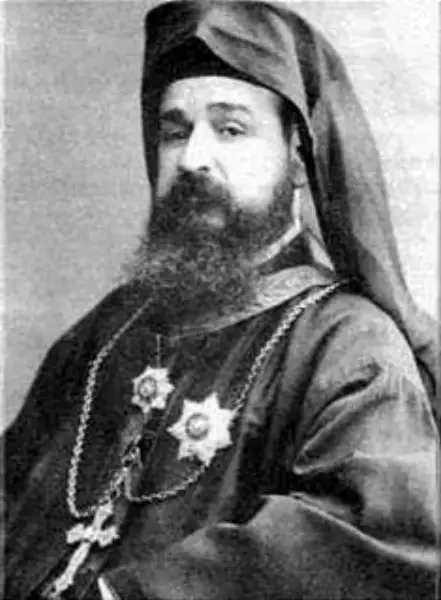
Overview
Shukrallah Maloyan was born in 1869 into an Armenian family. Sent at fourteen to the Armenian Catholic cathedral at Bzoummar in Lebanon, he completed his theological studies there in 1896 and took the name Ignatius, after Ignatius of Antioch. From 1897 to 1910 he cared for parishes in Alexandria and Cairo, worked in Constantinople from 1904 as assistant to the Armenian Catholic Patriarch, and after the divisions and Ottoman interference that convulsed his church was consecrated Archbishop of Mardin in Rome on 22 October 1911. He arrived to find his flock in turmoil and, once the 1913 Ottoman coup had turned the empire into a single-party state, increasingly at the mercy of men preparing the destruction of its Christian peoples; he worked to restore order and encouraged devotion to the Sacred Heart. In the spring of 1915, under Mehmed Reshid's governorate in Diyarbekir, the Christians of Mardin were arrested and deported. Marched out with his people toward the Sheikhan Caves, Maloyan was repeatedly offered his life in exchange for conversion to Islam, and refused, answering that he would live and die loyal to his faith and could boast only of the Lord's noble Cross. Mahmdouh Bey shot him personally on 11 June 1915; his reported last words commended his spirit into God's hands. John Paul II beatified him in 2001, and he was canonized on 19 October 2025.
The Complete Life
Early Life
Shukrallah Maloyan was born on 8 April 1869 into an Armenian Catholic family in Mardin, in the southeastern provinces of the Ottoman Empire. His family belonged to the Armenian Catholic church, an Eastern Catholic community in communion with Rome that kept the Armenian rite while governed through its own patriarch and hierarchy. When he was fourteen his parish priest sent him to the Armenian Catholic cathedral center at Bzommar in Lebanon, the community's patriarchal seat and the natural place for a boy of evident promise to be educated. There he followed the full course of studies for the priesthood, completing his theology on 2 August 1896. As a newly ordained priest he took the religious name Ignatius, in honor of Ignatius of Antioch, the second-century bishop-martyr whose letters he would have known intimately, and whose manner of death he was, unknowingly, to share.
§ Early life
Conversion and Vocation
Maloyan's first assignment was pastoral work in Egypt, where he served Armenian Catholic communities in Alexandria and Cairo from 1897 to 1910, a long apprenticeship among the merchant diaspora of the eastern Mediterranean. In 1904 Constantinople called him, to work at the side of Paul Petros XII Sabbaghian, patriarch of the Armenian Catholics, in a difficult posting that coincided with the massacres of the 1890s and their aftermath and with growing internal division among Armenian Catholics over the patriarch's conciliatory course. Maloyan witnessed at close range both the persecution of his people and the politics of a church trying to survive under a hostile state. The crisis reshaped the community's governance: a synod was eventually convened in Rome in 1911 over the Ottoman government's objections, and it was at that synod, on 22 October 1911, that Maloyan was consecrated Archbishop of Mardin in Rome, returning to his home city as its metropolitan.
§ Early life
Mission and Ministry
Throughout his Mardin episcopate, from 1911 to 1915, Maloyan led a diocese of Armenian, Chaldean, and Syriac Christians in a border province where Armenian, Kurdish, Turkish, and Syriac communities lived close together. His brief episcopate coincided with the disintegration of the Ottoman order: war with Italy, the Balkan wars, and then the general mobilization of the empire from August 1914, which fell on Christian men of military age with particular severity. In Mardin the war brought requisitions, house searches, arrests for real or invented desertion, and the daily violence recorded in contemporary diaries. Maloyan's ministry in these years was the care of a frightened flock: correspondence with officials, the burial and support of the destitute, and the maintenance of the churches' life while the machinery of destruction assembled around them. He conducted a solemn liturgy and public profession of faith with his people shortly before the final arrests, a gesture his biographers have treated as his pastoral testament.
§ The Great War
Trial and Final Years
In the spring of 1915 the deportations and massacres of the Armenian genocide reached Diyarbekir province, administered by the governor Mehmed Reshid, whose regime of killings in the province was extreme even by the standards of 1915. Maloyan was arrested with his clergy and faithful, and the convoy was driven out on the road toward the desert. At every stage he was offered his life on the single condition that he convert to Islam; his people, he was told, would follow if he led. He refused, celebrating what sacraments he could for the dying and encouraging the prisoners to hold to their faith. On 11 June 1915, near the village where the column halted in the desert country outside the city, he was tortured and shot by the gendarmes guarding the convoy, one of hundreds of thousands of Christians killed in the province that summer.
§ Introduction
Canonization
Maloyan's cause was introduced decades after his death and advanced with the memory of the genocide itself. He was beatified by Pope John Paul II in St Peter's Basilica on 7 October 2001, as a martyr killed in hatred of the faith, with the date of his beatification placing him among the prominent martyr-blesseds of the modern era. The cause then proceeded to canonization with unusual speed by historical standards: Pope Francis approved the plan for his canonization in 2025, and Ignatius Maloyan was canonized on 19 October 2025. He thus stands among the few saints of the Armenian church of the modern period formally recognized in the Catholic calendar, his sainthood inseparable from the historical catastrophe in which he died.
§ Introduction
Legacy
Maloyan's legacy operates on two levels. For the Armenian Catholic church he is the great modern confessor-bishop, the hierarch who, offered survival at the price of conversion, answered with his people rather than apart from them; icons of him in Armenian vestments circulate widely in the diaspora. For the historical memory of the Armenian genocide his beatification and canonization gave Catholic form to the witness of the Armenian church's dead, and his refusals, repeated to the end, are cited in accounts of the persecutions of the Christians of Diyarbekir, Armenians, Syriacs, and Chaldeans together. In Mardin itself, where Christian communities have shrunk almost to nothing, his name marks what the city was. His feast is kept on 11 June, the anniversary of his martyrdom.
§ The Great War
Timeline
- 8 Apr 1869
Born as Shukrallah Maloyan in Mardin, in the Ottoman Empire.
§ Introduction
- 2 Aug 1896
Completed his theological studies and adopted the religious name Ignatius in honor of St. Ignatius of Antioch.
§ Early life
- 1897
Took up parish ministry in Alexandria and Cairo for the Armenian Catholic eparchy based there.
§ Early life
- 1904
Moved to Constantinople, assisting Paul Petros XII Sabbaghian, patriarch of the Armenian Catholics.
§ Early life
- 22 Oct 1911
Consecrated in Rome as Archbishop of Mardin following a synod of the Armenian Catholic bishops.
§ Early life
- 1913
Arrived in his archdiocese shortly after the Ottoman coup d'etat, finding the Armenian Catholics of Mardin in turmoil.
§ Early life
- 28 Mar 1915
On Palm Sunday Turkish soldiers entered all the churches of Mardin for mass arrests of alleged deserters.
§ The Great War
- 6 Apr 1915
Learned that Sultan Mehmed V would award him a medal for professing his archdiocese's loyalty.
§ The Great War
- 20 Apr 1915
Received the Sultan's medal publicly, expressing hope for the empire's victory over the Allies.
§ The Great War
- 1 Jun 1915
Read aloud his farewell letter, entrusting it to Archbishop Tappouni as a testament preparing his flock for martyrdom.
§ Preparing for martyrdom
- 3 Jun 1915
Arrested with about 420 leading Christians of Mardin and imprisoned in Mardin Castle on orders from the Vali of Diyarbekir.
§ Arrest and trial
- 10 Jun 1915
Force-marched into the desert by night with around 400 other Christians under the direction of the Gendarmerie chief.
§ Martyrdom
- 11 Jun 1915
Refusing conversion to Islam, he was shot dead by Mahmdouh Bey at the Sheikhan Caves after giving absolution to his flock.
§ Martyrdom
- 7 Oct 2001
Beatified as a martyr by Pope John Paul II in Saint Peter's Basilica.
§ Legacy
- 2 Sep 2015
Vatican City issued a postage stamp commemorating the centennial of his martyrdom.
§ Legacy
- 31 Mar 2025
Pope Francis issued the papal decree clearing the way for his canonization.
§ Canonization
- 19 Oct 2025
Canonized by Pope Leo XIV in Saint Peter's Square.
§ Canonization
In Their Own Words
It does not please God that I should deny Jesus my Saviour. To shed my blood for my faith is the strongest desire of my heart.
My God, have mercy on me! Into Your hands I commend my spirit!
The Record
- Patron of
- Armenian Catholics
- Symbols
- Martyr's palm·Archbishop's cross
- Canonization
- Beatified by Pope John Paul II on 7 October 2001; canonized by Pope Leo XIV on 19 October 2025
Prayer
Bibliography
Show 12 sources
- 1 2 3 4 5 "Ignatius Maloyan (1869–1915)" . www.vatican.va . Retrieved 13 November 2021 .
- ↑ Charles E. Frazee (1983), Catholics and Sultans: The Church and the Ottoman Empire, 1453–1923 , Cambridge University Press. Pages 270–271.
- 1 2 3 Charles E. Frazee (1983), Catholics and Sultans: The Church and the Ottoman Empire, 1453–1923 , Cambridge University Press. Page 271.
- ↑ Charles E. Frazee (1983), Catholics and Sultans: The Church and the Ottoman Empire, 1453–1923 , Cambridge University Press. Pages 271–272.
- ↑ "Ignatius Maloyan (1869–1915)" . www.vatican.va . Retrieved 13 November 2021 .
- 1 2 Charles E. Frazee (1983), Catholics and Sultans: The Church and the Ottoman Empire, 1453–1923 , Cambridge University Press. Page 272.
- ↑ "Ignatius Maloyan (1869–1915)" . www.vatican.va . Retrieved 20 November 2021 .
- ↑ The View from the Roofs of Mardin: What Everyone Saw in the ‘Year of the Sword’ by David Gaunt . The Armenian Weekly , January 7, 1915.
- ↑ Armenian Tigranakert/Diarbekir and Edessa/Urfa . Richard G. Hovannisian (ed.) UCLA Armenian History and Culture Series: Historic Armenian Cities and Provinces, 6. Costa Mesa, CA: Mazda Publishers, 2006, p. 328–329.
- 1 2 3 4 5 Armenian Tigranakert/Diarbekir and Edessa/Urfa . Richard G. Hovannisian (ed.) UCLA Armenian History and Culture Series: Historic Armenian Cities and Provinces, 6. Costa Mesa, CA: Mazda Publishers, 2006, page 329.
- 1 2 3 Armenian Tigranakert/Diarbekir and Edessa/Urfa . Richard G. Hovannisian (ed.) UCLA Armenian History and Culture Series: Historic Armenian Cities and Provinces, 6. Costa Mesa, CA: Mazda Publishers, 2006, page 321.
- ↑ Armenian Tigranakert/Diarbekir and Edessa/Urfa . Richard G. Hovannisian (ed.) UCLA Armenian History and Culture Series: Historic Armenian Cities and Provinces, 6. Costa Mesa, CA: Mazda Publishers, 2006, page 329–330.
Profile text adapted from the Wikipedia article, licensed CC BY-SA 4.0.
Pray with this saint every day
Save St. Ignatius Maloyan to your favorites, read the full profile, and get feast-day reminders in the Saints app.
Get the Saints AppFree on the App Store for iPhone and iPad