
c. 33 – c. 108·Feast October 17
St. Ignatius of Antioch
Apostolic father and martyr of Rome
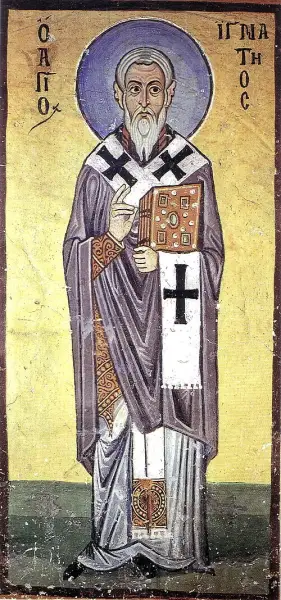
Overview
Ignatius of Antioch, honored as Theophorus, the God-bearer, was an early Christian writer and bishop of Antioch who died a martyr's death in Rome around 108, though some scholars argue for a date decades later. Tradition makes him, with his friend Polycarp, a disciple of John the Apostle, and one ancient story even identifies him with a child whom Jesus took in his arms and blessed. Eusebius records that he succeeded Evodius in the see of Antioch. Condemned for his faith, he was not executed at home but carried under guard across Asia Minor toward Rome, an extraordinary journey during which he met Christian communities and wrote the seven letters on which his fame rests. Those letters, addressed to the Ephesians, Magnesians, Trallians, Romans, Philadelphians, and Smyrnaeans, and to Polycarp of Smyrna, stand among the most important works of the Apostolic Fathers. In them Ignatius proclaimed the true divinity of Christ, called the Eucharist a medicine of immortality, urged loyalty to the single bishop in each city, and gave the first known use of the word catholic for the Church. Thrown to the beasts in the arena, he became one of the most venerated martyrs of the early Church, honoured on October 17 in the West.
The Complete Life
Origins Wrapped in Tradition
Almost nothing solid is recorded of Ignatius before his episcopate; his early life must be read through the words of his own letters and the traditions that gathered around his memory. He is said to have come to Christianity at a young age, a convert whose zeal never afterwards cooled. Ancient tradition links him with Polycarp of Smyrna as a fellow disciple of John the Apostle, a claim that would place him in the last generation with living contact to the world of the Gospels. An even tenderer legend numbers him among the little ones whom Christ gathered into his arms and blessed, an identification that earned him the name Theophoros, the God-bearer, by which he was commonly known. He bore that title in his own correspondence, addressing his readers as one who carried God within him. Whatever weight one gives the legends, they agree in presenting a man formed at the very fountain of apostolic Christianity, in the Greek-speaking world of Roman Syria, who carried its memory into the post-apostolic age. The province of his birth, Syria, was among the earliest heartlands of the faith, and its great city of Antioch would become his life's charge.
§ Life
Bishop of Antioch
Ignatius was chosen to serve as Bishop of Antioch, one of the most ancient and important sees of Christendom, the city where the disciples were first called Christians. The fourth-century historian Eusebius writes that he succeeded Evodius in that office, and the traditional succession lists assign his episcopate from 68 to 107, with Herodion taking up the see after him. Theodoret of Cyrrhus added a still older claim: that the Apostle Peter himself had left directions before his departure that Ignatius be appointed to the episcopal throne of Antioch. Whatever the precise chain of authority, Ignatius led the Antiochene church through the decades when the first generation of believers was dying out and the structures of the second century were being born. His letters later show a bishop consumed with concern for the unity and order of the churches, anxious that each congregation hold fast to its bishop, its presbyters, and its deacons. It was from this pastoral station that he was seized in the persecution that would end his life, taken from the city he had governed, and sent under military escort on the long road that led through Asia Minor to his death in Rome.
§ Life
The Journey of the Ten Leopards
Sentence of death was pronounced on Ignatius for his faith, yet the bishop was not put to death at Antioch: a squad of ten soldiers carried him off toward Rome, whom he described in a famous passage as ten leopards whose treatment grew only worse the better he behaved. Scholars have long found this transport unusual, since Christians condemned in the provinces were normally punished locally, and a chain of explanations has been proposed, from Allen Brent's suggestion that he was sent to provide a spectacle in the Colosseum to Stevan Davies's theory that a legate, lacking authority to impose a death sentence, shipped the prisoner to Rome for trial. The route itself was circuitous: from Antioch he travelled into Asia Minor, reached Smyrna over a road skirting the cities of Magnesia, Tralles, and Ephesus, though the way probably ran through Philadelphia, proceeded to Troas, sailed for Neapolis in Macedonia, passed through Philippi, and continued by land or sea to Rome. At the stops along the way the chained bishop received delegations and whole congregations of Christians, and through their messengers he sent out six epistles to the churches of the region plus a seventh to Polycarp, Smyrna's bishop, turning a death march into one of the most consequential dictations in Christian literature.
§ Route of travel to Rome
Theology Written in Chains
The seven letters Ignatius wrote on the way to his death form a compact summa of second-century Christian belief. He taught without qualification the deity of Christ, confessing in the letter to the Ephesians one Physician uniting flesh and spirit, at once created and uncreated, God present in flesh. He urged on the churches the supreme value of the Eucharist, calling it the medicine of immortality, and regarded persecution and suffering as a source of grace, longing earnestly for the martyrdom he saw before him. He is credited as the first Christian writer known to argue that the Lord's Day had taken the place of the Sabbath, inviting those raised in ancient practices to live in the newness of the day on which their life arose through Christ. His ecclesiology proved even more influential: he is the earliest writer on record to uphold the authority of one bishop over each city, served by its presbyters and deacons, and he gave the first recorded use of the word katholikos, catholic, to describe the whole Church, teaching that wherever the bishop appears, there the Catholic congregation is found. The very term Christianity itself appears among his pages in one of its first known uses, around the year 100.
§ Ecclesiology
Death in the Arena
Ignatius wrote before reaching Rome that he expected to be thrown to the beasts, and the fourth-century historian Eusebius reports a tradition that this is precisely what occurred; Jerome is the first writer to specify lions, and John Chrysostom the first to fix the scene at the Colosseum, though modern scholars doubt whether any of them had sources beyond Ignatius's own writings. Tradition, resting on Eusebius, places his death in the reign of Trajan, though some have argued for later dates, and Étienne Decrept has proposed that he died in July 116 during the festival of Apollo, a response to the earthquake that struck Antioch in late 115. A medieval text, the Martyrium Ignatii, presented as the testimony of his companions Philo of Cilicia and Rheus Agathopus, recounts his confrontation with Trajan and the details of the journey, and relates that after the martyrdom his remains were carried back to Antioch. In the sixth century the Emperor Theodosius II moved the revered remains to the Tychaeum, the temple of Fortune, and converted it into a church bearing Ignatius's name, so that the bishop who had died far from home was enthroned at last in the heart of his own city.
§ Death and aftermath
Veneration Across the Churches
Ignatius belongs to the earliest company of the Church's saints, honoured from pre-congregation times without any formal process; a later tradition even says that John the Apostle himself canonized him. His memory spread across the whole Christian world, and his feast came to be kept on different days by different churches. In his own Antioch his feast was observed on October 17, the date now kept by the Catholic Church and generally in Western Christianity, including the Church of England and the Lutheran churches; from the twelfth century until 1969 the Roman calendar instead assigned it to February 1. The Eastern Orthodox Church celebrates him on December 20. The Synaxarium of the Coptic Orthodox Church marks his martyrdom on 24 Koiak, a date corresponding in three years out of four to December 20 of the Julian calendar, and keeps a commemoration on 7 Epip. The Armenian Apostolic Church remembers him on the Monday after the fourth Sunday of Advent. His principal shrine is the Basilica of San Clemente in Rome, where his relics have rested since 637, and he is venerated not only by Catholics and Orthodox but by Oriental Orthodox, the Church of the East, Anglicans, and Lutherans alike.
§ Veneration
Seven Letters and a Thousand Questions
The seven letters of Ignatius, cited by Eusebius in the early fourth century, are generally judged authentic and rank him with Clement of Rome and Polycarp among the three most important Apostolic Fathers. Their text survives in three recensions: a Short Recension in pre-900 Syriac manuscripts, the Middle Recension now accepted as original, and an interpolated Long Recension produced by a fourth-century Arian who also forged six spurious letters under Ignatius's name. The text's history is dramatic. For a time only the Long Recension was known; in 1628 Archbishop James Ussher discovered a Latin translation of the Middle Recension and published it in 1646, and John Pearson's defence of that text in the late seventeenth century fixed the scholarly consensus. William Cureton published the Syriac Short Recension in the mid-nineteenth century, and Calvin himself had dismissed the letters as rubbish published under Ignatius's name, while William Dool Killen argued in 1886 that Pope Callixtus I had forged them. Modern debate over dating and authenticity continues, with most patristic scholars accepting the seven letters, yet the letters that treat church order, the sacraments, and the office of bishops remain, whatever the verdict of any generation, a foundational witness to the Church in its second-century youth.
§ Recensions
Timeline
- 33
Born around this year in the province of Syria, according to the traditional dating of his life.
§ Life
- 68
The succession lists place the beginning of his episcopate at Antioch in this year, succeeding Evodius.
§ Life
- 107
His tenure as bishop of Antioch ended, with Herodion listed as his successor.
§ Life
- 108
He died a martyr in Rome around this date, thrown to the beasts as he had foretold in his letters.
§ Date of martyrdom
- 116
Étienne Decrept has argued from John Malalas and the Acts of Drosis that he was martyred in July of this year under Trajan.
§ Date of martyrdom
- 637
When Antioch fell to the Rashidun Caliphate, his relics were moved to the Basilica di San Clemente in Rome.
§ Death and aftermath
- 1628
Archbishop James Ussher discovered a Latin translation of the Middle Recension of the letters.
§ Recensions
- 1646
Ussher published the Middle Recension he had found, opening the long debate over which text was original.
§ Recensions
In Their Own Words
From Syria even unto Rome I fight with beasts, both by land and sea, both by night and day, being bound to ten leopards, I mean a band of soldiers...
Let my spirit be counted as nothing for the sake of the cross, which is a stumbling-block to those that do not believe, but to us salvation and life eternal.
Wherever the bishop appears, there let the people be; as wherever Jesus Christ is, there is the Catholic Church.
There is one Physician who is possessed both of flesh and spirit; both made and not made; God existing in flesh; true life in death; both of Mary and of God; first passible and then impassible, even Jesus Christ our Lord.
I watch over you betimes to protect you from wild beasts in human form.
The Record
- Major works
- Epistle to the Ephesians·Epistle to the Magnesians·Epistle to the Trallians·Epistle to the Romans·Epistle to the Philadelphians·Epistle to the Smyrnaeans·Epistle to Polycarp
- Patron of
- Church in eastern Mediterranean·Church in North Africa
- Symbols
- surrounded by lions·chains
- Canonization
- Pre-congregation; later writings say John the Apostle canonized him.
Prayer
Bibliography
Show 6 sources
- Davies, Stevan L. (1976). "The Predicament of Ignatius of Antioch". Vigiliae Christianae. 30 (3): 175–180. doi: 10.1163/157007276X00249. JSTOR 1583332.
- Brent, Allen (2007). Ignatius of Antioch - A Martyr Bishop and the Origin of Episcopacy. New York: T&T Clark. ISBN 9780567032003.
- Barnes, Timothy D. (December 2008), "The Date of Ignatius", The Expository Times, 120 (3): 119–130, doi: 10.1177/0014524608098730, S2CID 170585027.
- Trevett, Christine (1989). "Ignatius "To the Romans" and 1 Clement LIV–LVI". Vigiliae Christianae. 43 (1): 35–52. doi: 10.1163/157007289X00173. JSTOR 1584438.
- Farmer, David, The Oxford Dictionary of Saints, Oxford University Press, 2011, ISBN 978-0-19959660-7, p. 220.
- Lightfoot, Joseph Barber (1889). The Apostolic Fathers - Revised Texts with Introductions, Notes, Dissertations and Translations. S. Ignatius, S. Polycarp (Second ed.). Macmillan. pp. 413–415.
Profile text adapted from the Wikipedia article, licensed CC BY-SA 4.0.
Pray with this saint every day
Save St. Ignatius of Antioch to your favorites, read the full profile, and get feast-day reminders in the Saints app.
Get the Saints AppFree on the App Store for iPhone and iPad