
1701 – 1781·Feast May 11
St. Ignatius of Laconi
Capuchin quester of the poor of Cagliari
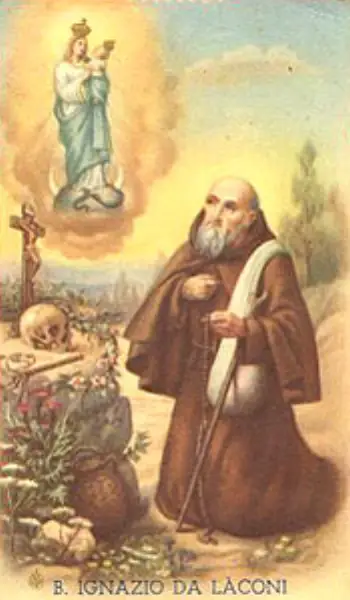
Overview
Ignatius of Laconi, born Francesco Ignazio Vincenzo Peis on 10 December 1701 in Sardinia, was a Capuchin friar whose quiet labours made him one of the island's best-loved saints. The son of poor peasants, he worked in the fields until a grave illness at about seventeen drew from him a vow to give his life to God in the Capuchin order. After recovering, and after a second deliverance when his frightened horse nearly threw him, he received his parents' blessing and entered the novitiate at Cagliari on 10 November 1721. Too frail for the missions, he served his friary for fifteen years in the weaving shed, and from 1737 until his death he went out daily as the quester of alms through the streets of Cagliari. The people came to see in the silent, gentle beggar a living sermon: he instructed children, comforted the sick, and urged sinners to penance, while obeying his superiors with absolute exactness. Famous as a wonder worker, he was credited with 121 miracles during his life. Blind from 1779, he laboured on until his death on 11 May 1781. Beatified in 1940 and canonized in 1951 by Pope Pius XII, his body remains incorrupt in Cagliari.
The Complete Life
A Peasant Son of Laconi
Francesco Ignazio Vincenzo Peis was born on 10 December 1701 in Laconi, in the Kingdom of Sardinia, the second of seven children of Mattia Peis Cadello and Anna Maria Sanna Casu, poor peasants who struggled to feed their family. His mother's pregnancy had been difficult, and she had invoked the intercession of Francis of Assisi for her child; in gratitude the boy was baptized with Francis's name among his own. From his earliest years he showed the piety that would shape his whole life: he liked to call the local church his home, and he took Lawrence of Brindisi, the Capuchin preacher and doctor of the Church, as his personal model. His childhood was one of labour, not schooling, for he laboured in the fields to sustain his parents. The turn toward religious life came through suffering: at about the age of seventeen, around 1719, he fell gravely ill and promised God that if he recovered he would consecrate himself and join the Order of Friars Minor Capuchin. He did recover, but the fulfilment of the promise was delayed, for his father, who depended on the boy's labour in the fields, persuaded him to wait, and there were signs that his parents resisted the idea altogether.
§ Life
The Renewed Vow and the Novitiate
Providence gave the hesitant young man a second summons. In 1721 the horse he was riding panicked, and he was in real danger of being thrown to his injury or death; he called upon Francis of Assisi, whose intercession had marked his birth and his baptismal name, and renewed the vow made in his illness. This time his parents raised no objection and granted him their blessing to become a friar. He asked for admission at the Capuchin convent in Cagliari, but the superiors hesitated, knowing his delicate health and fearing the austere life would break him. Only when an influential friend pleaded his cause did he gain admission to the novitiate on 10 November 1721, taking the religious name Ignatius. He made his profession a year later, on 10 November 1722. Frail as he was, his ardour carried him through the spiritual exercises of the order and made him an example in the observance of the Rule. From 1722 until 1737 he worked in the house's weaving shed, a hidden apprenticeship in humility, before the friars appointed him to the office through which all Cagliari would one day know his name: the quester of alms.
§ Life
Quester of Alms in Cagliari
From 1737 until his death forty-four years later, Ignatius walked the streets of Cagliari as the friary's beggar of alms, and transformed the office into a ministry. The people of the city discovered that the friar who asked for bread was himself giving something back, for his modest bearing as he went from door to door was felt as a quiet sermon preached without words. He seldom spoke, but when speech was required he answered with exceptional kindness and affection. To the children and the uneducated he gave simple instruction in the faith; he sought out the sick to comfort them, and urged sinners to be converted and to do penance. He was generous to all who were ill, mingling freely with every class of person he met, and his reputation as a wonder worker spread through the island, so that his cause would later record 121 miracles attributed to him during his lifetime. The poor of Cagliari, the students who watched him pass, and the whole city came to regard the begging friar as their own possession, a saint in their streets whose begging was, in truth, an unbroken act of charity in both directions.
§ Life
Obedience Unto the Denial of His Own Will
Obedience, unswerving and wholehearted, toward his superiors was what Ignatius was known for above all, even where it required the surrender of his own judgment. The stories told of him after his death show what that obedience cost. He had refused to call at the house of a certain usurer, fearing that alms taken from an unjust man would make him a sharer in the injustice; the man protested, the superior commanded acceptance, and when Ignatius came home and opened the sack, blood was seen to flow from it. To those standing by he said that what flowed there was the blood of the poor, wrung from them by usury, a rebuke he delivered only because obedience had put him in the way of it. His sister wrote again and again asking him to visit for his advice; he had no mind to go until his superior commanded, and then he went at once and left the moment the advice was given. When his own brother was sent to prison and the family hoped his reputation would win a pardon, his superior sent him to the governor, and he requested merely that justice take its course with his brother. Grace, not favour, was the currency he dealt in.
§ Life
Blindness and a Quiet Death
The friar's health had never been robust, and the superiors of 1721 had been right to fear for him, yet he continued his arduous round of labour without complaint into extreme old age. In 1779, two years before his death, his sight failed entirely, and the quester who had walked the streets of Cagliari for four decades went blind among the people he served. Even this he did not allow to end his work; he continued to labour for the benefit of those around him as far as his blindness permitted, the beloved figure of the city no longer able to see the faces that venerated him. He died on 11 May 1781 at three in the afternoon, in his eightieth year, in Cagliari, the city that had become his second home and the scene of every hour of his religious life. His remains were interred there, and the grave was almost at once a place where the faithful reported miracles, wonders that would flourish for generations and would form one of the pillars of the cause that eventually carried the humble quester to the altars of Saint Peter's Basilica.
§ Life
From Tomb to Canonization
The process that led to Ignatius's canonization began long after his death but moved steadily through every stage. The diocesan cause was opened in 1844 amid numerous reports of miracles at his tomb in Cagliari, and in 1868 the positio presenting his life and deeds reached the Congregation for the Causes of Saints. On 26 May 1869 Pope Pius IX, having confirmed the heroic virtue of the friar, declared him Venerable. Two miracles verified after his death opened the way to beatification, which Pope Pius XII presided over on 16 June 1940 in Saint Peter's Basilica. After two further wonders were ratified following the beatification, the same pope canonized Ignatius on 21 October 1951 in the same basilica. The records of the cause preserved the scale of the popular conviction behind these decrees: 121 miracles attributed to the friar during his lifetime and 86 more reported after his death. His body, preserved in Cagliari, remains incorrupt, and his cult has continued to grow: on 11 May 2007 he was proclaimed patron of the Province of Oristano, and on the same day in 2014 a statue in his honour was unveiled at Sestu.
§ Veneration
Patron of Beggars and Students
The legacy of Ignatius of Laconi rests on the union of two things rarely joined: absolute poverty of means and inexhaustible generosity of spirit. He is honoured as a patron of beggars, the class with whom he spent his life in solidarity, asking alms not for himself but for his friary and the poor it served, and as a patron of students, who see in the peasant friar who taught children in the streets a model of patient learning and simple faith. In Sardinia his memory has remained vivid from generation to generation: the Sardinian language keeps his name in its own form, Ignatziu dae Làconi, and the island regards him as one of its own glories, alongside the Francis of Assisi whose intercession marked his birth and whose order he adorned. The Franciscan habit in which he is portrayed recalls the order whose Rule he observed so exactly, and the incorrupt body in Cagliari draws pilgrims as his tomb drew them in the first years after 1781. For the Church at large he remains the witness that a life without office, without writings, and without travels can convert a whole city, if it is spent daily in the service of the poor.
§ Veneration
Timeline
- 10 Dec 1701
Born in Laconi, the second of seven children of the poor peasants Mattia Peis and Anna Maria Sanna.
§ Life
- 1719
A serious illness at about seventeen led him to vow that he would consecrate his life to God as a Capuchin.
§ Life
- 1721
When his panicked horse nearly threw him, he called on Francis of Assisi and renewed his vow; his parents then gave their blessing.
§ Life
- 10 Nov 1721
Received into the novitiate at the Capuchin convent in Cagliari after an influential friend interceded for him.
§ Life
- 10 Nov 1722
Made his religious profession as a Capuchin friar.
§ Life
- 1737
After fifteen years in the weaving shed, he was appointed the house's quester of alms.
§ Life
- 1779
Went blind, yet laboured on for the good of all about him.
§ Life
- 11 May 1781
Died at three in the afternoon in Cagliari, where his remains were interred.
§ Life
- 1844
The diocesan-level cause for his beatification was opened, with numerous miracles reported at his tomb.
§ Veneration
- 26 May 1869
Pope Pius IX, after confirming his heroic virtue, declared him Venerable.
§ Veneration
- 16 Jun 1940
Pope Pius XII presided over his beatification at Saint Peter's Basilica after two miracles were confirmed.
§ Veneration
- 21 Oct 1951
Pope Pius XII canonized him in Saint Peter's Basilica on the strength of two further miracles.
§ Veneration
- 11 May 2007
He was proclaimed patron saint of the Province of Oristano.
§ Veneration
- 11 May 2014
His statue was unveiled at Sestu.
§ Veneration
The Record
- Patron of
- patron of beggars·patron of students·patron of the Province of Oristano
- Symbols
- Franciscan habit
- Canonization
- Canonized 21 October 1951 at Saint Peter's Basilica by Pope Pius XII.
Prayer
Bibliography
Show 5 sources
- "Saint Ignatius of Laconi". Saints SQPN. 2 June 2017. Retrieved 28 August 2017.
- "May 11: St. Ignatius of Laconi". Capuchin Franciscans. 11 May 2011. Archived from the original on 27 January 2020. Retrieved 28 August 2017.
- "Saint Ignatius of Laconi". Santi e Beati. Retrieved 28 August 2017.
- "Saint Ignatius of Laconi". Franciscan Media.
- "St. Ignatius of Laconi, OFMCap". Franciscans Western America Province. Archived from the original on 27 January 2020.
Profile text adapted from the Wikipedia article, licensed CC BY-SA 4.0.
Pray with this saint every day
Save St. Ignatius of Laconi to your favorites, read the full profile, and get feast-day reminders in the Saints app.
Get the Saints AppFree on the App Store for iPhone and iPad