
1491-1556·Feast July 31
St. Ignatius of Loyola
Priest, Founder of the Society of Jesus
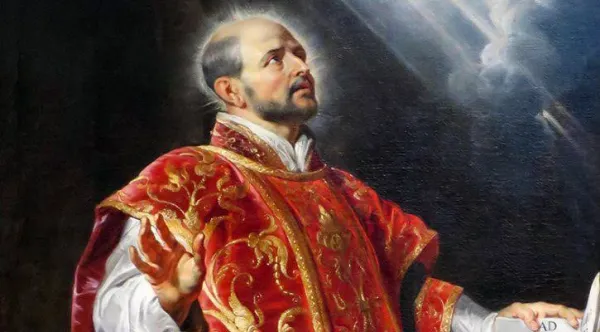
Overview
Íñigo López de Oñaz y Loyola was born around 23 October 1491 in the castle at Loyola, youngest of thirteen children of a Basque noble house. A page in a treasurer's household and then a soldier under the Duke of Nájera, he lived for fencing, gambling, fine clothes and fame, modeling himself on the knights of romance. At the siege of Pamplona on 20 May 1521 a cannonball shattered his leg; through successive brutal operations and a long convalescence, the only books in the castle were a life of Christ and lives of the saints, and reading them he noticed that worldly daydreams left him dry while holy ones left him in peace, his first lesson in discernment. Recovered, he kept an all-night vigil at Montserrat, hung up his sword, and spent a year of prayer and penance in a cave near Manresa, where the substance of the Spiritual Exercises took shape. Studies at Barcelona, Alcalá and Paris followed, with a brush with the Inquisition on the way. In Paris he gathered six companions; on 15 August 1534 they vowed their common work at Montmartre. The Society of Jesus was approved by Paul III in 1540, and Ignatius, ordained priest and elected first Superior General, spent his last years in Rome writing its Constitutions and sending men to the missions until his death on 31 July 1556.
The Complete Life
Early Life
Íñigo López de Loyola was born in 1491 at the family castle of Loyola near Azpeitia in the Basque province of Gipuzkoa, the youngest of the thirteen children of Beltrán Ibáñez de Oñaz y Loyola and Marina Sánchez de Licona. His was the lesser nobility of a warlike frontier society, and Íñigo took to its code whole: sent as a boy to be a page in the household of Juan Velázquez de Cuéllar, treasurer of Castile, at Arévalo, he grew into a courtier and soldier, vain, ambitious, and, by his own later account, given to gambling, duels, and the pursuit of women. In 1521, defending the fortress of Pamplona against a French army that vastly outnumbered the garrison, he had his leg shattered by a cannonball. The French, admiring the defense, carried him home to Loyola. A series of brutal operations, including the rebreaking of the poorly set bone so that he need not be lame, nearly killed him; during the long convalescence, finding no romances in the house and only a Life of Christ and a collection of saints' lives, he read them, and began to notice the different aftertaste of his two kinds of daydream.
§ Early life
Conversion and Vocation
The reading worked on him: the worldly fantasies left him dry, the thought of imitating the saints left him consoled, and Íñigo resolved to change his life. As soon as he could walk he made a pilgrimage: a night's vigil in arms before the image of Our Lady at the Benedictine abbey of Montserrat, where he hung up his sword and dagger, and then, instead of continuing to Jerusalem at once, nearly a year at nearby Manresa, where he lived in prayer, fasting, and scrupulosity, underwent the interior trials he would later describe, and received the graces that underlie the Spiritual Exercises — including, by the Cardoner river, an experience of illumination he regarded as the greatest of his life. He reached Jerusalem in 1523, was sent home by the Franciscans who controlled pilgrimage, and then, already past thirty, began to study: grammar at Barcelona, arts and theology at Alcalá and Salamanca, where his attempts to help souls while still a student brought him before the Inquisition, and finally the University of Paris from 1528, where he took the master's degree and gathered the companions who became the first Jesuits, among them Peter Faber and Francis Xavier; in 1534 he and six of them bound themselves by vows at Montmartre.
§ External links
Mission and Ministry
Ordained in 1537, Ignatius and his companions, now nine, put themselves at the Pope's disposal for whatever service was asked. The decisive step came in Rome in 1540, when Paul III approved the Society of Jesus by the bull Regimini militantis Ecclesiae: a religious order of priests, free of the choral office, bound by a special vow of obedience to the Pope concerning missions, mobile rather than monastic, and organized militarily under a Superior General for life — Ignatius himself, elected reluctantly. He spent his last sixteen years in Rome, the desk general of a dispersed army, writing some seven thousand letters of instruction, sending Xavier to the Indies and others to Ethiopia, India, Brazil, and Protestant Europe, and above all building the Society's colleges, which had begun as houses for the education of its own novices and became, within his lifetime, a European school system. He also dictated the Jesuit Constitutions, worked out through years of deliberation with the advice of the whole Society, and finalized the text of the Spiritual Exercises.
§ Foundation of the Jesuit order
Spirituality and Teaching
Ignatius's teaching is contained almost entirely in the Spiritual Exercises, a book of directions for a retreat-giver rather than a text to be read, composed over the Manresa years and polished at Rome until its approval in 1548. Its architecture is the four weeks: sin and its consequences, the kingdom, the two standards, the following of Christ, and the risen Christ's appearances; its presuppositions are the indifference of the retreatant to all created things, the search not for what is more but for what is more for the greater glory of God — the magis — and the discernment of spirits by the consolation and desolation the meditations produce. The Exercises end with the Contemplation to Attain Love, which gathers the whole into finding God in all things. This is the specifically Ignatian contribution: not new doctrine but a method, tested on his own soul, by which an ordinary person can, in silence and under guidance, come to a free election of life; and its corporate consequences — the examination of conscience, the rules for thinking with the Church, the emphasis on obedience and on work in the world rather than out of it — shaped the Jesuit character for four centuries.
§ Citations
Trial and Final Years
Ignatius's final years were those of an invalid administrator. His health, ruined at Pamplona and by the Manresa austerities, declined through the 1550s; he suffered from stomach trouble and recurrent fever, and by 1551 had asked to be relieved of the generalate, the request being refused. He continued to govern from his rooms at the professed house near the church of the Gesù, which he had built for the Society in Rome, correcting the Constitutions, settling disputes in colleges from Goa to Messina, and receiving visitors. He died suddenly and quietly at Rome on the morning of 31 July 1556, leaving the Society he had governed for fifteen years numbering about a thousand members with some hundred houses, colleges, and missions on four continents, and — by his own deliberate choice, since he had been pressed to — no finished veneration of his own person. He was, by the end, governing by letter an organization he could no longer visit, and the letters of his last years — instructions on obedience, on the education of novices, on the conduct of missions — are counted among the primary documents of Jesuit spirituality.
§ Citations
Canonization
The cause opened almost at once, and the delay that followed was political rather than skeptical: opposition from parties at Rome hostile to the Society, and the general Spanish-Italian jealousy of a new order, slowed it for decades. Paul V beatified Ignatius on 27 July 1609; Gregory XV canonized him on 12 March 1622, in the same ceremony that canonized Francis Xavier, Teresa of Ávila, Philip Neri, and Isidore the Farmer — a famous quintet whose common elevation announced the two great currents of early modern Catholic sanctity, the mystic-reformer and the missionary. His feast, kept on 31 July, is the dies natalis of his death. At his canonization in 1622 the juxtaposition with Teresa of Ávila was noticed by everyone: the Basque soldier and the Castilian mystic, the two architects, with Charles Borromeo and Philip Neri, of the Catholic restoration, were raised to the altar together. Numerous miracles were attested in the process, and devotion to him had already spread far beyond the Society through the Exercises and the colleges; pilgrims to the Gesù in Rome, where his body lies under the altar of the left transept in L. A. Gagini's baroque chapel, made him one of the most visited of early modern saints.
§ External links
Legacy
The legacy is the Society of Jesus and everything it built: the missions of Asia and the Americas, the school network that educated Europe's elites for three centuries under the Ratio Studiorum, and a style of Catholic engagement with the modern world, at once disciplined and adventurous, that has outlasted the order's suppression and restoration. The Spiritual Exercises remain the most influential Catholic retreat format in existence, given annually to hundreds of thousands, lay and religious, in everything from thirty-day houses to the everyday examen of prayer; their fingerprints are on the vocabulary of discernment now common far beyond the Jesuits. Ignatius is invoked as patron of retreats and of soldiers, and the annual election of a Superior General by the Society he designed is still conducted under the Constitutions he dictated. Biographically he is the standing type of the convert whose second life outran everyone's expectations: a broken courtier from a Basque castle becoming, at an age when his contemporaries were settling their estates, the administrator of a worldwide enterprise he had invented.
§ Foundation of the Jesuit order
Timeline
- 23 Oct 1491
Born Inigo Lopez de Onaz y Loyola at the castle of Loyola in Azpeitia, Gipuzkoa, in the Crown of Castile.
§ Introduction
- 1509
Took up arms at eighteen for Antonio Manrique de Lara, 2nd Duke of Najera, beginning his military career.
§ Military career
- 20 May 1521
Gravely wounded at the Battle of Pamplona when a cannonball shattered his right leg, ending his soldiering days.
§ Military career
- Mar 1522
During convalescent conversion he visited Santa Maria de Montserrat, confessed, and hung his sword and dagger at the Virgin's altar.
§ Religious conversion and visions
- 3 Sep 1523
Made a pilgrimage to the Holy Land, remaining from the 3rd to the 23rd of September before the Franciscans sent him back.
§ Period of studies
- 1526
Began studying theology and Latin at the University of Alcala, where he later faced Inquisition interrogation.
§ Period of studies
- 15 Aug 1534
In the chapel of the Martyrium of Saint Denis at Montmartre, he and six companions took solemn vows of their lifelong work.
§ Period of studies
- 1535
Earned his master's degree in Paris at forty-three and was thereafter often addressed as Master Ignatius.
§ Period of studies
- 1539
Formed the Society of Jesus together with Peter Faber and Francis Xavier.
§ Foundation of the Jesuit order
- 1540
The Society of Jesus received papal approval from Pope Paul III.
§ Foundation of the Jesuit order
- 1541
Chosen the first Superior General of the Jesuits in Paris, invested with the title Father General.
§ Introduction
- 1541
Bade Francis Xavier farewell before the missionary left for India with the words Ite, inflammate omnia.
§ Foundation of the Jesuit order
- 1548
Recorded his method of spiritual formation in the Spiritual Exercises, later known as Ignatian spirituality.
§ Introduction
- 1553
The Jesuit Constitutions, written with his secretary Polanco, were adopted, creating a centralised organisation for the order.
§ Foundation of the Jesuit order
- 1553
As his health failed he dictated the testament of his life to the Jesuit Louis Gonzalez.
§ Death and canonization
- 1555
His dictated testament was published as an autobiography.
§ Death and canonization
- 31 Jul 1556
Died in Rome, most likely from Roman Fever, a particularly severe strain of malaria common in the city.
§ Death and canonization
- 1 Aug 1556
Buried in priestly robes in the crypt of the Maria della Strada Church in Rome.
§ Death and canonization
- 1568
His remains were reinterred in a new coffin when the Church of the Gesu replaced the demolished Maria della Strada.
§ Death and canonization
- 27 Jul 1609
Beatified by Pope Paul V in Rome.
§ Death and canonization
- 12 Mar 1622
Canonized by Pope Gregory XV in Rome.
§ Death and canonization
- 1922
Pope Pius XI named him heavenly patron of every spiritual retreat.
§ Introduction
In Their Own Words
Go, set the world on fire.
We should always be prepared so as never to err to believe that what I see as white is black, if the hierarchical Church defines it thus.
Take, Lord, and receive all my liberty, my memory, my understanding, and my entire will, All I have and call my own. You have given all to me. To you, Lord, I return it. Everything is yours; do with it what you will. Give me only your love and your grace, that is enough for me.
The Record
- Major works
- Spiritual Exercises·Jesuit Constitutions·Autobiography (dictated to Louis Gonzalez)
- Patron of
- Society of Jesus·Basque provinces of Gipuzkoa and Biscay·Catholic soldiers·Spiritual retreats (declared by Pope Pius XI, 1922)·Military Ordinariate of the Philippines
- Symbols
- Jesuit cassock·Book of the Spiritual Exercises·Cannonball (his wound at Pamplona)·Motto: Ad maiorem Dei gloriam
- Canonization
- Beatified 27 July 1609 by Pope Paul V; canonized 12 March 1622 by Pope Gregory XV
Prayer
Bibliography
Show 1 sources
- ↑ / ɪ ɡ ˈ n eɪ ʃ ə s / ig- NAY -shəs ; Basque : Ignazio Loiolakoa ; Spanish : Ignacio de Loyola ; Latin : Ignatius de Loyola
Profile text adapted from the Wikipedia article, licensed CC BY-SA 4.0.
Pray with this saint every day
Save St. Ignatius of Loyola to your favorites, read the full profile, and get feast-day reminders in the Saints app.
Get the Saints AppFree on the App Store for iPhone and iPad