
died 6th century·Feast January 13 (also given as January 14 or 15; lapsed)
St. Ilar
Breton Missionary and Martyr of Ceredigion
Overview
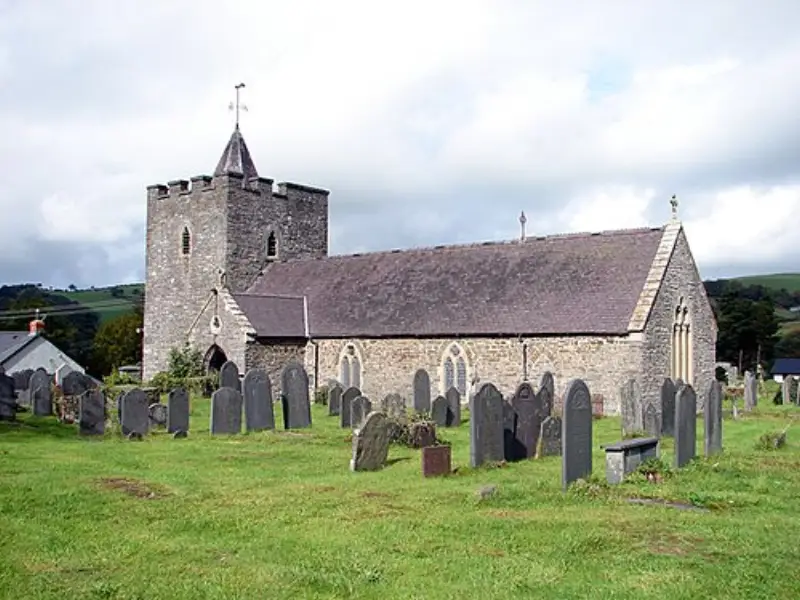
Ilar, whose name appears in Latin as Hilarus or Elerius, stands among the saints of sixth-century Wales, yet he remains one of its most obscure figures, for few details of his life survive beyond his name. Surviving records describe him as a Breton, a companion of Padarn and of Cadfan on their sixth-century mission to Wales, and it has been suggested that he came from Armorica, the Brittany of his fellow countrymen. The geography of his cult fits that mission: the parishes that bear his name lie to the south of Tywyn, which is credited to Cadfan, and near others credited to Padarn. He is the probable namesake of the parish church of Llanilar in Ceredigion and of the former hundred of Ilar, and the church at Trefilan is likewise dedicated to him, the village name being a corruption of Tref Ilar, the town of Ilar. Honoured as a martyr, he is thought to have met his death at the hands of the pagan Irish or Saxon invaders of the period. His feast was once assigned to the middle of January but has fallen out of observance in Wales.
The Complete Life
A Breton Among the Saints of Wales
The little that can be said of Ilar's origins comes from the early lists and learned collections of Welsh hagiography. There he is named as a Breton, associated with Armorica as his possible homeland, and joined to two of the great figures of the sixth-century British Church: Padarn and Cadfan. With them he is reckoned a companion of the mission by which Brittany and Wales exchanged saints, scholars and foundations across the Irish Sea and the Channel. Such companionship implies a monastic formation of the Celtic type, in which a holy man left kin and country to place himself under a master or to labour beside him in a new field. That Ilar belonged to this world is confirmed by the arrangement of the dedications that bear his name. The parishes associated with him stand in Ceredigion, to the south of Tywyn, the island church credited to Cadfan, and close to parishes credited to Padarn, so that his cult occupies precisely the ground his companions evangelized. The early genealogies of the Welsh saints, for all their confusions, preserve him in exactly this company.
§ Life
Mission and Martyrdom in Ceredigion
Ilar's work in Wales is written not in documents but in the map. The parish church of Llanilar in Ceredigion is his probable memorial, taking its name from him as so many Welsh llanau took theirs from the saints who first planted the faith there, and the medieval hundred of Ilar likewise preserves it across a whole district of the county. A second church, at Trefilan near Lampeter, is also dedicated to him, and the very name of the community is understood to have worn down from an original Tref Ilar, the town of Ilar. Tradition gives him the crown of martyrdom, honouring him under the title of martyr and attributing his death to the pagan raiders of the age, whether Irish or Saxon, whose incursions troubled the coasts and valleys of sixth-century Wales. His feast was assigned to the middle of January, with different authorities giving the thirteenth, the fourteenth or the fifteenth of the month, a divergence that itself testifies to the antiquity and local variety of his observance, though the feast has since lapsed and is no longer kept by either Anglican or Catholic church in Wales.
§ Life
A Saint Entangled with Hilary
No process of canonization stands behind Ilar's title; he belongs to the pre-congregation saints, named in the early lists of the sixth-century holy men of Wales. His memory, however, has been persistently entangled with that of a far more famous namesake, Hilary of Poitiers, the fourth-century bishop and confessor who died peacefully in his bed. Medieval and later writers constantly confused the two, and the confusion was encouraged by the near coincidence of their feasts, for Hilary of Poitiers was honoured on the thirteenth of January, one of the very days given for Ilar. To keep them apart, Welsh tradition assigned Ilar a set of distinguishing epithets: Ilar Bysgotwr, Hilary the Fisherman; Ilar Droedwyn, Hilary Whitefoot; and Ilar Ferthyr, Hilary the Martyr, which could never be said of the bishop of Poitiers. Another Hilary, Pope Hilarius of the fifth century, was likewise drawn into Welsh legend and credited with giving Saint Elvis his orders as bishop, by whom Saint David was afterward baptized. Baring-Gould even suggested that some dedications of Saint Hilary in Wales may originally have belonged to Ilar himself, or to Elian, Cybi's kinsman.
§ Name and Identity
Churches, Poets and Storytellers
Ilar's name proved more durable than the records of his life. Richard Rees and other antiquaries judged that the various Welsh churches of Saint Hilary might all be remnants of dedications to Ilar, among them the parish church of Llanilar, the church at Trefilan, and churches at Erbistock near Wrexham and Killay in Swansea, together with the Glamorgan village of St Hilary beside Cowbridge, all of them administered today by the Church in Wales. Baring-Gould, weighing the evidence, thought the Cowbridge church was certainly dedicated to the French bishop rather than to the Breton martyr, and an account in the Iolo Manuscripts, a collection marred by forgery, conflicts with the antiquarian consensus. The name lived in Welsh poetry as well: the fifteenth-century bard Lewis Glyn Cothi composed a line invoking gwyl Ilar hael a'i loer hir — rendered, the feast of Ilar the generous, attended by his long moon — whose meaning has teased commentators ever since. In the twentieth century Ilar passed into literature of another kind, for Arthur Machen set the saint, his holy well and his legends, together with his accidental replacement by the French bishop, at the heart of his Grail story The Secret Glory and its earlier form Levavi Oculos.
§ Legacy
The Record
- Patron of
- Llanilar·Trefilan in Ceredigion
- Canonization
- Pre-congregation; listed among the 6th-century saints of Wales
Prayer
Bibliography
Show 5 sources
- Stanton, Richard. A Menology of England and Wales. Burns & Oates, 1892, p. 703
- Williams, Robert. Enwogion Cymru: A Biographical Dictionary of Eminent Welshmen. Longman & Co. (London), 1852, p. 242
- Rees, Rice. An Essay on the Welsh Saints or the Primitive Christians Usually Considered to Have Been the Founders of Churches in Wales. Longman, Rees, Orme, Brown, Green, & Longman (London), 1836, p. 224
- Baring-Gould, Sabine & al. The Lives of the British Saints, Vol. III. Chas. Clark (London), 1908, pp. 299 f.
- Bartrum, Peter C. A Welsh Classical Dictionary: People in History and Legend up to about A.D. 1000. National Library of Wales, 1993, p. 438
Profile text adapted from the Wikipedia article, licensed CC BY-SA 4.0.
Pray with this saint every day
Save St. Ilar to your favorites, read the full profile, and get feast-day reminders in the Saints app.
Get the Saints AppFree on the App Store for iPhone and iPad