
607 – 667·Feast January 23
St. Ildefonsus
Archbishop of Toledo and Marian theologian
Overview
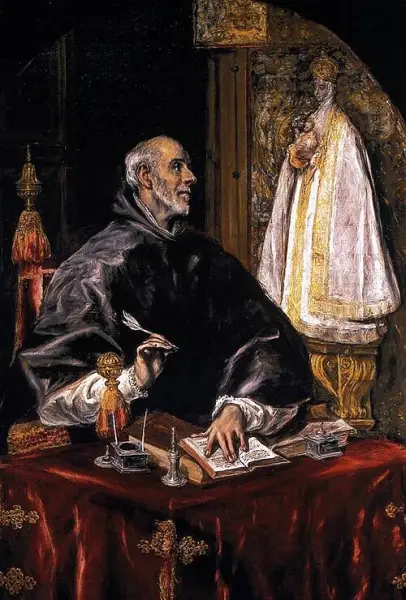
Ildefonsus, known in Gothic as Hildefuns, united the work of a scholar and theologian with ten years as metropolitan archbishop of Toledo, dying on 23 January 667. Born on 8 December 607 into a prominent Visigothic family during the reign of King Witteric, he was educated by his uncle Eugenius, who would later occupy the same episcopal throne. Ordained a deacon by Bishop Eladius of Toledo around 632, he defied his family's plans by becoming a monk at the monastery of Agali outside the city, where, before any advancement of his own, he established a house of nuns and furnished its endowment. Elected abbot of Agali in 650, he sat among the fathers at the eighth and ninth Councils of Toledo. On the death of his uncle, Bishop Eugenius II, in 657, King Recceswinth forced the unwilling monk to accept election as bishop of Toledo. His great work, De perpetua virginitate Mariae, became the centre of Spanish Marian devotion and is credited with shaping the Spanish custom of calling Mary the Virgin. Legend relates that on 18 December 665 the Mother of God appeared to him in the basilica and vested him with a chasuble from heaven. Buried at the Church of Santa Leocadia, he remains a patron saint of Toledo and Zamora.
The Complete Life
A Noble Youth of Visigothic Toledo
Ildefonsus was born in Toledo on 8 December 607, a son of one of the prominent families of the Visigothic kingdom, at a time when King Witteric held the throne. His entire youth was shadowed by the civil wars that tore at the Gothic realm through most of his lifetime, a disorder that forms the political backdrop to his quiet, scholarly career. The decisive influence of his boyhood was his uncle Eugenius, himself destined for the bishopric of Toledo, who took charge of educating the devout young man. From his uncle he received both the learning and the ecclesiastical ambition that his family had mapped out for him; unlike many noblemen's sons, however, he would eventually redirect that ambition away from the career his relatives intended. Around 632, when Eladius held the see of Toledo, Ildefonsus was ordained a deacon, formally entering the clergy of the city. Even at this stage his path diverged from expectation: rather than pursuing the comfortable advancement his family planned, he chose the monastic state, entering the monastery of Agali just outside Toledo, a decision that defied his relatives and set the pattern of a life governed by conscience rather than convenience.
§ Life
Monk of Agali and Abbot
At Agali Ildefonsus embraced the monastic life with the same intensity he had refused to spend on courtly advancement. Though still a monk of no office or standing, he established a monastery of nuns and furnished its endowment, an act of patronage that reveals both his means and his zeal for the contemplative life. In 650 the community elected him abbot of Agali, and in that capacity he became a figure in the affairs of the Iberian church, attending two of its great assemblies, the eighth and ninth Councils of Toledo. The councils made him known to the bishops of Hispania and to the court; it was probably at one of them that he served as a reporter, a role his successors remembered. When his uncle Eugenius II died in 657, the election of a successor turned inevitably to the abbot of Agali, the dead bishop's own nephew and protégé of his teaching. Ildefonsus did not want the office, and King Recceswinth had to compel him to accept it; he later complained of the matter to Quiricus of Barcelona, the young bishop under his patronage. Thus the monk who had once fled his family's plans for advancement found the kingdom itself forcing the mitre upon him.
§ Life
Archbishop in the Twilight of the Goths
As bishop and metropolitan of Toledo, Ildefonsus governed the most important see of the Visigothic kingdom during a decade of continual political strain. The city's councils had become the parliament of the Spanish church, and his presence at the eighth and ninth Councils of Toledo, before and during his episcopate, placed him among the framers of Iberian ecclesiastical order. His tenure elevated the standing of his church: partly in consequence of the vision attributed to him, Rome later raised Toledo to the metropolitan see of Carthaginiensis, the most authoritative in the Iberian Peninsula. He formed around him a circle of younger clergy, among them Quiricus of Barcelona, to whom he addressed several surviving letters and who would succeed him in the see. To him we owe an unparalleled literary portrait of his own church: his continuation of Isidore's De viris illustribus added seven biographies of Toledo's earlier bishops, emphasising their monastic backgrounds and his own concern for preaching, and became an essential historical source for Toledo in the sixth and seventh centuries. His episcopate thus joined governance with scholarship, and the bishop's desk proved as consequential as the bishop's throne.
§ Death and legacy
Theologian of the Virgin and the Sacraments
Ildefonsus's theology centres on two loves: the Virgin Mary and the sacramental life of the Church. His masterpiece, De perpetua virginitate Mariae contra tres infideles, written against three heretics whose teaching echoed that of Eligius, imitated an earlier work of Jerome and became the cornerstone of Spanish Marian theology; some scholars even trace to him the Spanish habit of speaking of Mary simply as the Virgin. In composing it he turned Isidore's synonymous method to theological use, repeating each phrase in varying forms until the argument became rhetorically unanswerable. A work recently translated as Crown of the Virgin, his Libellus de Corona Virginis, offers an ancient meditation on Mary's beauty and sanctity. On the sacraments his De cognitione baptismi explained the biblical origins of baptism and Hispanic baptismal practice, drawing on Augustine, Gregory the Great, and Isidore's Etymologies, though he dared to disagree with Isidore on Masses for the dead who lacked last rites, a position Julian of Toledo later defended in his Prognosticum. He regarded the Nicene Creed as sufficient knowledge for salvation, a compact between believer and God forming two pacts, and he encouraged frequent Communion while insisting on careful preparation.
§ Theology and writings
The Vision of the Chasuble
The most famous episode of Ildefonsus's life belongs to his last years and to legend. Archbishop Cixila of Toledo, writing at the end of the eighth century, relates that while Ildefonsus prayed before the relics of Saint Leocadia, the martyr came forth from her tomb to thank him for the honour he paid the Mother of God. A greater wonder followed: on 18 December 665, as the bishop and his congregation sang hymns in Mary's honour, light flooded the church and most of the worshippers fled. Remaining with only a few deacons, Ildefonsus saw the Blessed Virgin descend and take her seat upon the episcopal throne. She praised his zeal in her service, drew from her Son's treasury a special chasuble, and vested him with it, charging him to wear it only on her festivals. He died not long afterwards, on 23 January 667, ten years after taking up the see, and was laid in the city's basilica of Santa Leocadia, the same church where the vision had occurred. The council of Spanish bishops decreed that 18 December be kept as a Marian feast in commemoration, and even under Muslim rule the place where Mary was believed to have stood remained sacred to her name.
§ Legends
Cult and Patronage
Ildefonsus was never the subject of a formal canonization; he belongs to the saints of pre-congregation antiquity, venerated in both the Roman Catholic and Eastern Orthodox churches. His feast is kept on 23 January, the anniversary of his death, and some sources connect the December Marian feast instituted in his memory with the tenth Council of Toledo, at which he had served as a reporter, joined on the calendar with the Feast of the Annunciation. He came to be regarded as a patron saint of Toledo, of Zamora, and of several smaller towns. In Olula del Río in Almería his feast begins the night before with bonfires and fireworks and continues with a procession of the saint's image, in which bread is tossed to the onlooking crowds, a festivity that preserves something of the popular affection that surrounded him from the earliest times. Pilgrims once travelled to Toledo specifically to venerate the stone on which the Virgin was believed to have set her feet during the vision, and although the basilica became a mosque under Muslim occupation, the spot remained dedicated to her, an unusual continuity of devotion across conquest and centuries.
§ Death and legacy
From Toledo to the Ends of the Earth
Ildefonsus's influence long outlived the Visigothic kingdom whose church he served. His own successors became his first memorialists: Quiricus, the dedicatee of his great work on Mary's virginity, took up his see; Julian of Toledo included him among the biographies added to his own continuation of De viris illustribus; and Cixila composed a hagiographical life of him at the end of the eighth century. In the thirteenth century the Dominican Rodrigo de Cerrato numbered him among his vignettes of illustrious men. His writings never enjoyed a wide circulation beyond Hispania, yet for hundreds of years they held sway across the Iberian Peninsula, and it was Spanish missionaries, with the Portuguese to a lesser degree, who carried his name and devotion across the world: the San Ildefonso Peninsula, the Philippine municipalities of San Ildefonso in Bulacan and Ilocos Sur and the patronage of Tanay in Rizal, San Ildefonso Ixtahuacán in Guatemala, San Ildefonso in San Vicente, El Salvador, and San Ildefonso Pueblo in New Mexico all bear his name. In Ethiopia, where his legends travelled in Ge'ez translation, he is honoured under the name Dexius, so that the bishop of Toledo became a saint of nearly every continent.
§ Death and legacy
Timeline
- 8 Dec 607
Born in Toledo into a prominent Visigothic family during the reign of King Witteric.
§ Life
- 632
Ordained a deacon of Toledo by Bishop Eladius, beginning his religious career.
§ Life
- 650
Elected abbot of the monastery of Agali, outside Toledo.
§ Life
- 657
Elected bishop of Toledo on the death of his uncle Eugenius II, compelled to accept by King Recceswinth.
§ Life
- 18 Dec 665
Experienced the celebrated vision of the Blessed Virgin, who vested him with a priestly chasuble from heaven.
§ Legends
- 23 Jan 667
Died after a decade as archbishop and was buried at Toledo's Church of Santa Leocadia.
§ Death and legacy
The Record
- Major works
- De perpetua virginitate Mariae contra tres infideles·De viris illustribus·De cognitione baptismi·De progressu spiritualis deserti·Visigothic Mass of Ascension (attributed)·Libellus de Corona Virginis·Anthology of Isidore's works
- Patron of
- patron saint of Toledo·patron saint of Zamora
- Canonization
- Pre-congregation; venerated since antiquity in the Roman Catholic and Eastern Orthodox churches.
Prayer
Bibliography
Show 6 sources
- Poncelet, Albert. "St. Ildephonsus." The Catholic Encyclopedia. Vol. 7. New York: Robert Appleton Company, 1910.
- Collins, Roger. Visigothic Spain, 409–711. Oxford: Blackwell Publishing, 2004. ISBN 0-631-18185-7.
- Hillgarth, Jocelyn N. "Popular Religion in Visigothic Spain," in James, Edward (ed.).
- Díaz y Díaz, M. C. "Literary Aspects of the Visigothic Liturgy," translated by Robert Richman, Salvador Starling, Jocelyn N. Hillgarth, and Edward James, in James, Edward (ed.).
- Budge, E. A. Wallis (1900). The Miracles of the Blessed Virgin Mary, and the Life of Hannâ (Saint Anne), and the Magical Prayers of 'Aheta Mîkâêl: The Ethiopic Texts Edited with English Translations Etc. 2 vols, Lady Meux Manuscripts Nos. 2-5. London: W. Griggs. pp. 10–11.
- Ildefonsus. De viris illustribus, ed. and trans. by C. Codoñer Merino in Acta Salmanticensia, Filosofía y Letras, 65. Salamanca, 1972.
Profile text adapted from the Wikipedia article, licensed CC BY-SA 4.0.
Pray with this saint every day
Save St. Ildefonsus to your favorites, read the full profile, and get feast-day reminders in the Saints app.
Get the Saints AppFree on the App Store for iPhone and iPad