
6th century·Feast November 6
St. Illtud
Knight-Turned-Abbot and First Teacher of Wales
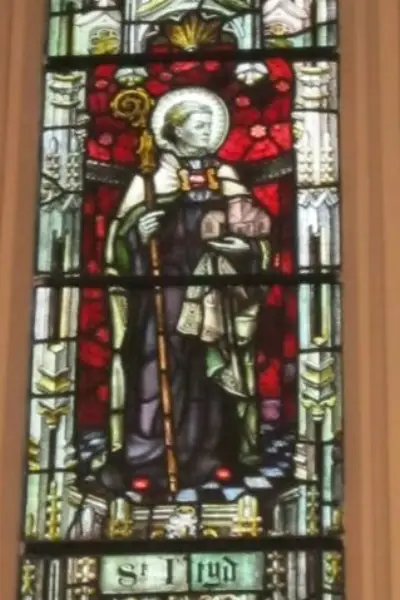
Overview
Illtud — also written Illtyd, Eltut, or in Latin Hildutus, and remembered as Illtud Farchog, 'the Knight' — stands at the head of the divinity school known as Bangor Illtyd, set at Llanilltud Fawr (today's Llantwit Major) in Glamorgan, Wales. There, in the sixth century, he founded the monastery and college that is believed to be the earliest centre of learning in Britain; at its height it held more than a thousand pupils and educated a host of the era's greatest saints, David, Samson of Dol and the historian Gildas among them. The earliest account, the Life of Samson written at Dol in Brittany around 600, calls him the most learned of all the Britons, versed in the Scriptures and in every branch of philosophy. A later medieval Life, composed about 1140, tells how he was born of Breton royal stock, served as a soldier of King Arthur, and after a dramatic act of divine warning abandoned the military life for penance and monastic observance. His cult, never formally canonized, lives on in an unusually rich map of dedications across Wales and Brittany and in his feast, kept on 6 November.
The Complete Life
A Prince's Son on the Borders
Reliable evidence about Illtud's origins is scarce; the very ancient Celts honored him, but few trustworthy records of his life survive. The earliest witness, the Life of Samson composed at Dol in Brittany around the year 600, presents him as the disciple of a bishop named Germanus — commonly taken to be Germanus of Auxerre, though the chronology better fits Germain of Paris, and a ninth-century Life of St. Brioc says he was educated by Germanus in Paris. That account declares him the most accomplished of all the Britons: at home in the Scriptures of both Testaments and in all the branches of philosophy — geometry, rhetoric, grammar, arithmetic — with a reputed gift, moreover, for telling what was to come. He appears in these pages as an educated Briton living just after Rome's withdrawal from the West. The medieval Life written about 1140 supplies a family for him: Bicanus, a Breton prince of small domain, as father; Rieingulid as mother, herself a princess, being the daughter of Anblaud, king of Lesser Britain — and kinship, moreover, with the legendary King Arthur.
§ Hagiography
From the Sword to the Cell
Though his parents destined him for the Church and had him schooled in literature for that end, the young Illtud forsook his religious upbringing for a soldier's career. He married a woman called Trynihid and rode as a warrior in western Britain — the Wales of today — first under King Arthur and then under King Poulentus, which is why tradition calls him Illtud the Knight. The turning point came on a hunting expedition onto the lands of St. Cadoc. His party insolently demanded that the abbot feed them; Cadoc, though he judged the demand rude, graciously offered a meal. Before they could eat it, the ground opened and swallowed the whole company as a punishment for their impiety. Illtud alone was spared. He crawled to Cadoc on his knees, begging pardon for his sinful act, and the abbot commanded him to abandon his selfish ways and return to the religious formation of his childhood. Inspired, he put away his wife — a detail later writers regarded as dubious — and withdrew to live as a hermit in the Vale of Glamorgan.
§ Hagiography
Britain's First School of Saints
Illtud helped pioneer Welsh monasticism by founding a monastery at what is now Llantwit Major in Glamorgan, the place whose Welsh name, Llanilltud Fawr — 'Illtud's great church' — still carries his own. This became the first great monastic school of Wales and a hub of Celtic Christianity in sub-Roman Britain. The divinity school attached to it, remembered as Bangor Illtyd, is believed to be the earliest centre of learning in the island of Britain, and at its height numbered more than a thousand pupils. Tradition reckons among Illtud's own students seven sons of British princes and scholars of the first rank: Patrick of Ireland, Paul Aurelian, Taliesin, Gildas and Samson of Dol, with David also believed to have spent time there. From one repentant knight, in other words, came a whole generation of apostles, teachers and historians — a harvest that spread from Glamorgan to Brittany and helped shape the character of Celtic Christianity for centuries.
§ Hagiography
An Ancient and Unbroken Cult
Illtud was never formally canonized; he belongs to the age before formal processes, when sanctity was recognized by the memory and devotion of the people. There is no documentary proof of his cult surviving from before the eleventh century, yet in the Celtic lands it is place-names that best record the saints of the oldest times, and by that measure Illtud's veneration is beyond dispute. His feast is kept on 6 November, and in Brittany the great 'pardon of Ildut' is celebrated at Locildut on the last Sunday of July. Legend placed his burial west of Brecon, in the church of Llanilltud on the moorland called Mynydd Illtud; beside it stands a megalithic monument known as Bedd Gwyl Illtyd, 'the Grave of St. Illtud's Eve,' at which the faithful kept the old practice of watching in vigil before his festival until comparatively recent times. The Life also tells of his bell being recovered from the armies of King Edgar, and of his protecting his people in the day of William the Conqueror.
§ Cult and veneration
A Landscape That Remembers
Few British saints have left so dense a map of memory. Llantwit Major itself grew up around his college and remains the chief centre of his cult, and St Illtyd's Church there stands on what is believed to be the site of the monastery. Across Glamorgan many churches bear his dedication — at Llantrithyd, Llantwit Fardre, Llantrisant, Newcastle and Bridgend — and others mark lands that once belonged to the Llantwit monastery: Llanhamlach east of Brecon, with the megalithic grave called Ty Illtud nearby, a medieval pilgrimage retreat bearing incised crosses; holy wells at Merthyr Tudful; dedications around Gower at Ilston, Oxwich, Llanrhidian and Llantwit-juxta-Neath; a thirteenth-century church on Caldey Island; and Llanelltyd near Dolgellau in the north. In Brittany nearly twenty-four place-names recall him, concentrated in the old dioceses of Leon, Treguier and Vannes. A ninth-century cross at Llantwit carries an inscription invoking his soul. Medieval romance went further: one Welsh document counts him among the three knights entrusted with the Holy Grail, and some scholars have even tried to identify him with Sir Galahad.
§ Cult and veneration
Timeline
- 600
The Vita Sancti Sampsonis, written at Dol in Brittany, gives the earliest mention of Illtud as a disciple of Bishop Germanus
§ Hagiography
- 1140
The Life of St. Illtud is written, recounting his Breton parentage, his knightly service and his conversion
§ Hagiography
- 1603
The antiquary John Stow records an 'Iltuta' among London's early bishops, an entry sometimes mistaken for the saint
§ Cult and veneration
The Record
- Major works
- Bangor Illtyd — the monastery and divinity school at Llanilltud Fawr (Llantwit Major)
- Canonization
- Pre-congregation; venerated in the Celtic churches from the earliest times, with the first written notice around 600
Prayer
Bibliography
Show 8 sources
- Rudge, F.M. (1910). "St. Illtyd". In The Catholic Encyclopedia. New York: Robert Appleton Company.
- Wade-Evans, A.W. "The Life of St. Illtud". Vitae Sanctorum Britanniae et Genealogiae.
- Bowen, Emrys George. "Illtud". Dictionary of Welsh Biography. National Library of Wales.
- Newell, Ebenezer Josiah (1887). A popular history of the ancient British church: with special reference to the church in Wales. Society for Promoting Christian Knowledge.
- Williams, Peter N. (March 2001). The Sacred Places of Wales: A Modern Pilgrimage. Wales Books. ISBN 978-0-7596-0785-9.
- Martyrologium Romanum, 2004, Vatican Press (Typis Vaticanis), page 609.
- Lewis, Samuel (1833). A Topographical Dictionary of Wales.
- Bruce, Christopher W. The Arthurian Name Dictionary. Routledge, 2013. ISBN 9781136755385.
Profile text adapted from the Wikipedia article, licensed CC BY-SA 4.0.
Pray with this saint every day
Save St. Illtud to your favorites, read the full profile, and get feast-day reminders in the Saints app.
Get the Saints AppFree on the App Store for iPhone and iPad