
written 1509, first printed 1511
In Praise of Folly
Erasmus' Satirical Oration That Shook the Church
Overview
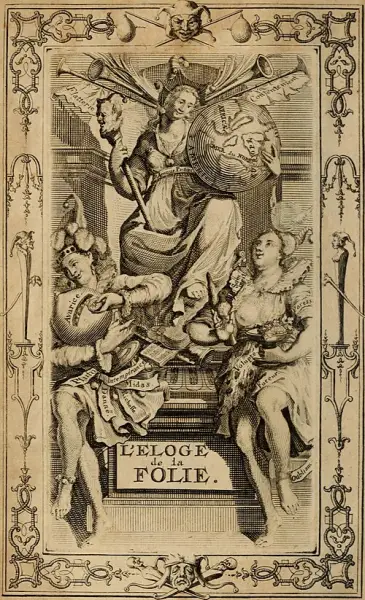
In Praise of Folly — in Latin Stultitiae Laus or Moriae Encomium — is an oration composed in 1509 by Desiderius Erasmus of Rotterdam and first printed in June 1511 by Gilles de Gourmont in Paris. Drawing on the Italian humanist Faustino Perisauli's De Triumpho Stultitiae, it unleashes a spiraling satirical assault on every order of human life — lovers, princes, inventors, writers, gamblers, professional liars, even hermits — before pivoting toward an orthodox religious purpose. Erasmus, who claimed to have dashed off the original in a single week while staying with Sir Thomas More, whose name hides in the Greek word for folly, revised and extended the book many times up to 1532. Folly herself narrates: paraded as a goddess, daughter of Plutus and the nymph Youth, she praises self-deception, mocks pedants, and scourges the superstitions and corrupt practices of the priests and people of a church to which Erasmus remained ever faithful — then turns almost into a sermon on the folly of the cross. One of the most celebrated works of the Renaissance, it shaped the teaching of rhetoric, drew illustrations from Hans Holbein the Younger, and is judged to have played a part in the beginnings of the Protestant Reformation.
The Complete Life
A Week in Bucklersbury
The book began, by its author's own cheerful account, as a holiday improvisation. Erasmus claimed the original text was written in the space of a single week while he was sojourning with his close friend Sir Thomas More at More's house in Bucklersbury, a lane leading off Cheapside and Poultry down toward Walbrook, one that has all but vanished from the modern map. The two men shared a taste for dry humour and intellectual play, and their friendship is baked into the title itself: Moriae Encomium carries a punning second meaning, 'In Praise of More', since the Greek word for folly is moria. Behind the title also stood the Italian humanist Faustino Perisauli, whose De Triumpho Stultitiae inspired the enterprise. The Latin 'Moriae' whispers a further allusion to 'Mariae', to Mary Magdalene who chose the better part — a triple wordplay typical of a text in which double and triple meanings run from first page to last.
§ Introduction
The Orator Folly
The finished oration adopts the mask of a learned encomium on the model of Lucian, the Greek satirist whose writings Erasmus and More had lately rendered into Latin. Folly, dressed as a goddess — offspring of Plutus, god of wealth, and the nymph Youth, nursed by Inebriation and Ignorance, attended by self-love, flattery, forgetfulness, laziness, pleasure, dementia, wantonness, intemperance and heavy sleep — celebrates herself without pause, contending that without her presence life would turn dreary and unlovely. Her self-panegyric spares no estate: hermits and dice-players, writers and princes, lovers, inventors and professional liars all pass before her. Then the tone darkens in a series of orations: Folly exalts self-deception and madness, weighs the abuses of doctrine practiced under a guise of piety and the corrupt ways of the church's clergy and laity alike, and ridicules the folly of pedants, increasingly speaking in Erasmus' own chastising voice. He revised and extended the work repeatedly, printing it in June 1511 and perfecting it through many changes up to 1532.
§ Content
The Folly of the Cross
For all its mockery, the book's deepest movement is religious. In one of its notable pivots, the satire resolves into something close to a full sermon on the cross's own folly, drawn from 1 Corinthians 1:21-23 — the divine foolishness that confounds the wise. Hans Urs von Balthasar saw in the Encomium a raising of folly to metaphysical heights: a polemic against gloomy scholastic wisdom and the love of apatheia, insisting that the hallmark of reality is the folly that lies beneath the mind and above it — the whole vitality of life, love and youth, and all that is gratuitous, playful and graceful, even the world of the gods, crowned by Christ's own interpretation of evil on the Cross. The Latin pun of Moriae on Mariae points the same way: the madness of the lover, who lives no longer in himself but in the beloved, becomes Mary Magdalene's portion — the better part that no change of life can strip away, only bring to perfection. Commentators who reduce the book to an attack on the Roman church miss this center: the contrast between human wisdom, which is truly folly, and divine folly, which is truly wisdom.
§ Content
Astonishing the World
The book swept its world, startling and at times embarrassing its author; even Pope Leo X and Cardinal Cisneros reportedly read it with amusement, though his close friends at first warned him of the danger of seeming to attack the establishment. Before his death it had passed through numerous editions and been translated into Czech, French and German, with an English edition soon following. Its influence reached the schoolroom: it shaped the teaching of rhetoric in the later sixteenth century, and Elizabethan grammar schools took up adoxography, the sport of praising worthless things, as a favorite classroom exercise. The Basel edition of 1515/16, illustrated with Hans Holbein the Younger's pen-and-ink drawings, gave the text its most famous images. Its supposed criticism of church practice and the church's political allies earned it a role in the beginnings of the Protestant Reformation, though translators often added sectarian interpolations the original never contained. Erasmus later wrote that he almost regretted writing it, so much trouble had it caused — yet not from the satirized princes, popes, bishops and cardinals, but from certain theologians.
§ Reception
A Text That Endures
Five centuries of continuous retranslation amount to a kind of secular canonization. The roll call of English versions begins with Sir Thomas Chaloner's Elizabethan rendering, The praise of folie, and runs through Charles Patin, John Adams, the editions of Wilford and Kennet, the anonymous polemicist of 1876, Hoyt Hopewell Hudson's scholarly Princeton translation of 1941, Hendrik Willem Van Loon's of 1942, Harry Carter's of 1952, R.A. Adams', Clarence Miller's of 2003, Betty Radice's Penguin version, and Charles Packard's rhymed verse of 2016 — each generation finding its own voice in Folly's. From 1541, Latin editions carried the Commentary of Girardus Listrius, completed with Erasmus' help for Froben in 1515 and perhaps penned under a pseudonym by Erasmus himself. Scholars confess the text notoriously difficult to analyse, and Dante, Ockham and Eckhart could not have developed its theme. But the original manuscripts survive at Latin Wikisource, the English at Wikisource, and the goddess who praises herself still holds the stage.
§ Translations and editions
Timeline
- 1509
Erasmus writes the oration, by his own account in about a week, while staying with Sir Thomas More at Bucklersbury in London
§ Introduction
- Jun 1511
First printed in June 1511 by the publisher Gilles de Gourmont in France
§ Introduction
- 1515
Hans Holbein the Younger supplies witty marginal drawings of Folly in a copy owned by Erasmus himself
§ Content
- 1516
The Basel edition of 1515/16 appears, illustrated with the Holbein pen-and-ink drawings that become the work's most famous pictures
§ Reception
- 1541
Latin editions from this year onward frequently carry the Commentary of Girardus Listrius, completed with Erasmus' help in 1515
§ Translations and editions
- 1548
Sir Thomas Chaloner publishes the first major English translation, The praise of folie
§ Translations and editions
- 1686
John Adams' English translation appears
§ Translations and editions
- 1735
W. Kennet's English version is issued as Moriae Encomium, or, the Praise of Folly
§ Translations and editions
- 1941
Hoyt Hopewell Hudson's translation, with essay and commentary, is published by Princeton University Press
§ Translations and editions
- 2016
Charles Packard renders the 1509 Latin prose into rhymed English verse as Folly on Folly
§ Translations and editions
In Their Own Words
you'll find nothing frolic or fortunate that it owes not to me
And this is that Mary's better part which is not taken away by change of life, but perfected.
I did not, like other infants, come crying into the world, but perked up, and laughed immediately in my mother's face.
Prepare therefore to be entertained with a panegyric, yet not upon Hercules, Solon, or any other grandee, but on myself, that is, upon Folly.
Wisdom makes men weak and apprehensive, and consequently you'll generality find the wise associated with poverty, hunger, and the reek of smoke, living neglected, inglorious, and disliked.
The Record
- Major works
- Moriae encomium (the Latin oration itself, first printed June 1511)
- Symbols
- Folly personified as a goddess, daughter of Plutus and the nymph Youth·Hans Holbein the Younger's marginal drawings of Folly (1515)
Prayer
Bibliography
Show 8 sources
- Zweig, Stefan (1934). Erasmus And The Right To Heresy. pp. 51–52.
- Müller, Christian (2006). Hans Holbein the Younger: The Basel Years, 1515-1532. Prestel. ISBN 978-3-7913-3580-3.
- Janin, Hunt (2008). The University in Medieval Life, 1179–1499. McFarland. p. 160. ISBN 9780786452019.
- Levy, A. H. T. (1993). "Introduction". Praise of Folly. Penguin. ISBN 0140446087.
- Gavin, J. Austin; Walsh, Thomas M. (1971). "The Praise of Folly in Context: The Commentary of Girardus Listrius". Renaissance Quarterly. 24 (2): 193–209.
- Rummel, Erika, ed. (1990). "Letter to Dorp". The Erasmus Reader. University of Toronto Press. pp. 169–194. ISBN 978-0-8020-6806-4.
- Bizzell, Patricia (1992). "The Praise of Folly, the Women Rhetor, and Post-Modern Skepticism". Rhetoric Society Quarterly. 22 (1): 7–17.
- Wolf, Norbert (2004). Hans Holbein the Younger, 1497/98–1543: the German Raphael. Cologne: Taschen. p. 11. ISBN 3822831670.
Profile text adapted from the Wikipedia article, licensed CC BY-SA 4.0.
Pray with this saint every day
Save In Praise of Folly to your favorites, read the full profile, and get feast-day reminders in the Saints app.
Get the Saints AppFree on the App Store for iPhone and iPad