
1001 – 1050·Feast February 10
St. Ingegerd Olofsdotter
Grand Princess of Kiev, venerated as Saint Anna
Overview
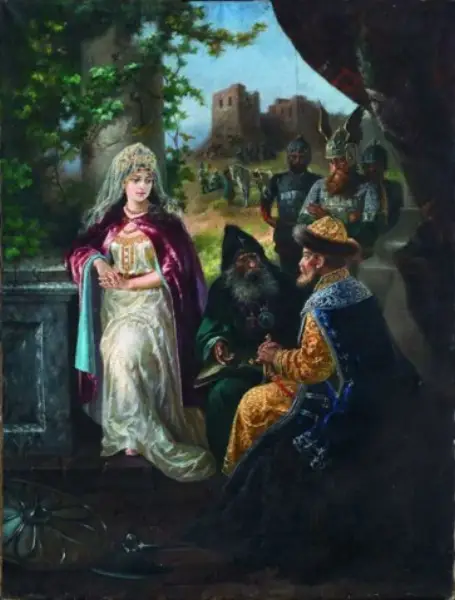
Ingegerd Olofsdotter, also known as Irene or Anna, was a Swedish princess who became grand princess of Kiev as the wife of Yaroslav the Wise, reigning as his consort from 1019 until her death in 1050. She was the daughter of King Olof Skötkonung of Sweden and Estrid of the Obotrites. A proposed marriage to Olaf II of Norway collapsed in 1016 when her father withdrew his consent, and she was wed instead to the ruler of Novgorod and Kiev, taking the Greek name Irene in her new country. Several sagas record that she received Ladoga and its neighbouring lands as a marriage gift, territory whose later name, Ingria, is said to derive from her own. She bore Yaroslav six sons and four daughters, three of whom became queens of France, Hungary, and Norway. She promoted the building of the Saint Sophia cathedrals in both Kiev and Novgorod, sheltered political exiles, and ended her life as a monastic under the name Anna. The Eastern Orthodox Church venerates her as St. Anna of Novgorod.
The Complete Life
A Swedish Princess
Ingegerd was born in 1001 into the court of King Olof Skötkonung, the first Christian ruler of Sweden, and his wife Estrid of the Obotrites. Her father was remembered by the church as the All-Christian King, one who laboured to spread Orthodoxy through Scandinavia, and she grew up amid that newly planted faith. Marriage was the diplomacy of her age, and her hand was contested early. When Olaf II of Norway took the throne in 1015 he proposed a royal alliance, and in 1016 noblemen of both kingdoms worked to arrange a match between the Norwegian king and the Swedish princess. Olof Skötkonung consented at first, then withdrew his word; rather than part with Ingegerd he offered his other daughter, Astrid Olofsdotter, who duly became Queen of Norway. The rebuffed suitor and the disappointed bride alike became figures of legend, and the sagas preserve the drama of the broken betrothal. Ingegerd remained at her father's court until a grander alliance presented itself, one that would carry her from the lakes of Sweden to the courts of the east. The broken Norwegian betrothal, retold with delight in the northern sagas, was the first of the turns of providence by which the course of her life was redirected.
§ Life
Bride of the East
Olof Skötkonung next arranged his daughter's marriage to Yaroslav I the Wise, the powerful grand prince of Novgorod, a ruler bound to Sweden by a flourishing trade, and the wedding took place in 1019. When Yaroslav soon after established himself in Kiev, Ingegerd went with him and exchanged her Norse name for the Greek form Irene, the name her new subjects used. According to several sagas the bridegroom presented her with Ladoga and the adjacent lands as a marriage gift, a territory whose later designation, Ingria, is generally traced to a corruption of Ingegerd's own name. She governed this northern holding through a deputy, entrusting it to jarl Ragnvald Ulfsson, a kinsman of her father, who held it on her behalf. The marriage proved fruitful and politically luminous: six sons and four daughters were born to the couple, and three of the daughters married kings, becoming queens of France, Hungary, and Norway. A fresco in the cathedral of Saint Sophia depicts the whole family, the Swedish bride and the Russian prince surrounded by the dynasty their union produced. With the marriage gift of Ladoga she acquired not merely lands but responsibilities, and she discharged them through deputies and jarls while carrying the weight of a crown in a country not her own.
§ Life
Builder and Benefactor
The church that later enrolled Ingegerd among its saints assigned as the grounds of her canonisation chiefly her works of stone: she initiated the building of Saint Sophia's Cathedral in Kiev, whose foundation was laid in 1037, and likewise the Cathedral of St. Sophia in Novgorod, raised between 1045 and 1050. In both cities the cathedral of Holy Wisdom stood as the spiritual centre of the realm, and the princess who commissioned them left her mark on the Christian face of eastern Europe. Her charity extended as far as her patronage. The church's account records that she opened her halls to the exiled sons of the British king Edmund, Edmund and Edward, and to the Norwegian prince Magnus, who eventually returned home to his own kingdom. Such hospitality made her court a refuge for the dispossessed of the north. The chronicle also celebrates her domestic piety, describing a household profoundly devout, in which the royal couple raised their many children in the fear of God and prepared three daughters to carry the faith to the thrones of western Europe. Between these two temples of Holy Wisdom her own name came to be joined in the memory of the faithful of both cities.
§ Sainthood
The Name of Peace
Orthodox tradition reads a whole spiritual biography in the succession of names Ingegerd carried. Baptised in Sweden as the daughter of the All-Christian King, she was called Irene by her Russian subjects, who perceived in her the divine and ineffable peace her Greek name proclaimed. When at last she submitted to monastic obedience and received the great schema of prayer and fasting, she took a third name, Anna, that of the honoured forebear of Christ. The hymns composed for her feast unfold this progression with liturgical art: they greet her as the joy of the Swedish people who gladdened the Russian realm, adorning its throne with majesty and shining with piety like a priceless gem in a royal crown. They honour the concord of her marriage with the right-believing and most wise Yaroslav, the holiness of the offspring she bore him, and her final self-offering, when after her husband's repose she betrothed herself to the Lord as her heavenly Bridegroom, disdaining vanity, donning coarse robes, and giving herself to fasting and intercession for her people's deliverance from want and misfortune.
§ Sainthood
Repose and Burial
Ingegerd died in Kiev on 10 February 1050, aged about forty-eight, having taken the veil as a nun called Anna before the end. The church records that she reposed in the Cathedral of Holy Wisdom, the great church she herself had caused to rise in the city. Even the place of her burial, however, reflects the twofold memory she left in the lands of the Rus: different sources locate her grave either in Saint Sophia's Cathedral in Kiev or in the Cathedral of St. Sophia in Novgorod, the two cities whose wisdom-churches she had founded and in both of which she came to be honoured as a saint. Her feast is kept on two days, 10 February, the anniversary of her repose, and 4 October, and in the calendar of the Orthodox Church she is remembered as St. Anna, Grand Duchess of Novgorod. The princess who had arrived from Scandinavia as a young bride thus ended as a nun of the Russian Church, her last days given to the monastic discipline she had patronised all her life. Thus the daughter of Swedish kings finished her days within the walls of the great church she had raised to the wisdom of God.
§ Death and burial
The Church's Verdict
The churches of Novgorod and Kiev afterwards enrolled Ingegerd among their saints as St. Anna, and the church that canonised her set out its reasons plainly: she had initiated the building of the two cathedrals of Holy Wisdom, in Kiev and in Novgorod, and had added to these foundations many other good deeds. The official account recalls her as the daughter of the Swedish king Olaf Sketktung, the 'All-Christian King', one who laboured for the spread of Orthodoxy across Scandinavia, and of the pious queen Astrida. It enumerates her mercies, the shelter she gave the exiled princes, and her motherhood of Vsevolod, whose own son Vladimir Monomakh became forefather of the princes of Moscow, and of the daughters Anna, Anastasia, and Elisiv, queens of France, Hungary, and Norway, born of a family it calls profoundly devout and pious. Her cult thus belongs to both halves of her life, the Swedish and the Russian, and her liturgical office, with stichera in Tone I after the melody Joy of the ranks of heaven, celebrates the union of the two peoples in one devotion.
§ Sainthood
Mother of Queens and Princes
Ingegerd's dynastic legacy spread her family across the map of eleventh-century Europe. Her daughter Elisiv married Harald III of Norway, Anastasia married Andrew I of Hungary, and Anne of Kiev became queen of France as the wife of Henry I; a possible fourth daughter, Agatha, was the wife of Edward the Exile. Among her sons, Vsevolod I ruled Kiev and fathered Vladimir Monomakh, from whom the later princes of Moscow traced their descent, while Vladimir of Novgorod, Iziaslav I, Sviatoslav II, and Igor Yaroslavich each played his part in the history of the Rus. A fresco in the Saint Sophia Cathedral in Kiev portrays her daughters, Anne probably the youngest among them beside Anastasia and Elisiv. Through these children the Swedish princess became an ancestress of royal houses from Norway to France, and through her monastic grandson's line, of the Muscovite dynasty. The church honours her under three names, Ingegerd, Irene, and Anna, a triple memory of the Scandinavian princess, the Russian consort, and the nun of Novgorod, whose feast days of 10 February and 4 October keep her before the faithful.
§ Children
Timeline
- 1001
Born a princess at the court of King Olof Skötkonung of Sweden and Queen Estrid of the Obotrites.
§ Life
- 1016
Noblemen of Sweden and Norway sought to arrange her marriage to King Olaf II of Norway, but Olof Skötkonung reneged and gave his daughter Astrid instead.
§ Life
- 1019
Married Grand Prince Yaroslav I the Wise, ruler of Novgorod and Kiev, with whom Sweden enjoyed a flourishing trade.
§ Life
- 1037
The foundation of Saint Sophia's Cathedral in Kiev, whose building she had initiated, was laid.
§ Sainthood
- 1045
Construction began on the Cathedral of St. Sophia in Novgorod, which she had also initiated.
§ Sainthood
- 10 Feb 1050
Died in Kiev, by then a monastic bearing the name Anna; sources differ on whether she was buried in Saint Sophia's Cathedral in Kiev or in Novgorod.
§ Death and burial
The Record
- Major works
- Saint Sophia's Cathedral, Kiev (initiated its building)·Cathedral of St. Sophia, Novgorod (initiated its building)
- Canonization
- Declared a saint under the name of St. Anna in Novgorod and Kiev; feasts kept on 10 February and 4 October
Prayer
Bibliography
Show 4 sources
- "Ingegärd – den heliga Anna av Novgorod". ortodoks.org. May 14, 2008. Retrieved May 1, 2018.
- Krag, Claus (May 14, 2008). "Astrid Olavsdatter". Norsk biografisk leksikon. Retrieved May 1, 2018.
- Cross, Samuel Hazzard (April 1929). "Yaroslav the Wise in Norse Tradition". Speculum. 4: 181.
- Lagerqvist, Lars O. (1982). "Sverige och dess regenter under 1.000 år" (in Swedish). Albert Bonniers Förlag AB. ISBN 91-0-075007-7.
Profile text adapted from the Wikipedia article, licensed CC BY-SA 4.0.
Pray with this saint every day
Save St. Ingegerd Olofsdotter to your favorites, read the full profile, and get feast-day reminders in the Saints app.
Get the Saints AppFree on the App Store for iPhone and iPad