
1797 – 1879·Feast March 31 (O.S.) / April 13
St. Innocent of Alaska
Enlightener of the Aleuts and Apostle to America
Overview
Innocent of Alaska, baptised Ivan Evseyevich Popov, was a Russian Orthodox missionary priest who became the first Orthodox bishop consecrated for the Americas and, later, their first archbishop, and ended his life as Metropolitan of Moscow and Kolomna. Born in Siberia in 1797 to a church servitor's family, he took the surname Veniaminov at the Irkutsk Theological Seminary and was ordained, married, and then volunteered in 1823 for the remote parish of Unalaska in the Aleutian Islands, travelling there with his wife and infant son. Over the following decades he mastered indigenous languages of Alaska, devised a Cyrillic alphabet for the Aleut-Unangan dialect, translated scripture and liturgical texts, and produced pioneering ethnographic and linguistic scholarship on the Aleut and Tlingit peoples. Widowed in 1840, he accepted monastic tonsure and rose through the hierarchy as Bishop of Kamchatka and the Kuril and Aleutian Islands, Archbishop, and finally Metropolitan of Moscow. Renowned as a linguist, scholar, and administrator of great zeal, he was glorified by the Russian Orthodox Church in 1977 under the title 'Enlightener of the Aleuts and Apostle to America', and is honoured as equal-to-the-apostles.
The Complete Life
A Siberian Boyhood
The future apostle of America was born Ivan Evseyevich Popov on 26 August 1797 in the village of Anginskoye in Verkholensk District, Irkutsk Governorate, into the family of a church servitor. His father Evsey died when the boy was only six, and Ivan was taken in by his uncle, the parish deacon of Anga, in whose household his religious vocation first took shape. At the age of ten, in 1807, he entered the Irkutsk Theological Seminary, and there the rector gave him a new surname, Veniaminov, in honour of the recently deceased Bishop Veniamin of Irkutsk, a name the young student would carry for the rest of his life. He proved a capable student, and after completing his studies in 1818 he took up a post teaching in a parish school. His path to the altar proceeded steadily: in 1817 he had married Catherine, daughter of a local priest, and on 18 May of that year he was ordained deacon for the Church of the Annunciation in Irkutsk; on 18 May 1821 he was ordained priest for the same church, becoming known in Russian as Father Ioann.
§ Early life and education
The Call to Unalaska
At the beginning of 1823 Bishop Michael of Irkutsk was instructed by the synod to provide a priest for Unalaska island in the Aleutian chain of Alaska. The assignment was formidable: a parish scattered across remote islands, reachable only by a journey of many months through some of the harshest country in the Russian Empire. Father Ioann Veniaminov volunteered. On 7 May 1823 he set out from Irkutsk accompanied by his ageing mother, his brother Stefan, his wife Catherine, and their infant son Innocent, for whom the family's later apostle would be named. The journey by land and water consumed nearly a year of hardship before they reached Unalaska on 29 July 1824. Once there, father and family built an earthen hut to live in, and the priest set about the double work that would define his ministry: learning the language of his flock and providing them with a church. He taught several of his new parishioners Russian methods of building and, with them, raised the Holy Ascension Church, completed the following July, the first fruits of his labours in the islands.
§ Ministry in Alaska
Apostle of the Aleuts and Tlingit
Father Ioann's parish embraced Unalaska and the neighbouring Fox and Pribilof islands, whose indigenous inhabitants had been baptised before his arrival yet still retained many of their earlier beliefs and customs. He journeyed constantly between the islands by canoe, contending with the stormy waters of the Gulf of Alaska, and through these travels he came to know the local speech intimately, mastering six of the dialects. For the most widely used, the Unangan dialect of Aleut, he devised a written alphabet based on Cyrillic letters, and in 1828 he rendered parts of the Bible and other church texts into it; in 1829 he travelled to the Bering Sea shore of the Alaskan mainland to preach to the people there. In 1834 he was transferred to Novoarkhangelsk on Sitka Island, where he gave himself to the Tlingit people, studying their language and customs and producing the scholarly Notes on the Kolushchan and Kodiak Tongues with a Russian-Kolushchan glossary. In 1836 he travelled south on pastoral visitation to Fort Ross in Northern California, taking a census and celebrating marriage and baptism among the Russians and local natives.
§ Ministry in Alaska
Bishop, Archbishop, Metropolitan
In 1838 Father Ioann travelled to St. Petersburg, Moscow, and Kiev to report on his mission and seek its expansion; while there he learned that his wife had died in Irkutsk. Offered instead of a homecoming the counsel to become a monk, he at first declined, but on 29 November 1840 he accepted tonsure with the name Innocent, after the first bishop of Irkutsk, and was raised to archimandrite. On 15 December 1840 he was consecrated Bishop of Kamchatka and the Kuril and Aleutian Islands, with his see at Novoarkhangelsk, where he returned in 1841 and laboured for nine years over a vast diocese. Elevated to archbishop on 21 April 1850, he received the Yakut region into his care in 1852 and settled in Yakutsk the next year, devoting great energy to translating the scriptures and liturgical service books into Yakut. In April 1865 he joined the Holy Governing Synod, and on 19 November 1867 he was appointed Metropolitan of Moscow. There he corrected erring church texts, raised funds for impoverished clergy, and founded a retirement home, until his death on 31 March 1879 and burial at the Trinity Lavra of St. Sergius.
§ Kamchatka ministry
Enlightener and Equal-to-the-Apostles
On 6 October 1977 the Russian Orthodox Church, at the petition of the Orthodox Church in America, glorified Innocent as a saint, bestowing on him the title 'Enlightener of the Aleuts and Apostle to America'. The ceremony took place in Moscow under Patriarch Pimen I, and his major shrine remains the Trinity-St. Sergius Lavra, where his relics rest in the Assumption Cathedral. Orthodox tradition keeps his memory three times each year: on 31 March by the Julian reckoning, 13 April in the Gregorian, the anniversary of his repose; on 6 October, the date of his glorification; and on 18 October, the Synaxis of the Moscow Hierarchs. He is honoured far and wide with the epithet equal-to-the-apostles, honoured as the Orthodox apostle of America, a rank the church reserves for those who converted whole peoples. Even beyond Orthodoxy his sanctity is acknowledged: the Episcopal Church in the United States remembers him on its liturgical calendar with a feast on 30 March, and the Anglican Communion venerates him alongside the Orthodox churches of Russia and America. The glorification bound together the two great fields of his apostolate, the Aleutian islands of his priesthood and the Russian capital of his final office, into one memory of sanctity.
§ Sainthood
Scholar, Linguist, Missionary
Innocent's enduring legacy lies in the union of scholarship and evangelisation. He is remembered for his missionary labours, his learning, and his leadership in Alaska and the Russian Far East; contemporaries prized his scholarship, his gift for languages, his talent for administration, and above all his zeal. His published books began appearing in 1840: the Indication of the Pathway into the Kingdom of Heaven, a catechetical classic in Aleut; a short Christian catechism prepared with Jacob Netsvetov; his translation of the Gospel of Matthew into the Aleut-Fox language, printed by the Synodal Press and presented to the world by the National Library of Russia; and his ethnographic and linguistic studies of the Aleut and Tlingit peoples, among the first scholarly studies of Alaska's native peoples. In Russian he left sermons, letters, and the memoirs of his island diocese. As the first Orthodox bishop raised to the episcopate for the Americas he headed that church's North American diocese from 1840 until 1868, and as Metropolitan of Moscow he guided the mother church. Aleut, Tlingit, and Yakut believers received from him the faith in their own tongues, an inheritance that endures.
§ Death and legacy
Timeline
- 26 Aug 1797
Born Ivan Evseyevich Popov into the family of a church servitor in the village of Anginskoye, Irkutsk Governorate.
§ Early life and education
- 1807
Entered the Irkutsk Theological Seminary at age ten, where the rector renamed him Veniaminov in honour of the late Bishop Veniamin of Irkutsk.
§ Early life and education
- 18 May 1817
Married Catherine, a local priest's daughter, and was made deacon at the Church of the Annunciation in Irkutsk.
§ Early life and education
- 18 May 1821
Ordained a priest to serve the Church of the Annunciation in Irkutsk, taking the name Father Ioann.
§ Early life and education
- 7 May 1823
Volunteered for the parish of Unalaska and departed Irkutsk with his mother, brother, wife, and infant son.
§ Ministry in Alaska
- 29 Jul 1824
Arrived on Unalaska after a yearlong journey by land and water, and began building Holy Ascension Church with local parishioners.
§ Ministry in Alaska
- 1828
Having mastered six local dialects and devised a Cyrillic alphabet for Unangan Aleut, rendered parts of the Bible and other church texts into that tongue.
§ Ministry in Alaska
- 1834
Transferred to Novoarkhangelsk on Sitka Island, where he gave himself to the Tlingit people, learning their tongue and ways.
§ Ministry in Alaska
- 1836
Made a pastoral tour of southern Russian America as far as Fort Ross in Northern California, conducting a census and administering sacraments.
§ Ministry in Alaska
- 1840
Widowed, he accepted monastic tonsure on 29 November under the name Innocent and was consecrated Bishop of Kamchatka and the Kuril and Aleutian Islands on 15 December.
§ Kamchatka ministry
- 21 Apr 1850
Elevated to archbishop; two years later the Yakut area joined his diocese and he took up residence in Yakutsk.
§ Kamchatka ministry
- Apr 1865
Named to the Holy Governing Synod of the Russian Orthodox Church.
§ Kamchatka ministry
- 19 Nov 1867
Appointed Metropolitan of Moscow, succeeding his friend and mentor Filaret (Drozdov).
§ Metropolitan of Moscow
- 31 Mar 1879
Died in Moscow; buried on 5 April at the Trinity Lavra of St. Sergius outside the city.
§ Death and legacy
- 6 Oct 1977
Glorified as a saint by the Russian Orthodox Church in Moscow, at the official request of the Orthodox Church in America.
§ Sainthood
The Record
- Major works
- Indication of the Pathway into the Kingdom of Heaven (1840)·Notes on the Kolushchan and Kodiak Tongues and Other Dialects of the Russo-American Territories, with a Russian-Kolushchan Glossary·Translation of the Holy Gospel According to St. Matthew into Aleut-Fox (1840)·Beginnings of Christian Teaching and Short Christian Catechism (1840, with Jacob Netsvetov)·Translations of the scriptures and service books into the Yakut (Sakha) language
- Symbols
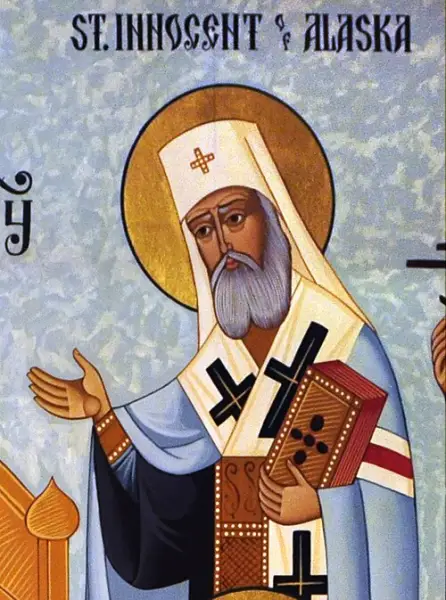
- Vested as a bishop with a moderately long black beard, holding a Gospel Book or scroll
- Canonization
- Glorified on 6 October 1977 in Moscow by Patriarch Pimen I of the Russian Orthodox Church, at the request of the Orthodox Church in America
Prayer
Bibliography
Show 5 sources
- "Святитель Иннокентий, митрополит Московский" [Saint Innocent, Metropolitan of Moscow]. Православный Церковный календарь.
- "St. Innocent of Alaska". Orthodox Church in America.
- Garrett, Paul (1979). Saint Innocent, Apostle to America. Crestwood, New York: Saint Vladimir's Seminary Press.
- Garrett, Paul D. (1998). "Innocent, Veniaminov (Ivan Popov-Veniaminov)". In Anderson, Gerald H. (ed.). Biographical Dictionary of Christian Missions. New York: Macmillan Reference USA. p. 320.
- Kobtzeff, Oleg (1984). "Ruling Siberia: The Imperial Power, the Orthodox Church and the Native People". Siberica. II. British Siberian Studies Seminar: 6-15.
Profile text adapted from the Wikipedia article, licensed CC BY-SA 4.0.
Pray with this saint every day
Save St. Innocent of Alaska to your favorites, read the full profile, and get feast-day reminders in the Saints app.
Get the Saints AppFree on the App Store for iPhone and iPad