
c. 1680 – 1731·Feast November 26
St. Innocent of Irkutsk
First bishop of Irkutsk and apostle to Siberia
Overview
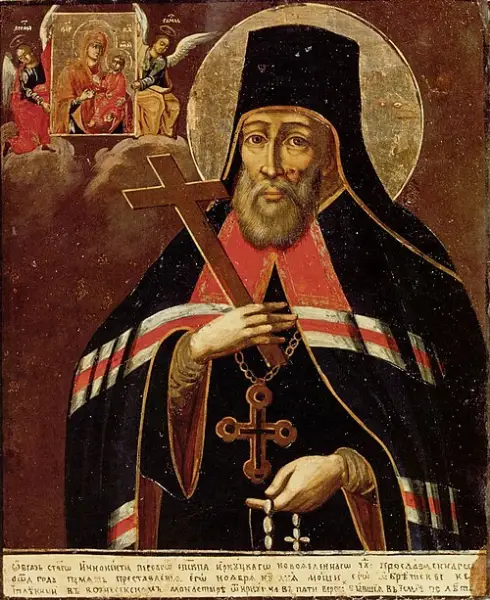
Innocent of Irkutsk, born Ivan Kulczycki around 1680, laboured as a missionary in Siberia and served as Irkutsk's first bishop in Russia. A noble of the Chernigov region, he embraced monastic life at the great Lavra of the Kiev Caves in 1706 and rose through the academic and administrative ranks of the Russian Church, teaching at the Ecclesiastical Academy of Moscow and serving as locum tenens chaplain-general at the Lavra of St. Alexander Nevsky in St. Petersburg. Consecrated a bishop in 1721 with the Orthodox mission destined for China entrusted to his leadership, he was never permitted to enter that country, and in 1727 he was appointed instead to the newly minded see of Irkutsk. There he learned Mongolian and preached with such fruit that many of the local people embraced the Christian faith. He died on November 27, 1731, and was laid to rest below the altar of the Tikhvin church in the Ascension Monastery of Irkutsk. His relics were found incorrupt in 1764, and after many recorded miracles the Russian Orthodox Church glorified him in 1804. He is remembered today as a patron saint of China and of Orthodox Siberia.
The Complete Life
From Chernigov to the Monastic Habit
The future bishop was born Ivan Kulczycki, sometimes written Koulczycki or Ivan Kouchtzky, around 1680 into a noble family of the Diocese of Chernigov, a region of churchly tradition on the south-western marches of the Russian world. Drawn to the monastic life rather than to the privileges of his birth, he received the habit in 1706 at the celebrated Lavra of the Kiev Caves, the ancient mother-house of Ruthenian monasticism, whose caves had sheltered the relics and the prayers of saints for centuries. His abilities soon marked him out for wider service. He was named a professor of the Ecclesiastical Academy of Moscow, the empire's foremost school of theology, and afterwards served as locum tenens chaplain-general at the Lavra of St. Alexander Nevsky in St. Petersburg, the new capital's great monastic foundation. The trajectory of his early career, from the ancient lavra of Kiev through the academy of Moscow to the monastic establishment of the new imperial capital, prepared him for the unusual and difficult assignment that the Church would soon place in his hands, a mission at the far eastern edge of the world.
§ Introduction
The China Mission Denied
In 1721, at the Lavra Caves Monastery, Innocent was consecrated bishop of Pereyaslavl with a singular purpose in view: his heading of the Orthodox mission bound for China, an enterprise the Russian Church had long hoped to establish. The appointment, however, ended in disappointment. In his episcopal rank he was refused entry to China, and the mission he had been consecrated to lead remained closed to him. Providence redirected his apostolate instead toward another frontier. In 1727 he was appointed to the see of Irkutsk, the young diocese of eastern Siberia, and there he found a field no less demanding than the one he had lost. The new bishop set himself to learn Mongolian, the language of many of the peoples among whom he laboured, and preached to the local inhabitants with such effect that he converted many of them to the Christian faith. The China mission that had been refused him bore unexpected fruit on Siberian soil: the bishop who never reached Peking became, in the judgment of many Chinese Orthodox today, the natural patron of the church in China.
§ Introduction
Shepherd of Irkutsk
Innocent's episcopate in Irkutsk lasted only a handful of years, but it fixed the shape of Orthodoxy in that part of Siberia. From the see city on the Angara he shepherded a diocese of vast distances and newly baptised peoples, preaching in the languages of the land and consolidating the church's presence at the eastern limit of the empire. He died on November 27, 1731, and was laid to rest below the altar of the Tikhvin church, one of the five churches of the Ascension Monastery in the town of Irkutsk, a fitting resting place for the diocese's first bishop. His repose came barely a decade after his consecration, yet his labours had already borne fruit in the conversions he accomplished among the Mongolian-speaking peoples. The date of his death, November 26, became his principal feast, though it would later be moved by one day on account of an older commemoration. The monastery church that held his body became the focus of the devotion that would, within a generation of his burial, bring the church to examine his remains and confirm what the faithful had already come to believe.
§ Introduction
Incorrupt Relics and Glorification
When the church underwent restoration in 1764, the saint's relics proved incorrupt, and the discovery gave fresh impetus to his veneration. Numerous miracles were attributed to his intercession, and after this witness the Holy Synod of the Russian Orthodox Church glorified him a saint on February 9, 1804. Because his true date of repose, November 26, fell in the church's calendar together with the feast of the icon of the Mother of God 'Of the Sign' of Novgorod, and so his commemoration was transferred to the previous day, November 26, and February 9 became the feast of his translation and glorification, with September 2 later kept as the feast of a second translation of his remains. The age of revolutions brought new trials. In 1921 the Soviet government seized his relics and exhibited them in assorted museums as a 'Siberian mummy', and the church that housed them was burned to the ground. Only in the closing years of the Soviet era were the relics restored to the Church, being returned on September 7, 1990, and enshrined at the Znamensky Monastery in Irkutsk.
§ Introduction
Apostle of Siberia, Patron of China
Innocent of Irkutsk is honoured as the apostle to Siberia and the father of Orthodoxy in the lands east of Lake Baikal, and his cult has travelled far beyond the region he served. Because he was appointed head of the Orthodox mission in China, even though he was never allowed to enter that country, many Chinese Orthodox regard him as their patron saint, claiming the blessing of a bishop whose longing for their land was never fulfilled in life but has been fulfilled in devotion. His memory is complicated by a case of mistaken identity: he is sometimes mistaken for the later Innocent of Alaska, the great nineteenth-century metropolitan who was named in his honour, and the two saints' shared name and shared Siberian connections have sometimes mingled their stories. The confusion is itself a tribute, for the later Innocent took from this one both his name and, in a sense, his mission, carrying eastward the same apostolic zeal. The feast days of November 26, February 9, and September 2 keep his memory alive in the Russian Church, and his shrine at Irkutsk remains a place of pilgrimage for the peoples he converted.
§ Introduction
Timeline
- 1706
Received the habit at the Lavra of the Kiev Caves, beginning a life spent in the service of the Church.
§ Introduction
- 1721
Consecrated bishop of Pereyaslavl at the Lavra Caves Monastery in preparation for his heading of the Orthodox mission bound for China.
§ Introduction
- 1727
Since Chinese authorities refused him entry to China, appointed instead to the see of Irkutsk in Siberia.
§ Introduction
- 27 Nov 1731
Died in Irkutsk and was interred beneath the altar of the Tikhvin church within the Ascension Monastery.
§ Introduction
- 1764
During restoration work on the church, his relics were discovered to be incorrupt.
§ Introduction
- 9 Feb 1804
Glorified a saint by the Russian Orthodox Church after numerous miracles attributed to his intercession.
§ Introduction
- 1921
The Soviet authorities seized the relics and exhibited them in assorted museums as a Siberian curiosity.
§ Introduction
- 7 Sep 1990
His relics were returned to the church after the fall of the Soviet regime.
§ Introduction
The Record
- Patron of
- Patron saint of China
- Canonization
- Glorified by the Holy Synod of the Russian Orthodox Church on February 9, 1804
Prayer
Bibliography
Show 3 sources
- Orthodox Eastern Church (1998). The Synaxarion: The Lives of the Saints of the Orthodox Church. Vol. 2. Hieromonk Makarios of Simonos Petra; Hookway, Christopher; Rule, Maria; Burton, Joanna. Ormylia, Chalkidike, Greece: Holy Convent of the Annunciation of Our Lady. ISBN 978-960-85603-7-6. OCLC 40530820.
- "10 знаковых мест Иркутска: Иркутский Вознесенский монастырь" [10 iconic places of Irkutsk: Irkutsk Ascension Monastery]. Областная газета (in Russian). 22 April 2011.
- Семивскій [Semivsky], Николай Васильевич [Nikolai Vasilevich] (1817). "Chapter VI: Ангара". Новѣйшія, любопытные и достоверные, повѣствованія о Восточной Сибири [New, curious and authentic, Stories from Eastern Siberia]. St. Petersburg. p. 112.
Profile text adapted from the Wikipedia article, licensed CC BY-SA 4.0.
Pray with this saint every day
Save St. Innocent of Irkutsk to your favorites, read the full profile, and get feast-day reminders in the Saints app.
Get the Saints AppFree on the App Store for iPhone and iPad