
1887 – 1934·Feast October 9
St. Inocencio of Mary Immaculate
Passionist priest and martyr of Turon
Overview
Inocencio of Mary Immaculate, born Manuel Canoura Arnau on March 10, 1887, was a Spanish Catholic priest of the Passionist Congregation who was killed during the Asturias revolt of 1934 and now ranks among the Martyrs of Turon. A Galician by birth, he entered the Passionist seminary at fourteen and pursued his philosophy and theology at Deusto in Biscay, receiving the subdiaconate in 1910, the diaconate in 1912, and priestly ordination in 1920. As a priest he preached parish missions and taught in schools, and while stationed at Mieres, not far from Turon, he was asked by the Brothers of the Christian Schools to hear the confessions of their pupils preparing for First Communion. It was in that service that the Asturias uprising overtook him: on October 5, 1934, strikers seized the Lasallian school at Turon, and Father Inocencio was imprisoned alongside the eight Brothers inside the building its captors called the House of the People. Condemned to death by the revolutionary committee, he and his companions were shot in the early hours of October 9, 1934, and buried in a common grave. Pope John Paul II canonized him with his fellow martyrs in 1999.
The Complete Life
A Galician Boy Enters the Passionists
Manuel Canoura Arnau was born on March 10, 1887, at Santa Cilla do Valadouro in the parish of Foz, near the Cantabrian coast of the province of Lugo in Galicia, a green and rugged corner of north-western Spain. At the age of fourteen he left home for the Passionist seminary at Penafiel, near Valladolid, beginning the long formation that would make him a religious of the Congregation of the Passion. His studies continued at Deusto in Biscay, in the Basque country, where he joined the Passionist Congregation and pursued his course in philosophy and theology. The Church's ministries were conferred on him step by step at Mieres, a mining town in the Asturian coal country not far from the little industrial parish of Turon where his life would end: the subdiaconate in 1910, the diaconate in 1912, and, after a long preparation, priestly ordination in 1920. He took the religious name Inocencio of Mary Immaculate, and wore from then on the habit and the Sign of the Passionists, the congregation founded to keep alive the memory of the sufferings of Christ.
§ Life
A Passionist of the Congregation of the Passion
The Passionists into whose ranks the young Galician had been received were an order with a single driving purpose: to proclaim and remember the passion of Jesus, and to do so among the poor. Inocencio's formation at Penafiel and Deusto immersed him in this spirit, and once ordained he embodied it in the two great works of his priestly life, the preaching of missions and the teaching of the young. For fourteen years, from his ordination in 1920 until his death in 1934, he went where the congregation sent him, giving missions in the towns of northern Spain and instructing the children of Catholic schools. His assignment to Mieres in the Asturias brought him within reach of Turon, a small industrial town whose Lasallian school served the children of the mining families. There the Brothers of the Christian Schools, the De La Salle Brothers who ran the school, asked the Passionist father to hear the confessions of their pupils as they prepared for their First Communion, a work he gladly undertook. It was this ministry of reconciliation, offered to children, that placed him in the schoolhouse on the very days the revolution broke.
§ Life
Ministry in the Asturias
Inocencio's priestly ministry unfolded in the industrial towns of the Asturian coalfield, among working people whose poverty and whose grievances would shortly erupt in one of the bloodiest risings of the Spanish Republic's brief history. As a Passionist he preached missions, the popular exercises by which the congregation renewed the faith of parishes, and he taught in the schools of the region, combining the pulpit and the classroom in the tradition of his institute. At Mieres he became known to the De La Salle Brothers of Turon, who asked him to come to their school and hear the confessions of the boys preparing for their First Communion, a work of quiet pastoral charity. It was the season of the Asturias rising, and the communist and anti-clerical parties had taken up arms against the government of the Second Republic, and anti-Catholic fury swept the mining towns. Father Inocencio did not withdraw from the danger; he continued to exercise his priestly ministry among the children entrusted to him. On Friday, October 5, 1934, a band of strikers stormed the Lasallian school at Turon where he was at work, and the missionary of a few weeks became a prisoner with the Brothers who had called him.
§ Life
Martyrdom at Turon
After the strikers seized the school, Father Inocencio and the eight De La Salle Brothers were held captive inside the building its captors named the 'House of the People', there to await the judgment of the revolutionary committee. The verdict was death. In the early hours of October 9, 1934, the nine men were taken out and executed by a firing squad, and the nine were laid together in a common grave, denied even the dignity of individual burial. Father Inocencio was forty-seven years old. The Catholic Church numbers him among the Martyrs of the Spanish Civil War even though his death came before the outbreak of the war itself by nearly two years, for his blood was shed in the same convulsion of anti-clerical violence that would devastate Spanish Christianity after 1936. He died not as a combatant but as a priest caught in the act of ministry, seized while hearing the confessions of children, and condemned for what he was rather than for anything he had done. With the eight Brothers who shared his cell and his fate he is honoured as one of the Martyrs of Turon, the nine who perished together in the Asturian autumn.
§ Martyrdom
From Venerable to the Altars
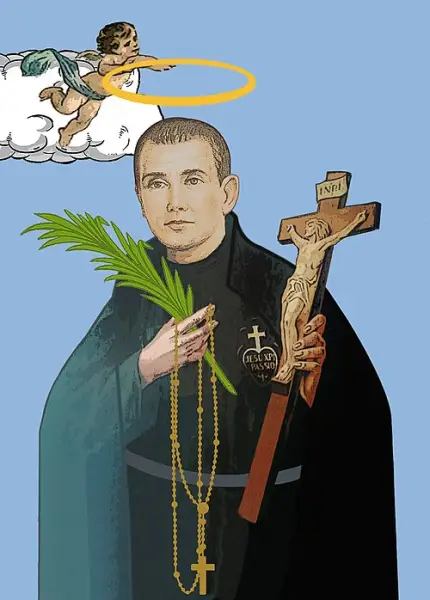
The process that raised Inocencio and his companions to the altars followed the swift, sure path of twentieth-century martyr causes. In 1989, fifty-five years after their execution, the pope declared Inocencio and the eight De La Salle Brothers venerable, affirming the heroism of their sacrifice. On April 19, 1990, they were beatified, their common grave becoming a shrine of the new martyrs of Spain. Finally, on November 21, 1999, Pope John Paul II canonized the nine martyrs of Turon in a ceremony in Italy, enrolling the Passionist priest and the eight teaching Brothers among the saints of the universal Church. The cause had been prepared and documented by both religious families, the Passionists and the De La Salle Brothers, and the Church's official citation names them together: the martyrs Cirilo Bertran with his eight brothers of the Lasallian institute, joined by the Passionist priest Inocencio de la Inmaculada. Their feast is kept on October 9, the anniversary of the executions at Turon, and the martyr is depicted in his Passionist habit bearing the Passionist Sign. Thus the priest seized while preparing children for their first communion was raised to the honours of the altar a little more than sixty years after his death.
§ Canonization
The Martyrs of Turon Remembered
Inocencio's memory is inseparable from that of his companions, and the Church honours the nine men of Turon as a single company of martyrs. His death, though it came in the Asturias revolt of 1934 and not in the Civil War that followed, is counted by the Catholic Church among the Martyrs of the Spanish Civil War, for it sprang from the same violence and the same anti-clerical hatred that scarred Spain throughout those years. He stands in the long calendar of Spanish martyrs beside the brothers of Turon, the martyrs of Daimiel, and the hundreds of others beatified in the great causes of the twentieth century, a witness to the price the Church paid in the convulsions of modern Spain. For the Passionist Congregation he is a son who died in the congregation's characteristic work, the ministry of reconciliation; for the De La Salle Brothers he shares the glory of their own teaching martyrs, who perished with the priest they had invited. The Vatican keeps their story in its official record, and their feast of October 9 recalls each year the nine who went together from the House of the People to a common grave and, the Church believes, to a common crown.
§ Canonization
Timeline
- 10 Mar 1887
Born Manuel Canoura Arnau at Santa Cilla do Valadouro, close to the Cantabrian coast, in Lugo province, Galicia.
§ Life
- 1910
Received the subdiaconate at Mieres, not far from Turon.
§ Life
- 1912
Received the diaconate at Mieres.
§ Life
- 1920
Ordained a priest; thereafter preached missions and taught in various schools.
§ Life
- 5 Oct 1934
strikers burst into the Lasallian school in Turon, where he was exercising his ministry, and he was imprisoned with the eight Brothers.
§ Martyrdom
- 9 Oct 1934
Condemned to death by the revolutionary committee and executed by firing squad with his eight companions in the early hours of the morning.
§ Martyrdom
- 1989
Declared venerable, together with his eight fellow martyrs of Turon.
§ Canonization
- 19 Apr 1990
Beatified by Pope John Paul II.
§ Canonization
- 21 Nov 1999
Canonized by Pope John Paul II in Italy, together with his companions.
§ Canonization
The Record
- Symbols
- Passionist habit and the Passionist Sign
- Canonization
- Declared venerable in 1989, beatified April 19, 1990, and canonized November 21, 1999 by Pope John Paul II
Prayer
Bibliography
Show 3 sources
- "Cirilo Bertran and 8 Companions, religious of the Institute of the Brothers of the Christian Schools and Inocencio de la Inmaculada, priest of the Congregation of the Passion of Jesus Christ, martyrs (+1934, +1937)". vatican.va.
- Mercurio, R. "The Passionists", page 176. The Liturgical Press, 1991.
- "St. Innocencio Canoura Arnau, martyr". Archived from the original on 2007-09-29. Retrieved 2007-08-15.
Profile text adapted from the Wikipedia article, licensed CC BY-SA 4.0.
Pray with this saint every day
Save St. Inocencio of Mary Immaculate to your favorites, read the full profile, and get feast-day reminders in the Saints app.
Get the Saints AppFree on the App Store for iPhone and iPad