
dates unknown·Feast January 13
St. Irenarch of Rostov
Barefoot Hermit and Recluse of Rostov
Overview
Irenarch, also called Irenarchus, is honored as a recluse by the Russian Orthodox Church. Born Elias to peasant parents at Kondakovo, a village of the Rostov district, he entered monastic life in his thirtieth year at the monastery of Saints Boris and Gleb in Rostov. There he gave himself fully to the work of the cloister, attended the church services faithfully, and passed his nights in prayer, sleeping on the bare ground. An early act of charity marked out the whole course of his asceticism: meeting a wanderer who had no shoes, he handed the man his own boots, and from that day forward he walked barefoot, even across the snow. Contemporaries regarded him as a mystic and a visionary, and he kept company with John the Hairy, another holy figure of the Rostov land. After his death, many cures of body, mind, and spirit were credited to contact with his relics. The Church keeps his memory on 13 January.
The Complete Life
Early Life
The records of Irenarch's childhood are sparse, but they place his beginnings among the plain people of the Rostov land. He first saw the light of day in Kondakovo, a village in the Rostov district, and his family lived by the labor of their hands, as peasants had done for generations. Such a childhood, framed by the seasons and by hard work, formed in him the endurance and simplicity that later marked his ascetic life. At his baptism he received the name Elias, a name that would be set aside only when he put on the monastic habit. Nothing in the surviving account suggests that his youth was remarkable; what the tradition preserves is the fruit of those hidden years, a disposition ready to surrender everything for God. When the call came, he answered it decisively, leaving the village of his birth for the monastery that bore the names of the passion-bearers Boris and Gleb, the beloved princely saints of early Rus. There the peasant's son Elias would become the recluse Irenarch, whose memory the Russian Church still honors each January.
§ Introduction
Vocation
In his thirtieth year Irenarch was tonsured a monk at the Rostov monastery of Saints Boris and Gleb, and from the first he set himself a demanding rule. He labored fervently at the tasks assigned to him in the common life, was present at the church services, and reserved his nights for private prayer, denying himself even a bed and sleeping instead upon the ground. The turning point of his ascetic career came through a simple encounter: a vagrant came to him with no shoes to protect his feet, and Irenarch, moved by pity, took off his own boots and gave them away. From that moment he resolved to go without footwear himself, and he kept that resolution through winters, walking barefoot over the snow. What began as a single act of mercy became a lifelong discipline, a daily reminder that the monk owns nothing, not even the shoes on his feet. In this he followed a long line of Russian holy fools and ascetics for whom bodily comfort was surrendered gladly for the sake of the soul.
§ Introduction
Legacy
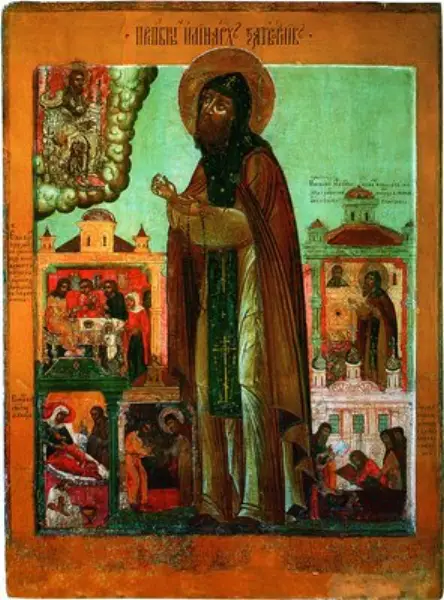
Irenarch was remembered after his death as a mystic and a visionary, a man whose prayer opened onto the unseen world. Among his companions in holiness the tradition names John the Hairy, another figure of the Rostov region whose own asceticism complemented the recluse's hidden life. The strongest sign of the veneration that gathered around him, however, came through his relics: many healings of a physical, psychological, and spiritual nature were attributed to the touching of his remains after his death. Pilgrims who came to his tomb found there not only the memory of a severe ascetic but a channel of grace that restored the sick and the troubled. The Russian Orthodox Church inscribed him in its calendar with a feast on 13 January, and iconography depicts him in the monk's habit, often shown with bare feet in token of his celebrated charity. For the faithful of Rostov and beyond he remains a witness that sanctity can grow from a peasant village and flourish in the silence of a cloister.
§ Introduction
The Record
- Symbols
- Monk's habit·Bare feet
- Canonization
- Pre-congregation; honored as a saint in the Russian Orthodox Church
Prayer
Bibliography
Profile text adapted from the Wikipedia article, licensed CC BY-SA 4.0.
Pray with this saint every day
Save St. Irenarch of Rostov to your favorites, read the full profile, and get feast-day reminders in the Saints app.
Get the Saints AppFree on the App Store for iPhone and iPad