
1088 – 1134·Feast Not specified in the source article
St. Irene of Hungary
Hungarian Princess and Byzantine Empress
Overview
Irene of Hungary, born Piroska of the Árpád dynasty in 1088, died as Byzantine empress on 13 August 1134. Daughter of King Ladislaus I of Hungary and Adelaide of Rheinfelden, she was orphaned young and raised at the court of her cousin Coloman the Learned. In 1104, at sixteen, she was married to John Komnenos, heir to the Byzantine throne, as part of a Hungarian-Byzantine rapprochement, and she took the Greek name Irene upon settling in Constantinople, where custom required her conversion to Eastern Orthodoxy. When her husband acceded in 1118 she became empress consort of an empire at its height. Greek writers credit her with eight children, among them the future emperor Manuel I. Government she left almost entirely to her husband; her own strength went to prayer, almsgiving, and the care of her many children. With John she stood as principal initiator of the Monastery of Christ Pantokrator, whose hospital of five wards served all classes and anticipated the hospitals of Western Europe. She died unexpectedly in Bithynia while accompanying John on campaign against the Seljuk Turks, took the monastic name Xene on her deathbed, and was buried at the Pantokrator, later the mausoleum of two dynasties. Canonized under her son, she remains the only empress of twelfth-century Byzantium raised to the altars.
The Complete Life
A Princess of the Árpáds
Piroska was born in 1088 into the royal house of Hungary, the daughter of King Ladislaus I, who would himself be canonized, and of Adelaide of Rheinfelden, a princess of the German lands. Her childhood was shadowed by loss: her mother died in 1090, and on 29 July 1095 her father followed, leaving the girl an orphan while still a child. The crown passed to her cousin Coloman, remembered as Coloman the Learned, and it was at his court that Piroska spent her youth and received the thorough education for which that bookish king's household was known. Here she grew up amid the cares and ceremonies of one of the newest monarchies in Christian Europe, a kingdom her father had consolidated and the Church had blessed. Her original Hungarian name cannot now be established with certainty; the illuminated chronicle of the Árpáds renders the king's daughter's name in a form that scholars have debated ever since, and both Piroska and the Latin Prisca have been proposed. Whatever its exact form, the name belonged to a dynasty of saints, and she would add to their number.
§ Family
Bride of Byzantium
In 1104, when she was sixteen, Piroska met the customary fate of medieval princesses: she was promised to a man she had never met, and shortly afterward became his wife. King Coloman arranged the match to improve relations with Emperor Alexios I Komnenos, and the chosen bridegroom was John, called the Beautiful, the emperor's eldest son and designated heir. Anna Komnene records a treaty in which Alexios addressed the Hungarian king as co-father-in-law, a term that reflects the dynastic marriage and the political warmth it was meant to secure. The negotiations succeeded, the wedding took place in 1104, and the union was written down by the chroniclers Joannes Zonaras and John Kinnamos. Crossing from the Danube to Constantinople, the Hungarian princess took the Greek name Irene, in accordance with Byzantine custom, which also required her conversion to the Eastern Orthodox faith. Greek authors noted her foreign origin, unusual in an empress: she was the first Western princess in living memory to sit on the Byzantine throne. The marriage proved deeply happy; contemporary sources attest a lifelong and harmonious bond between John and Irene, one of the firmest imperial marriages of the age.
§ Empress consort of the Byzantine Empire
Empress and Founder
When John II succeeded his father in 1118, Irene became empress consort of an empire at its height, beside a husband later judged the greatest of the Komnenian rulers. Greek sources record eight children born to them, four sons and four daughters: twins Alexios and Maria came in 1106 at Thessaloniki, and the youngest son, Manuel, was born in 1118, the very year of the accession, and would reign as Manuel I from 1143. Irene took little part in the government of the empire. Her energies went to her large family and to works of piety, after the pattern of the saintly women of the Árpád house. She received foreign delegations at her court, welcomed pilgrims from the Holy Land and envoys from Hungary, and several times mediated in political affairs between her birth-kingdom and her adopted empire. Her great achievement was the Monastery of Christ Pantokrator in Constantinople, which she initiated and oversaw continuously together with her husband. Its complex of three churches included a hospital of five wards open to people of every social class, together with a residence for the elderly; hagiographic sources call it the greatest accomplishment of her life.
§ Empress consort of the Byzantine Empire
Piety and the Pantokrator Hospital
The charity of Empress Irene was extensive from the beginning of her time in Constantinople, and its monument was medical. The hospital section of the Pantokrator complex was exceptionally large for its age, and the regulations under which it operated have survived. These documents reveal that already in the early 1100s the hospital ran on principles of medical care and administration strikingly ahead of its time, with standards that comparable hospitals in Western Europe reached only much later, perhaps under the influence of the Pantokrator example. For this reason the monastery-hospital associated with her life's work may be counted among the important forerunners of modern European healthcare. To the end of her days Irene remained devoted to the support of the poor, the vulnerable, and the sick, though she passed away before the Pantokrator monastery-hospital of her planning was ever consecrated. On her deathbed, following Byzantine custom, she received monastic vows and took the name Xene, completing in the habit what she had practiced in charity. The empress who had governed no province had, by her foundations, governed something more lasting: a house of healing that treated the sick body as a matter of Christian duty.
§ Empress consort of the Byzantine Empire
Death in Bithynia
Irene's death came suddenly and far from Constantinople. On 13 August 1134 she was in the Bithynian region, where she had accompanied her husband on his campaign against the Seljuk Turks, when she died unexpectedly. The emperor's grief found expression in the foundation charter of the Pantokrator, where he declared the monastery to have been his wife's own initiative and offered to God the one through whom he had found a companion in planning and execution, lamenting that her departure had left him torn in two. She was laid to rest at the Pantokrator, and John afterward chose the same church for his own burial; under his example the church became the burial site of the Komnenian dynasty and afterward of the Palaiologoi as well. The court poet Theodore Prodromos, who had praised her at her son's coronation, composed verses for her epitaph, declaring her descended from the blessed kings of the entire West and crowned with beauty by the Graces. When the Ottomans took Constantinople in 1453 the complex became a mosque, and its ancient imperial burials, the empress's among them, crumbled into ruin.
§ Death
Canonization
Irene was raised to the saints during the reign of her son Manuel I Komnenos, most probably in the year 1166, an honor that makes her the only canonized empress of twelfth-century Byzantium. At the time of her glorification the young prince Béla, the future King Béla III of Hungary and a relative of the empress, resided at Constantinople as the designated heir of the imperial throne; it was Béla who later promoted the canonization of Irene's own father, King Ladislaus I of Hungary, venerated as Saint Ladislaus, so that the family's holiness was honored on both sides of the frontier. Her cult was first recognized in the Orthodox East, and veneration later spread to the Catholic West as well, so that both communions number her among the saints. Hungary, though Western in its allegiance, honors Piroska as a saint of her own Árpád line, joining her father and the other holy men and women of the dynasty. Some Catholic sources list her as Blessed Irene of Hungary, while others do not; the Orthodox East keeps her without qualification among the saints.
§ Sainthood and veneration
Legacy: The Mosaic and the Memory
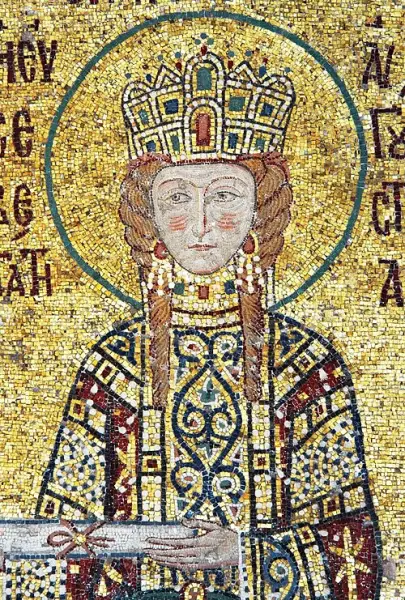
Irene of Hungary is the only member of the Árpád dynasty for whom a portrait made during her lifetime has survived. At Hagia Sophia, in the great mosaic dated about 1118, she stands beside her husband on the right of the Virgin: a light-haired empress with roses in her cheeks, stiff in the formal robes of state, set in glass and gold while the empire around it rose and fell. No comparable contemporary image exists for any other Árpád. Her more consequential memorial, however, is architectural and medical: the Pantokrator monastery-hospital, whose surviving regulations show an institution of astonishing sophistication, with standards of care and administration that Western Europe would reach only generations later, possibly under the influence of her foundation. After the Ottoman conquest the church became the Zeyrek Mosque and the imperial tombs decayed, but the typikon of the hospital has preserved the record of what the empress built. Historians of Byzantium count her among the pious empresses who converted position into philanthropy, and in Hungary she is remembered as the king's daughter who became, in the words of her panegyrist, mistress of the entire West, uniting East and West in her own person and in her children.
§ Depiction at Hagia Sophia
Timeline
- 1088
Born Piroska, daughter of King Ladislaus I of Hungary and Adelaide of Rheinfelden
§ Family
- 1090
Her mother, Adelaide of Rheinfelden, dies
§ Family
- 29 Jul 1095
Her father, King Ladislaus I, dies; his nephew Coloman succeeds and takes charge of her upbringing
§ Family
- 1104
Married at sixteen to John Komnenos, heir of Emperor Alexios I, sealing a Hungarian-Byzantine alliance
§ Empress consort of the Byzantine Empire
- 1106
Gives birth to twins, Alexios and Maria, in Thessaloniki
§ Empress consort of the Byzantine Empire
- 1118
Her husband accedes as John II Komnenos; her youngest son, the future Manuel I, is born the same year
§ Empress consort of the Byzantine Empire
- 1119
Her eldest son Alexios is crowned co-emperor, an occasion celebrated in a poem by Theodore Prodromos
§ Empress consort of the Byzantine Empire
- 1127
War breaks out between Byzantium and Hungary, lasting until 1129, disturbing the peace she had helped build
§ Empress consort of the Byzantine Empire
- 13 Aug 1134
Dies unexpectedly in Bithynia while accompanying John II on campaign against the Seljuk Turks; is buried at the Pantokrator
§ Death
- 1166
Canonized under her son Manuel I, most likely in this year
§ Sainthood and veneration
In Their Own Words
I offer to You [God] what is already Yours – she through whom I found a companion in planning and execution, my partner in life and my helper – even though, before the work was fully completed, she departed from this world according to Your mysterious decree, and by her departure left me here torn in two.
I descend from blessed ancestors, from the kings of the entire Western Empire; I was raised by the Julius Caesars and crowned with beauty by the Graces.
The Record
- Major works
- Monastery of Christ Pantokrator, Constantinople (principal initiator, with John II)
- Symbols
- Fair-haired, rosy-cheeked empress in rigid ceremonial attire, as shown in the Hagia Sophia mosaic
- Canonization
- Canonized during the reign of her son Manuel I Komnenos, most likely in 1166
Prayer
Bibliography
Show 8 sources
- Mielke, Christopher (2021). The Archaeology and Material Culture of Queenship in Medieval Hungary, 1000–1395. Springer Nature. p. 62. ISBN 978-3-030-66511-1.
- Tóth, Anna (12 August 2021). “Piroska-Eiréné, egy magyar királylány Bizánc trónján” [Piroska-Eirene, a Hungarian princess on the throne of Byzantium]. Institute of Hungarian Research (in Hungarian).
- Diós, István (ed.). “Szent Piroska” [Saint Piroska]. A szentek élete [The Life of Saints] (PDF) (in Hungarian). Szent István Társulat, Pázmány Péter Elektronikus Könyvtár. ISBN 963 360 734 5.
- Garland, L. (1999). Byzantine Empresses. Women and Power in Byzantium, AD 527-1204. Routledge. p. 199. ISBN 0-203-02481-8.
- Ousterhout, Robert (2001). “Ch. 9: Architecture, art and Komnenian ideology at the Pantokrator Monastery”. In Necipoğlu, Nevra (ed.). Byzantine Constantinople: Monuments, Topography and Everyday Life. BRILL. p. 133. ISBN 9004116257. Retrieved 10 May 2026.
- Szabados, György (13 August 2024). “1134. augusztus 13-án hunyt el Árpád-házi Szent Piroska” [Saint Piroska of Hungary died on 13 August 1134]. Székesfehérvár (in Hungarian).
- “Árpád-házi Szent Piroska emlékezete – interjú Pályi Gyulával, a Modenai Egyetem professzorával” [Remembering Saint Piroska of the House of Árpád – Interview with Gyula Pályi, Professor at the University of Modena]. Vatican News (in Hungarian). 11 August 2024.
- Hendy, Michael F. (1999). Catalogue of the Byzantine Coins in the Dumbarton Oaks Collection. Vol. 4. Dumbarton Oaks. p. 244. ISBN 9780884022336.
Profile text adapted from the Wikipedia article, licensed CC BY-SA 4.0.
Pray with this saint every day
Save St. Irene of Hungary to your favorites, read the full profile, and get feast-day reminders in the Saints app.
Get the Saints AppFree on the App Store for iPhone and iPad