
died 288·Feast April 3
St. Irene of Rome
Widow of Castulus Who Tended Saint Sebastian
Overview
Irene of Rome was a Christian woman of the late third century who died around the year 288, during the period of the persecutions under Diocletian. She was the wife of Castulus, a saint who, by tradition, served in the household of the Roman emperor, and she shared with him the hidden life of the persecuted Church in the capital. Her marriage ended in martyrdom when Castulus was put to death for practicing the Christian faith and for bringing others to it. Irene did not withdraw after this loss. The hagiographic tradition remembers her above all for an act of mercy that became one of the most painted scenes of Christian art: when Sebastian was strung up and shot with arrows for his faith, Irene came to him and cared for his wounds. Her own death in the same persecution crowned a life spent in service to the Christian community of Rome. Her feast is kept on 3 April, and her memory endures in countless canvases devoted to the rescue of the wounded martyr.
The Complete Life
Early Life and Marriage
Irene belonged to the Christian community of Rome at the close of the third century, the era when the faith was proscribed and its followers met in secret. She became the wife of Castulus, and by tradition he held a post in the service of the Roman emperor himself, a striking position for a Christian in a court where the faith was a capital offense. Their household thus stood at the crossroads of two worlds: the official Rome that condemned the Church and the underground Rome that sustained it. What Irene's maiden years were like, and how she and Castulus came to be married, the tradition does not relate; it preserves instead the shape of their common life, a marriage joined to the perilous practice of Christianity in the imperial city. The couple's faith was not a private inheritance but an active force, for Castulus was remembered not only for believing but for converting others to the religion of Christ. In that shared mission Irene was his partner, and his martyrdom would leave her a widow in the very city where the Church was bleeding.
§ Biography
Mercy to the Wounded Martyr
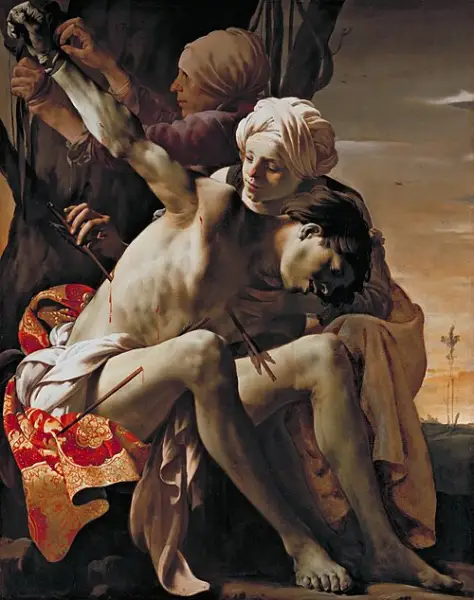
Widowed by the martyrdom of Castulus, Irene did not flee the Christian community of Rome but continued to serve it actively. The act for which she is remembered belongs to the hagiography of Saint Sebastian. Sebastian, a soldier and leading Christian of the city, had been condemned and handed over to Mauretanian archers, who shot him with arrows and left him for dead. According to the legend, it was Irene who went to him, tended his wounds, and cared for the body of the man the empire had tried to kill. Whether he survived her care or received the crown of martyrdom afterward, the sources of her story keep their focus on her deed: a woman of the persecuted Church risking herself to nurse a condemned man. This scene of mercy caught the imagination of later centuries. Painters returned to it again and again, and the image of Irene bending over the wounded Sebastian became one of the recognizable subjects of Christian art, ensuring that her quiet courage would be visible long after the names of her persecutors were forgotten.
§ Biography
Legacy in Art and Memory
Irene's death around 288, in the era of Diocletian's persecution, made her one of the host of Roman martyrs in whom the early Church saw the faith's firstfruits. She was never formally canonized, for she belongs to the pre-congregation ages when the martyrs were honored by the unanimous memory of the Church; her feast of 3 April keeps that ancient cult alive. Her most enduring monument, however, is pictorial. The subject of Saint Sebastian tended by Saint Irene occupied painters across the sixteenth and seventeenth centuries and beyond: Hendrick ter Brugghen rendered it in 1615, Marcantonio Bassetti around 1620, Trophime Bigot and Dirck van Baburen took it up in their own manners, Felice Ficherelli painted it about 1650, and Georges de La Tour gave it at least two powerful versions, one from the early 1630s and another dated 1650. Benedetto Luti and Vicente López y Portaña returned to it at the end of the eighteenth century. Through these canvases the widow who once bound a martyr's wounds continues to teach the Church the works of mercy.
§ Biography
The Record
- Symbols
- Tending to Saint Sebastian
- Canonization
- Pre-congregation; ancient Roman martyr venerated from the earliest centuries
Prayer
Bibliography
Show 3 sources
Profile text adapted from the Wikipedia article, licensed CC BY-SA 4.0.
Pray with this saint every day
Save St. Irene of Rome to your favorites, read the full profile, and get feast-day reminders in the Saints app.
Get the Saints AppFree on the App Store for iPhone and iPad