
c. 635 – c. 653·Feast October 20
St. Irene of Tomar
Virgin Martyr of Visigothic Portugal
Overview
Irene of Tomar, in Portuguese Santa Iria, was a virgin of the seventh century who was put to death for her faith in Visigothic Portugal, around the year 653. Born about 635 at Nabância, today's Tomar, into a family of standing, she was given a guarded upbringing: her parents placed her in a convent school and engaged a private tutor for her, and she left home only for Mass or for prayer at the sanctuary of Saint Peter. Her consecrated virginity drew both an admirer, the noble Britald, whom she declined in favor of her vow, and a treacherous tutor, the monk Remigius, whose advances she refused. His slander, and a drug that swelled her body to give it credit, persuaded Britald that she had betrayed her promise, and he hired a soldier who killed her with a single stroke of the sword as she returned from visiting a sick man. Her body, cast into the Nabão River, was recovered uncorrupted by monks at Scalabis, whose town later took her name: Santarém. Some scholars judge her legend to be little more than this story, yet her cult is ancient and her feast on 20 October endures.
The Complete Life
A Guarded Childhood in Nabância
The legend places Irene's birth about the year 635 at Nabância, the settlement that grew into the Portuguese town of Tomar. Her family was one of influence in the region, and her parents, anxious to shield a daughter so promising, built a wall of protection around her upbringing. She was enrolled in a convent school, where religious women supervised her formation, and a private tutor was engaged to continue her education at home. The legend stresses how rarely she crossed her own threshold: apart from her schooling, the only occasions that drew her out were attendance at Mass and visits to the sanctuary of Saint Peter for prayer. In the Visigothic Portugal of the seventh century, where the Christian faith of the ruling peoples shaped daily life, such a childhood formed a girl in piety, learning, and seclusion alike. The biographers of her story concede how slender the historical record is, noting that the tale of her life may amount to little more than these outlines. Yet even in outline it shows a soul shaped from the first for consecration rather than for the marriage market of her rank.
§ Legend
The Vow and Its Rivals
Two figures interrupted the quiet course of Irene's consecrated girlhood, and both ended in tragedy. The first was Britald, a young nobleman who saw her on one of her rare journeys to church and fell in love. He began to follow her whenever she went out, and at length he made formal proposal of courtship. Irene refused him, and when his disappointment deepened into depression she hastened to soften the blow by explaining its reason: she had already given herself to God as a nun, and no earthly marriage was possible for her. The second figure was darker. Remigius, the monk engaged as her tutor, made improper advances to his pupil, and when she rejected him he abandoned his post and set out to destroy her reputation. Asked why he no longer taught the girl, he declared that he had left upon learning she was pregnant. To give the lie substance he contrived to give her a drink that inflated her belly, and the slander spread through the town. Britald, hearing that the woman who had refused him was dishonored, burned with rage and hired a mercenary to take her life.
§ Legend
Martyrdom
The blow fell on a day of ordinary charity. Irene had gone out to visit an elderly man who was disabled, one of the few errands of mercy that took her from home, and she was on her way back when the hired assassin came upon her from behind. A single stroke of his sword ended her life, and the virgin who had defended her consecration against seduction and slander alike died for it, about the year 653, in the town then called Scalabis. Her murderers cast her body into the Nabão River, which flows down to the Tagus, supposing that water would carry away the evidence of their crime. The river refused that office. Her remains were recovered from the water uncorrupted by Benedictine monks near Scalabis, and the legend adds that Christ had made known to Celius, her uncle and an abbot, both what had really happened to his niece and where her remains could be found. The monks buried her with honor and carried her cultus abroad, and the memory of the murdered virgin took root in the soil of Portugal.
§ Veneration
Legacy: Santarém and Her Cult
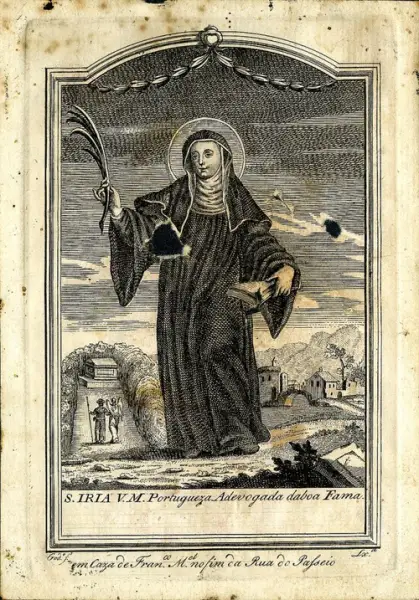
Few martyrs have left their names so deeply written into a landscape as Irene of Tomar. The reverence paid to her at Scalabis grew so great that the town abandoned its ancient name and took instead that of the saint, becoming Santarém, which is to say Saint Irene, the name it bears to this day. Her birthplace, too, remembers her: Tomar, the city that grew from Nabância, counts her as its patron, and the parish of Santa Iria de Azóia in Loures keeps her name at the gates of Lisbon. Her feast is celebrated on 20 October, and she is depicted as a nun holding the palm of martyrdom. The Portuguese honor her in both the Catholic and Orthodox traditions, and her cultus is counted among the ancient ones, spread by the Benedictines who first told the story of the body that rose uncorrupted from the river. Hagiographers caution that the legend may be little more than the tale as it stands, but the devotion of centuries is its own testimony, and the name of Santa Iria remains woven into the map and memory of Portugal.
§ Veneration
Timeline
- 635
Born at Nabância, present-day Tomar, into an influential family
§ Legend
- 653
Martyred at Scalabis, struck down by a hired assassin on her way home from visiting a disabled man
§ Legend
The Record
- Patron of
- Tomar, Portugal·Santarém, Portugal·Santa Iria de Azóia, Loures
- Symbols
- Nun's habit·Palm of martyrdom
- Canonization
- Pre-congregation; her cultus spread from the Benedictine monks who recovered her body
Prayer
Bibliography
Show 3 sources
- Encyclopedia of Catholic Saints, Vol. 10 (1966). Chilton Books, pp. 99–100.
- Oliveira, Miguel de, Santa Iria e Santarém. Lenda e História. Estudos hagiográficos, Lisboa, União Gráfica, 1964.
- Costa, Avelino de Jesus, Santa Iria e Santarém, revisão de um problema hagiográfico e toponímico, Coimbra, FLUC, 1972.
Profile text adapted from the Wikipedia article, licensed CC BY-SA 4.0.
Pray with this saint every day
Save St. Irene of Tomar to your favorites, read the full profile, and get feast-day reminders in the Saints app.
Get the Saints AppFree on the App Store for iPhone and iPad